

Ancient skeleton found in Mexico cave threatened by train
Advertisement
Read this article for free:
or
Already have an account? Log in here »
To continue reading, please subscribe:
Monthly Digital Subscription
$1 per week for 24 weeks*
- Enjoy unlimited reading on winnipegfreepress.com
- Read the E-Edition, our digital replica newspaper
- Access News Break, our award-winning app
- Play interactive puzzles
*Billed as $4.00 plus GST every four weeks. After 24 weeks, price increases to the regular rate of $19.95 plus GST every four weeks. Offer available to new and qualified returning subscribers only. Cancel any time.
Monthly Digital Subscription
$4.99/week*
- Enjoy unlimited reading on winnipegfreepress.com
- Read the E-Edition, our digital replica newspaper
- Access News Break, our award-winning app
- Play interactive puzzles
*Billed as $19.95 plus GST every four weeks. Cancel any time.
To continue reading, please subscribe:
Add Free Press access to your Brandon Sun subscription for only an additional
$1 for the first 4 weeks*
*Your next subscription payment will increase by $1.00 and you will be charged $16.99 plus GST for four weeks. After four weeks, your payment will increase to $23.99 plus GST every four weeks.
Read unlimited articles for free today:
or
Already have an account? Log in here »
Hey there, time traveller!
This article was published 13/09/2022 (1298 days ago), so information in it may no longer be current.
MEXICO CITY (AP) — A prehistoric human skeleton has been found in a cave system that was flooded at the end of the last ice age 8,000 years ago, according to a cave-diving archaeologist on Mexico’s Caribbean coast.
Archaeologist Octavio del Rio said he and fellow diver Peter Broger saw the shattered skull and skeleton partly covered by sediment in a cave near where the Mexican government plans to build a high-speed tourist train through the jungle.
Given the distance from the cave entrance, the skeleton couldn’t have gotten there without modern diving equipment, so it must be over 8,000 years old, Del Rio said, referring to the era when rising sea levels flooded the caves.
“There it is. We don’t know if the body was deposited there or if that was where this person died,” said Del Rio. He said that the skeleton was located about 8 meters (26 feet) underwater, about a half-kilometer (one third of a mile) into the cave system.
Some of the oldest human remains in North America have been discovered in the sinkhole caves known as “cenotes” on the country’s Caribbean coast, and experts say some of those caves are threatened by the Mexican government’s Maya Train tourism project.
Del Rio, who has worked with the National Institute of Anthropology and History on projects in the past, said he had notified the institute of the discovery. The institute did not immediately respond to questions about whether it intended to explore the site.
But Del Rio said Tuesday that institute archaeologist Carmen Rojas told him that the site was registered and would be investigated by the institute’s Quintana Roo state branch Holocene Archaeology Project.
He stressed that the cave — whose location he did not reveal because of a fear the site could be looted or disturbed — was near where the government has cut down a swath of jungle to lay train tracks, and could be collapsed, contaminated or closed off by the building project and subsequent development.
“There is a lot more study that has to be done in order to correctly interpret” the find, Del Rio said, noting that “dating, some kind of photographic studies and some collection” would be needed to determine exactly how old the skeleton is.
Del Rio has been exploring the region for three decades, and in 2002, he participated in the discovery and cataloguing of remains known as The Woman of Naharon, who died around the same time, or perhaps earlier, than Naia — the nearly complete skeleton of a young woman who died around 13,000 years ago. It was discovered in a nearby cave system in 2007.
President Andrés Manuel López Obrador is racing to finish his Maya Train project in the remaining two years of his term over the objections of environmentalists, cave divers and archaeologists. They say his haste will allow little time to study the ancient remains.
Activists say the heavy, high-speed rail project will fragment the coastal jungle and will run often above the fragile limestone caves, which — because they’re flooded, twisty and often incredibly narrow — can take decades to explore.
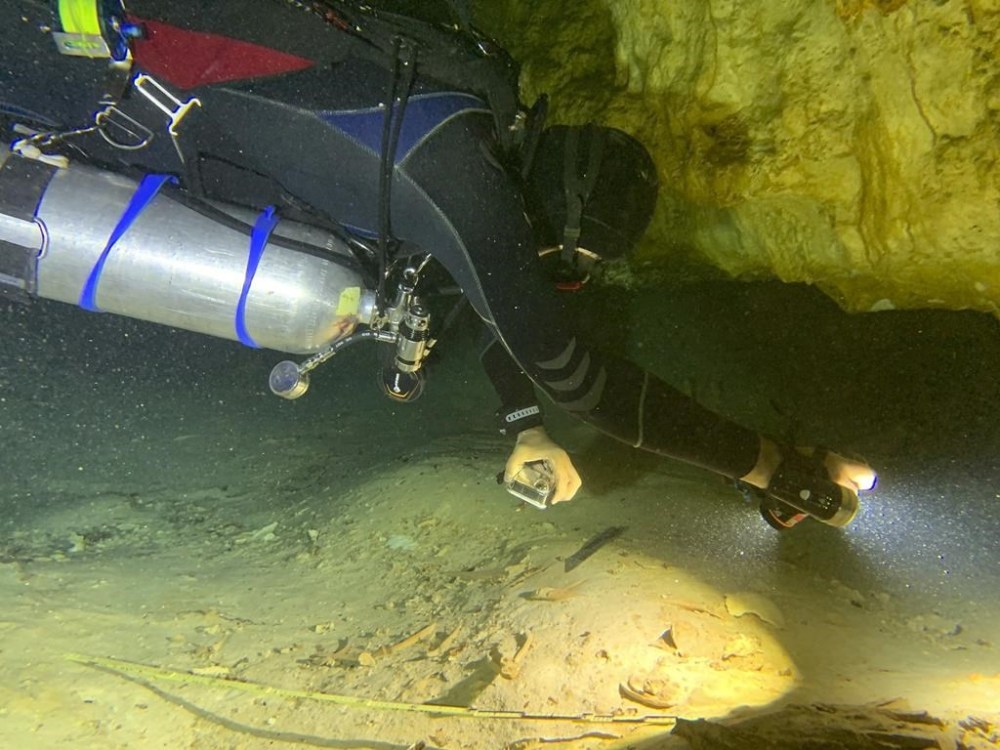
Caves along part of the coast already have been damaged by construction above them, with cement pilings used to support the weight above.

The 950-mile (1,500-kilometer) Maya Train line is meant to run in a rough loop around the Yucatan Peninsula, connecting beach resorts and archaeological sites.
The most controversial stretch cuts a more than 68-mile (110-kilometer) swath through the jungle between the resorts of Cancun and Tulum.
Del Rio said the route through the jungle should be abandoned and the train should be built over the already-impacted coastal highway between Cancun and Tulum, as was originally planned.
López Obrador abandoned the highway route after hotel owners voiced objections, and cost and traffic interruptions became a concern.
“What we want is for them to change to route at this spot, because of the archaeological finds that have been made there, and their importance,” said Del Rio. “They should take the train away from there and put it where they said they were going to build before, on the highway … an area that has already been affected, devastated.”