

Triangle’s social satire isn’t as pointed as it should be

Advertisement
Read this article for free:
or
Already have an account? Log in here »
To continue reading, please subscribe:
Monthly Digital Subscription
$1 per week for 24 weeks*
- Enjoy unlimited reading on winnipegfreepress.com
- Read the E-Edition, our digital replica newspaper
- Access News Break, our award-winning app
- Play interactive puzzles
*Billed as $4.00 plus GST every four weeks. After 24 weeks, price increases to the regular rate of $19.95 plus GST every four weeks. Offer available to new and qualified returning subscribers only. Cancel any time.
Monthly Digital Subscription
$4.99/week*
- Enjoy unlimited reading on winnipegfreepress.com
- Read the E-Edition, our digital replica newspaper
- Access News Break, our award-winning app
- Play interactive puzzles
*Billed as $19.95 plus GST every four weeks. Cancel any time.
To continue reading, please subscribe:
Add Free Press access to your Brandon Sun subscription for only an additional
$1 for the first 4 weeks*
*Your next subscription payment will increase by $1.00 and you will be charged $16.99 plus GST for four weeks. After four weeks, your payment will increase to $23.99 plus GST every four weeks.
Read unlimited articles for free today:
or
Already have an account? Log in here »
Hey there, time traveller!
This article was published 21/10/2022 (1248 days ago), so information in it may no longer be current.
This eat-the-rich satire from Ruben Östlund pushes the notion that ultra-wealthy people are both awful and unhappy. That tends to be an audience-friendly gambit, at least with the non-superyacht-crowd.
Still, the Swedish provocateur is not one to let his viewers off lightly. While his anti-capitalist stance takes on some easy targets, it remains a deliberately difficult watch. As he did in Force Majeure, a sharp critique of gender and family roles, and The Square, a vicious takedown of the contemporary art world, Östlund keeps everything uncomfortable and off balance, turning almost every human interaction into tension-filled weirdness.
Unfortunately, Triangle (which is predominantly in English) isn’t as fully realized as those previous films, its satire scathing but scattershot, its storyline stretched out but underdeveloped. And damningly for a film that’s wants to be setting off bombs in the current class war, Triangle is not quite as dangerous as it seems.
Östlund presents a three-part narrative composed of abrupt, absurdist, off-kilter scenes alternating with some extended tableaux, including the sequence that’s been notorious since the film won the Palme d’or at Cannes — a comically gross wallow in projectile vomiting and overflowing toilets.
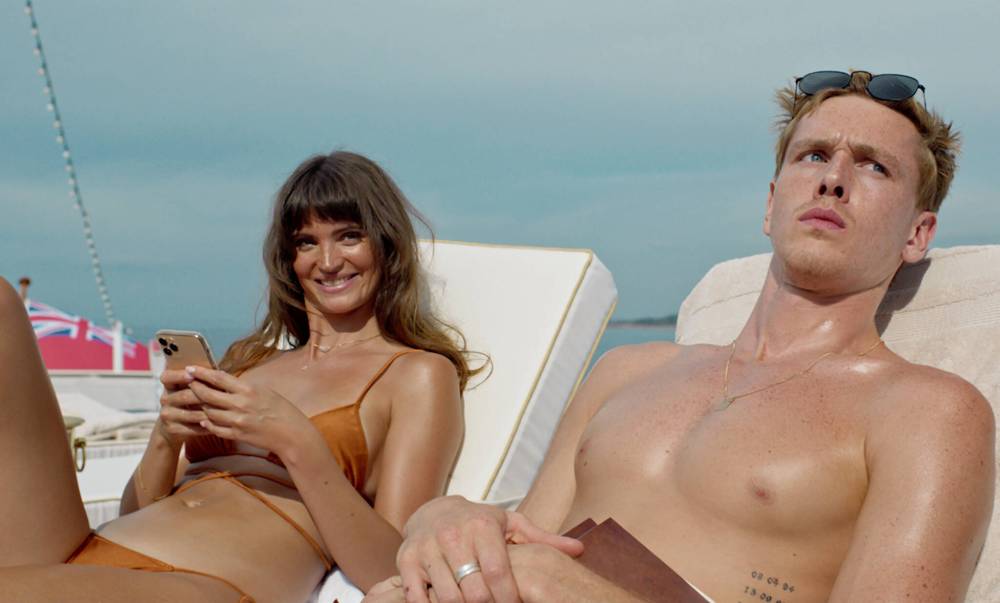
Triangle’s first chapter is set in the world of high fashion, centring on two models-slash-influencers, Yaya (Charlbi Dean) and Carl (Harris Dickinson). As the two engage in an extended emotional argument over who pays for their expensive dinner, we get brief glints of sincere feeling immediately subsumed into transactional negotiations.
It’s not surprising the two translate everything into euros, though. Scenes from their professional lives concisely demonstrate the ways their youth and beauty and fame are commodities, from humiliating cattle-call casting sessions to runway shows where a high-end label triumphantly proclaims that “Everyone is Equal,” while minions police the front row, kicking out regular people to seat celebs in their place.
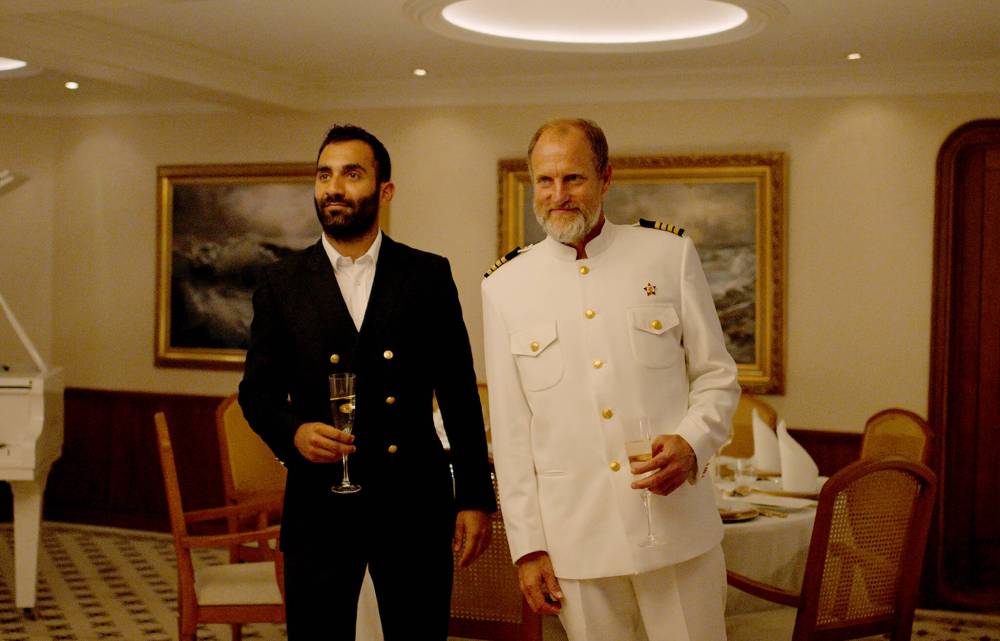
The second chapter takes place on a luxury yacht cruise. Carl and Yaya, keeping up their exquisitely curated social-media facade, get free passage because of their Instagram reach. The other passengers include a Russian oligarch (Zlatko Buric), an awkward Swedish tech guy and a pair of deceptively genteel British arms dealers.
Surrounded by seemingly everything they could want — including jars of Nutella that one passenger demands be delivered by helicopter — you might think they would enjoy themselves, but no. Instead, they channel their frustrations into petty assertions of power. One lady complains that the ship’s sails are dirty, for example, a complaint that must be indulged even though the ship has no sails.
Neon
Arvin Kananian, left, and Woody Harrelson in Triangle of Sadness, partially set on a luxury yacht.
Staff members, meanwhile, led by the frantic Paula (Vicki Berlin), are veering into White Lotus terrain. Efficient service is not enough. They are expected to offer guests a kind of performative servility.
Then there’s the captain (Woody Harrelson), drunk with self-loathing because he claims to be a socialist while making his living aboard a massive floating metaphor for late-stage capitalism. He and the oligarch bond over their ability to consume copious amounts of alcohol and the ridiculousness of their respective positions: “A Russian capitalist and an American communist arguing aboard a $250-million yacht.”

Triangle’s moral queasiness morphs into physical nausea when a storm boils up and the camera angles start slanting wildly. Just as Östlund’s The Square has a performance art sequence that makes you want to hide under your seat, Triangle has the captain’s dinner, when all that finicky food is daintily consumed and then violently expelled in a semi-comic, completely disgusting barf-fest.
A reckoning for all this excess is coming, as Below Decks becomes Swept Away and survivors of the storm are stranded on an isolated island. Abigail (Dolly De Leon), previously a cleaner consigned to invisibility and anonymity, is now the only one with any practical survival skills. The balance of power shifts, as does the economy — Rolex watches are now worthless, but Carl’s sexual allure is being bartered for pretzel sticks.
This third chapter is the film’s most important, but it’s where Östlund seems to lose his momentum., and Triangle ends up an intriguing disappointment.
Neon
Charlbi Dean, left, and Harris Dickinson play models/influencers who parlay their looks and youth into a lavish lifestyle.
The film has some sideways humour, but it’s not quite the laugh-riot promised by the trailer. Its serious messages, meanwhile, are big and brash and outrageous but not as subversive as they need to be. By concentrating on the obscene wealth of the one per cent, Östlund lets us 99 per centers off the hook. Instead of making us think about our complicity in the socioeconomic order, he lets us feel complacent.
alison.gillmor@winnipegfreepress.com
Studying at the University of Winnipeg and later Toronto’s York University, Alison Gillmor planned to become an art historian. She ended up catching the journalism bug when she started as visual arts reviewer at the Winnipeg Free Press in 1992.
Our newsroom depends on a growing audience of readers to power our journalism. If you are not a paid reader, please consider becoming a subscriber.
Our newsroom depends on its audience of readers to power our journalism. Thank you for your support.
Movie Review
Triangle of Sadness
Starring Woody Harrelson, Dolly De Leon, Charlbi Dean and Harris Dickinson
● McGillivray
● PG, 147 minutes
★★★ stars out of five
Other voices
Other Don’t go in expecting art-house intellectualism. The movie is as loaded with fun as it is with social implications.
— Kyle Smith, Wall Street Journal
There are a couple of good scenes… but nothing substantial enough to warrant the two-and-a-half-hour running time.
— Glenn Whipp, Los Angeles Times
This, in the end, is a very bad movie, executed with enough visual polish and surface cleverness to fool the Cannes jurors, something Östlund has done twice. Shame on them!
— A.O. Scott, New York Times
The ideas might not be new, and the targets might be easy, but (Ruben Östlund) has once again made something exceedingly uncomfortable and undeniably entertaining.
— Lindsey Bahr, Associated Press
For 95 minutes of its 147-minute running time, Triangle of Sadness is one of the best movies of the year.
— Mick LaSalle, San Francisco Chronicle
(A) disappointingly blunt satire of class and status…
— David Rooney, Hollywood Reporter
The thing about Östlund is that he makes you laugh, but he also makes you think.
— Peter Debruge, Variety
Studying at the University of Winnipeg and later Toronto’s York University, Alison Gillmor planned to become an art historian. She ended up catching the journalism bug when she started as visual arts reviewer at the Winnipeg Free Press in 1992.
Our newsroom depends on a growing audience of readers to power our journalism. If you are not a paid reader, please consider becoming a subscriber.
Our newsroom depends on its audience of readers to power our journalism. Thank you for your support.
Advertisement Advertise With Us
Advertisement Advertise With Us