Two-man show
Longtime theatrical collaborators Daniel MacIvor and Daniel Brooks work together to craft solo performance

Advertisement
Read this article for free:
or
Already have an account? Log in here »
To continue reading, please subscribe:

Digital Subscription
One year of digital access for only $205*
- Enjoy unlimited reading on winnipegfreepress.com
- Read the E-Edition, our digital replica newspaper
- Access News Break, our award-winning app
- Play interactive puzzles
*First annual payment billed as $205.00 + GST for one year. This annual subscription will automatically renew at $233.00 + GST every 52 weeks (10% off the regular annual price of $259.35). Offer available to new and qualified returning subscribers only. Cancel any time.
To continue reading, please subscribe:
Add Free Press access to your Brandon Sun subscription for only an additional
$1 for the first 4 weeks*
- Enjoy unlimited reading on winnipegfreepress.com
- Read the E-Edition, our digital replica newspaper
- Access News Break, our award-winning app
- Play interactive puzzles
*Your next Brandon Sun subscription payment will increase by $1.00 and you will be charged $17.95 plus GST for four weeks. After four weeks, your payment will increase to $24.95 plus GST every four weeks.
Read unlimited articles for free today:
or
Already have an account? Log in here »
Hey there, time traveller!
This article was published 02/12/2022 (1340 days ago), so information in it may no longer be current.
One Daniel is early and the other is late.
That’s usually the case for Daniel MacIvor and Daniel Brooks, one of the country’s most celebrated theatre duos. MacIvor is frequently the dawdler, while Brooks is usually as punctual as a Swiss pocket watch.
But three days before their show, Let’s Run Away, debuts at the Royal Manitoba Theatre Centre Warehouse, MacIvor, in Winnipeg, is right on time, and Brooks, in Toronto, is the dilly-dallier.

SUPPLIED
Director Daniel Brooks, left, and playwright-actor Daniel MacIvor circa 2004.
Wearing a speckled grey turtleneck to hide his newly clean-shaven face, MacIvor — who stars in the one-person show as Peter, a man experiencing homelessness — chides his fellow Daniel, who directs, for his tardiness. They exchange barbs with gentle love, as only can be shared between people who have known each other throughout many seasons of life.
The following interview has been edited for length and clarity.
Daniel MacIvor: He had a time-zone brainfart.
FP: We all have those.
DM: Brooks, look at me.
Daniel Brooks: I’m looking at your sweater; it was the first thing I noticed.
DM: No, not the sweater.
DB: Your beard! It’s gone. That was a long run.
DM: I feel so naked, and vulnerable, and strange.
DB: You’re adorable. Look at you.
DM: I don’t know. I feel a bit like an old baby. Of course, I wear a mask anyway, so it doesn’t (expletive) matter. Sorry, we’re just catching up.
FP: It’s completely fine. Before you got here, Brooks, I was asking MacIvor if one of you is always late.
DB: MacIvor is, although he has improved over the years.
DM: When I was active in my addiction, I somehow thought 15 minutes wasn’t late. Of course 15 minutes is late.
FP: Now that we’re all here, a good place to start with any partnership is to ask about when, where, and how you met.
DB: My first contact with Daniel was actually watching a play that he had written that was produced at the Tarragon Theatre (in Toronto). I saw such talent in his writing.
Stephanie MacDonald photo
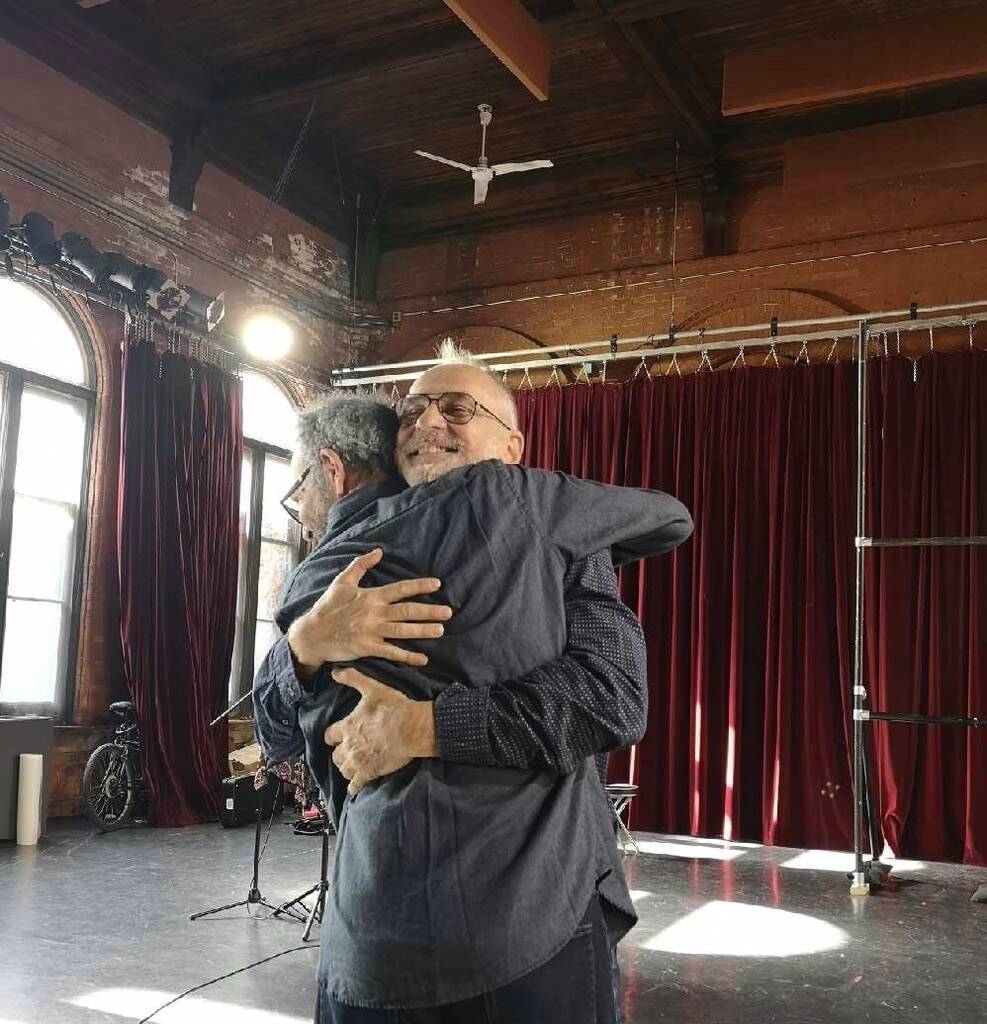
Daniel Brooks hugs Daniel MacIvor during a rehearsal for Let’s Run Away, now playing at RMTC Warehouse, at Canadian Stage.
Some time later, I did a play that was a kind of satire on what we called Canadian naturalism, about an author from the East Coast who goes to the big city before returning home. We wanted to make fun of that type of structure, which so happened to be the structure of Daniel’s play.
So we did this show, with (actors) Don McKellar and Tracy Wright. Daniel came to see the show, and thought it was a satire of his work, and he introduced himself after the show and we went out for a drink. We had a grand old time. And for me, that was the beginning of our friendship. That was 1988.
DM: Let me just add one thing. When I went to see this play, the play itself was called Indulgence, And the play-within-a-play was called Sometime Come Often. And my play was called Somewhere I Have Never Travelled. So let me just put that on the table. But I remember thinking (about Indulgence) that, “This is goooooood. This is subversive. Deeply, profoundly, on a DNA-level-of-thinking subversive.” And that was exciting. And we met that night. And I think we were just kindred.
FP: My next question was going to be, “Was it love at first sight?”
DB: Daniel can have a very easy rapport with people initially and I tend not to. I was a pretty shy person and I would come off as quite aloof. But he ripped that mask off immediately.
DM: I was also trying to pick him up. And I decided that whether he was on my team or not was irrelevant. I would make him love me and that would be that. I was determined.
DB: It’s nice to be desired, and I think I very graciously declined.
DM: I’m queer and he’s straight. But back in the day he identified as queer, politically, as far as embracing the community as an ally.
FP: You did a lot of work at Buddies in Bad Times Theatre in Toronto back then, which isn’t too far from the Church-Wellesley neighbourhood (an LGBTTQ+ enclave of the city).
DM: Buddies was the… I don’t know which part of the body of the queer theatre community.
FP: The spleen?
DM: That is where we did a lot of drinking.
FP: Tell me about your first official collaboration.
DB: It was House, in 1991 (winner of the Chalmers Canadian Play award, described as a “stand-up-sit-down comedy nightmare”).
DM: Interestingly, the main character, Victor, from House, is a precursor to Peter, the main character in Let’s Run Away. House was a rage against the system. In the Jungian sense, the house is the soul and the self. But it was about this capitalist idea that we needed to own a house, and then we were somebody.
Then it was also an explosion of my own obsessions and rages, and we found a single voice to contain them. And that voice was quite mad in both senses of that word.
SUPPLIED
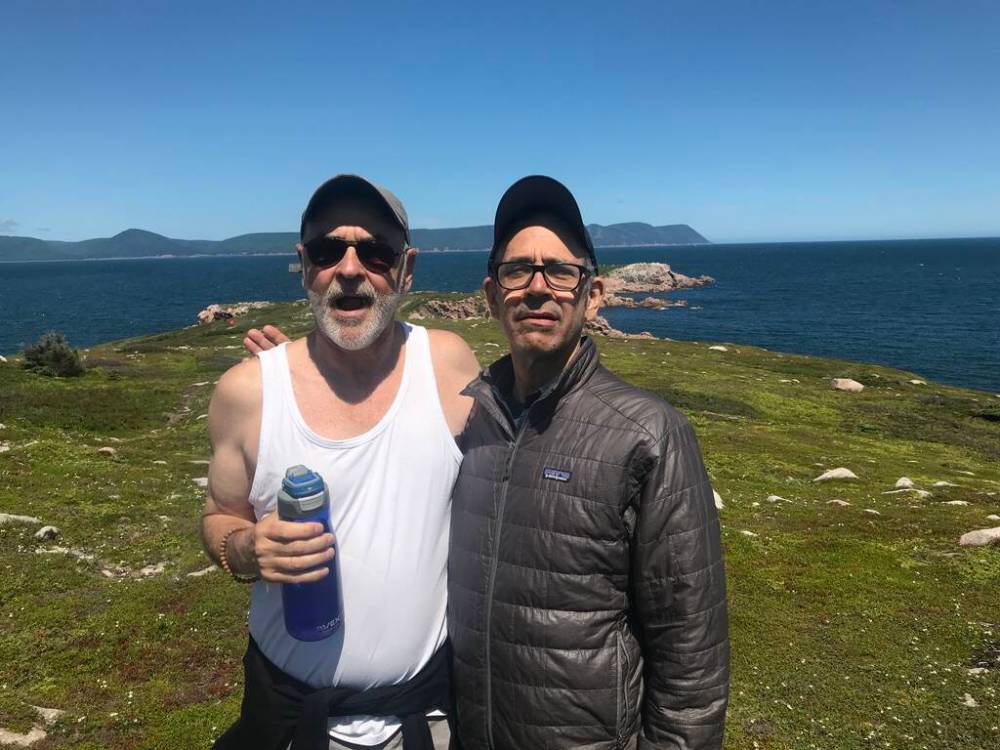
Sydney-born Daniel MacIvor, left, shows Daniel Brooks the sights of Cape Breton in 2018.
DB: At a certain point, I discovered a guiding principle for me and Daniel, which was that the show was an explosion of the self. And we fumbled for weeks. We were exploring each other and what it was we were doing together as artists. It took us a long time to find the form of the play.
DM: These discoveries all were manifested through performance. It wasn’t through talk, or writing, or dramaturgical whatever. It was through actually being on stage and finding it. The thing got woven in performance.
FP: You’ve collaborated six more times since House. Has that process remained?
DB: I would say yes. But with (Let’s Run Away), we started with no writing, so that’s a substantial difference.
FP: No writing?
DM: We did a seven-day residency in Banff, and I talked for hours, and Dan would write down what I said. And I was trying to work through some issues: relationships, anxieties. We ended up with something called Seven, because it would be our seventh show. And eventually it just came down to the voice of Peter, the character in Let’s Run Away.
FP: Who is Peter?
DM: He is me if I had taken a different road. Had I not found the theatre. He’s queer. He’s in his late 50s.
DB: Clean shaven.
DM: He lives unhoused by choice, he would say. He doesn’t like authority and was born into the foster system. So he never had a sense of home or family in the way that many people do. So he manifests a lot of distrust and anger around that.
Peter has managed to find the wherewithal to rent the theatre for the evening, and he is going to address some things for the audience. He has a message for the world he wants to share. He is in the room with us, with a mission to accomplish in real time.
DB: Daniel, for some reason, neglects to talk about another aspect of how the character was developed.
DM: I was a writer-in-residence in London, Ont., working one day a week at the public library. And I would come in the morning and in the washroom there would be a guy washing his feet in the sink who ended up being the guy consulting me about his writing.
It was an interesting mix of people coming in. Some had been published, but a lot of the people had some stories they wanted to tell but were outside that system.
DB: And it challenged Daniel to view writing in a very different way than he was accustomed. And it opened him up to looking at people in a very compassionate and much more open way, and I think it had a tremendous influence on (the character of) Peter.
DM: I suppose in some ways, I had a lot of bias (against people like the character of Peter), and carried it with me. My father spent time in prison. He was a chronic alcoholic. My grandfather was a bootlegger. My father lived on the streets somewhat, so I had some issues.
SUPPLIED
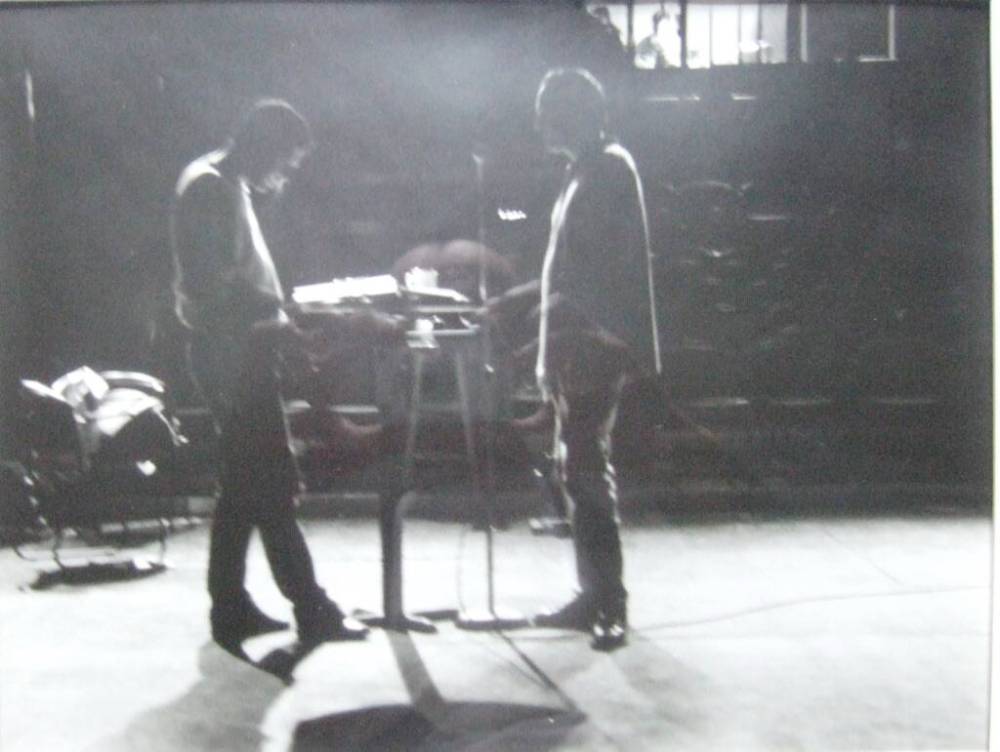
Daniel Brooks, left, and Daniel MacIvor working on Here Lies Henry (1991) at Toronto’s Buddies in Bad Times Theatre.
The work in London really helped with that, because I had an opportunity to sit with these people and experience them as people hungry to tell a story.
FP: In Winnipeg, housing instability, unaffordability and other root causes of homelessness have arguably never been more pronounced. There also tends to be disdain against those who choose to live on the streets. Were you worried about telling this story compassionately, as neither of you have been in that position yourselves?
DM: This story emerged from this character. We didn’t have an idea about unhoused people. I have my father in me. I’m a recovered addict of crack and alcohol. And those are all parts of me still. I was a tourist on the street. When I start digging in me, those parts of me are there. So the ideas of it were generated from the flesh of it.
DB: I’d also say that we weren’t doing a sociological analysis of a character. That’s not how we were thinking about it for a second. We never saw him objectively in that way. That isn’t the nature of the theatre that we’re creating.
FP: It comes down to a question of artistry.
DB: Yes.
DM: And that’s something I struggle with. I struggle with what I am and what’s left to speak of for me. I don’t know. But I do know that there is a living spirit and heart of something here that exists when it’s embodied in performance.

DB: These questions about representation are questions that are asked of a very conscious part of the mind. And part of what we are doing in rehearsal is trying to access something that is not so known, so intellectualized. We’re trying to access some unconscious elements of existence. And I feel very strongly that the theatre hungers for the mystery of the unconscious, unmediated by such decided principles.
DM: Certainty is the problem now. I was talking with a colleague today who said that they always wanted the audience to leave knowing less.
DB: That’s a nice way of putting it.
DM: When you meet Peter, you might not think you want to spend any time with this person. But by the end, I think you’re asking more questions and knowing less about what you thought was certain previously.
ben.waldman@winnipegfreepress.com
Ben Waldman is a National Newspaper Award-nominated reporter on the Arts & Life desk at the Free Press. Born and raised in Winnipeg, Ben completed three internships with the Free Press while earning his degree at Ryerson University’s (now Toronto Metropolitan University’s) School of Journalism before joining the newsroom full-time in 2019. Read more about Ben.
Every piece of reporting Ben produces is reviewed by an editing team before it is posted online or published in print — part of the Free Press‘s tradition, since 1872, of producing reliable independent journalism. Read more about Free Press’s history and mandate, and learn how our newsroom operates.
Our newsroom depends on a growing audience of readers to power our journalism. If you are not a paid reader, please consider becoming a subscriber.
Our newsroom depends on its audience of readers to power our journalism. Thank you for your support.
Theatre preview
Let’s Run Away
By Daniel MacIvor
● Tom Hendry Warehouse Theatre
● Runs to Dec. 17
● Tickets at royalmtc.ca
Ben Waldman is a National Newspaper Award-nominated reporter on the Arts & Life desk at the Free Press. Born and raised in Winnipeg, Ben completed three internships with the Free Press while earning his degree at Ryerson University’s (now Toronto Metropolitan University’s) School of Journalism before joining the newsroom full-time in 2019. Read more about Ben.
Every piece of reporting Ben produces is reviewed by an editing team before it is posted online or published in print — part of the Free Press‘s tradition, since 1872, of producing reliable independent journalism. Read more about Free Press’s history and mandate, and learn how our newsroom operates.
Our newsroom depends on a growing audience of readers to power our journalism. If you are not a paid reader, please consider becoming a subscriber.
Our newsroom depends on its audience of readers to power our journalism. Thank you for your support.
Related Articles
Two Daniels take humorous look at perception in Warehouse offering
Advertisement Advertise With Us
Advertisement Advertise With Us