Sweet relief from a buttoned-down life
Bill Nighy sublime in remake of Kurosawa masterpiece that forbids sentimentality

Advertisement
Read this article for free:
or
Already have an account? Log in here »
To continue reading, please subscribe:

Digital Subscription
One year of digital access for only $205*
- Enjoy unlimited reading on winnipegfreepress.com
- Read the E-Edition, our digital replica newspaper
- Access News Break, our award-winning app
- Play interactive puzzles
*First annual payment billed as $205.00 + GST for one year. This annual subscription will automatically renew at $233.00 + GST every 52 weeks (10% off the regular annual price of $259.35). Offer available to new and qualified returning subscribers only. Cancel any time.
To continue reading, please subscribe:
Add Free Press access to your Brandon Sun subscription for only an additional
$1 for the first 4 weeks*
- Enjoy unlimited reading on winnipegfreepress.com
- Read the E-Edition, our digital replica newspaper
- Access News Break, our award-winning app
- Play interactive puzzles
*Your next Brandon Sun subscription payment will increase by $1.00 and you will be charged $17.95 plus GST for four weeks. After four weeks, your payment will increase to $24.95 plus GST every four weeks.
Read unlimited articles for free today:
or
Already have an account? Log in here »
Hey there, time traveller!
This article was published 26/01/2023 (1304 days ago), so information in it may no longer be current.
Quiet and delicate, this period drama from director Oliver Hermanus and screenwriter Kazuo Ishiguro is a close remake of Akira Kurosawa’s Ikiru (1952), transposed from postwar Japan to 1950s England. While Living might not rise to the level of Kurosawa’s masterwork, it is, taken on its own, a simply lovely film — profound, poignant and graced with a note-perfect performance by Bill Nighy (which has just earned him his first Oscar nomination).
Veteran character actor Nighy is always a welcome presence. His appearance even in a bit part can boost a mediocre movie. Here, given a lead role, the 73-year-old Nighy draws not just on the deep resources of his acting experience but his decades of life on earth to portray Mr. Williams, an aging British bureaucrat who has been told he has a terminal illness.
The film begins by showing us the repetitive routines and granular class distinctions that have hemmed Mr. Williams into his stifling sense of respectability. We watch a procession of pin-striped, bowler-hatted civil servants, all with tightly rolled umbrellas, as they board their train into London.
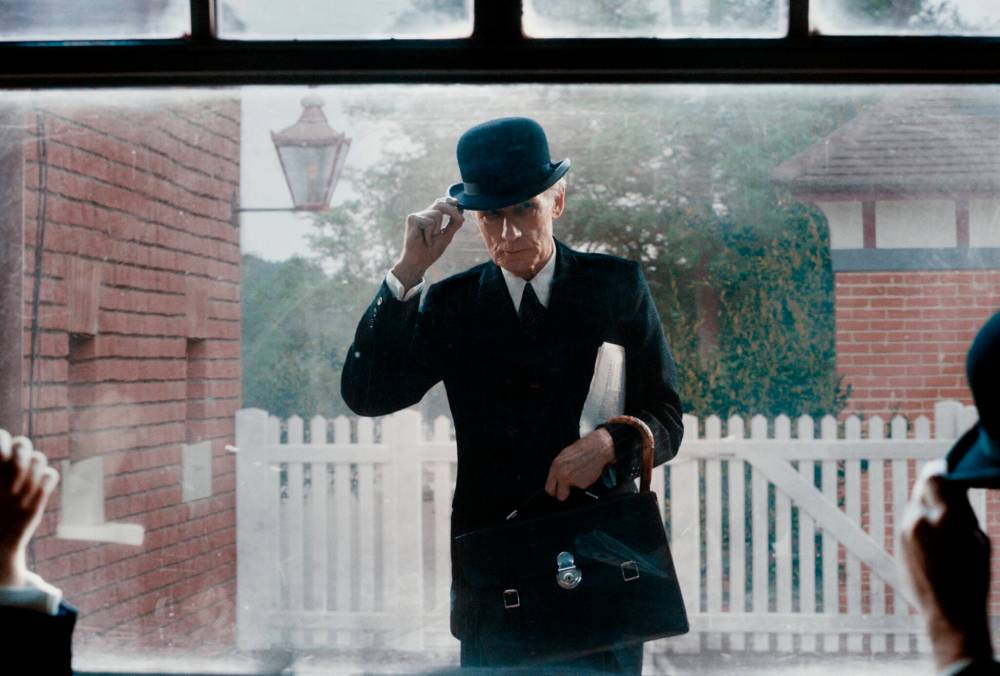
Their protocols and hierarchies are rigid. The new fellow at work (Alex Sharp) is almost frozen out for the social crime of being friendly and enthusiastic. We see how Mr. Williams’ subordinates defer to him, as he later defers to his superior, the lofty Sir James (Michael Cochrane).
At work, Mr. Williams specializes in avoidance, delay and moving paper about. We see his office dealing with three mothers, desperate to convert the open cesspool near their council housing into a children’s playground, only to find themselves shunted back and forth among the departments of Sewage, Parks and Public Works in a seemingly endless circuit.
On this particular day, though, Mr. Williams’ daily round is broken up by a medical appointment. His doctor is apologetic as he delivers the bad news. “These things are never easy,” the doctor says. “Quite,” Mr. Williams replies. That is, at least at first, the only reaction Nighy allows us to see.
He finds no solace in his family life, in which genuine feeling has long been muffled in silence. Mr. Williams, a widower, lives with his son and daughter-in-law (Barney Fishwick and Patsy Ferran), but they are distant, seemingly concerned mostly with their inheritance.
Determined to “live it up” but not quite sure what that would entail, Mr. Williams tries bohemian nightlife, led by Sutherland (Tom Burke), an eccentric writer. He samples luxury, lunching at Fortnum’s. He’s also drawn to a young woman at work, Miss Harris (Aimee Lou Wood), seeing in her cheerful love of life something he has somehow forgotten. Finally, he looks for purpose, enough to break through those bureaucratic hurdles he once propped up.
Mr. Williams changes, but don’t expect him to bust out with a big Hollywood redemption arc. Nighy’s performance is dignified, reserved and, at times, whisper-quiet. Within those constraints, though, he still conveys an overwhelming sense of banked emotion. Nighy is helped in this tricky bit of needle-threading by South African director Hermanus’s gentle approach and by a measured, subtle screenplay from Booker Prize-winning novelist Ishiguro (The Remains of the Day).

Small British period pieces can sometimes fall into overly cozy preciousness, but Living cuts through any potential sentimentality with a sharp sense of the absurd. The bureaucratic obfuscation at Mr. Williams’ workplace is Kafkaesque in its futility, for example. And there are points where the repression is wound so unbearably tight it becomes comic, as when Mr. Williams, in a typically English use of understatement, repeatedly refers to his cancer diagnosis as “a bit of a bore.”
The film also draws from a deep well of melancholy as Mr. Williams reckons with his mortality. Memories flood in, seen in brief, imagistic flashbacks, and he wonders how inertia has “crept up, as one day follows the next.” The film becomes a minor-key meditation on the meaning of life, steeped in a sadness that is both devastating and affirming.
That sweet sadness is perhaps most exquisite in a scene in which Mr. Williams sings an old Scottish folk song, The Rowan Tree. A word to the wise here: anyone who cried when Nighy performed Wild Mountain Thyme in Their Finest should come to Living prepared with hankies.
Many, many hankies.
alison.gillmor@freepress.mb.ca
Studying at the University of Winnipeg and later Toronto’s York University, Alison Gillmor planned to become an art historian. She ended up catching the journalism bug when she started as visual arts reviewer at the Winnipeg Free Press in 1992.
Our newsroom depends on a growing audience of readers to power our journalism. If you are not a paid reader, please consider becoming a subscriber.
Our newsroom depends on its audience of readers to power our journalism. Thank you for your support.
Movie review
Living
Starring Bill Nighy
McGillivray
106 minutes, PG
★★★★ out of five
Studying at the University of Winnipeg and later Toronto’s York University, Alison Gillmor planned to become an art historian. She ended up catching the journalism bug when she started as visual arts reviewer at the Winnipeg Free Press in 1992.
Our newsroom depends on a growing audience of readers to power our journalism. If you are not a paid reader, please consider becoming a subscriber.
Our newsroom depends on its audience of readers to power our journalism. Thank you for your support.
Advertisement Advertise With Us
Advertisement Advertise With Us