Considering Pink Vista without rose-coloured glasses
Advertisement
Read this article for free:
or
Already have an account? Log in here »
To continue reading, please subscribe:

Digital Subscription
One year of digital access for only $205*
- Enjoy unlimited reading on winnipegfreepress.com
- Read the E-Edition, our digital replica newspaper
- Access News Break, our award-winning app
- Play interactive puzzles
*First annual payment billed as $205.00 + GST for one year. This annual subscription will automatically renew at $233.00 + GST every 52 weeks (10% off the regular annual price of $259.35). Offer available to new and qualified returning subscribers only. Cancel any time.
To continue reading, please subscribe:
Add Free Press access to your Brandon Sun subscription for only an additional
$1 for the first 4 weeks*
- Enjoy unlimited reading on winnipegfreepress.com
- Read the E-Edition, our digital replica newspaper
- Access News Break, our award-winning app
- Play interactive puzzles
*Your next Brandon Sun subscription payment will increase by $1.00 and you will be charged $17.95 plus GST for four weeks. After four weeks, your payment will increase to $24.95 plus GST every four weeks.
Read unlimited articles for free today:
or
Already have an account? Log in here »
Hey there, time traveller!
This article was published 03/03/2023 (1299 days ago), so information in it may no longer be current.
My mother collected Mason’s Pink Vista china, table settings and serving dishes, as well as curious and idiosyncratic pieces whose function seems indeterminate, though I think one is a cup for a goose egg. Would I ever fulfill its purpose? Probably not. But I think it would present well if filled with pickled red pearl onions.
The pattern celebrates an old-fashioned rouge pink, salmon and cream landscape, inspired by what I feel must be an early-Jane Austen ending: the idyllic one where all the young women are safely retrieved from the errors of their ways, and/or rescued from malignant class structures. They stand, draped in shawls, demure in bonnets, cinched by corsets or empire waistlines, poured into cropped bodices, modified by bustles, dutifully attending to the conversations of top-hatted and tailed men of means, dispersed in front of an imposing distant mansion — the entire scene bookended by upstretched yews and encircled further by filigreed vine leaves. (I never asked my mother about her enthusiasm for this world view. I wish I had.)
At the time of my mother’s death, and as the only daughter, I was the designated recipient of the Pink Vista. In retrospect I question the inevitability of that decision, recognizing the limits of the bias that dictated its terms. Why wouldn’t one of my three brothers have wished it, been as likely a candidate?
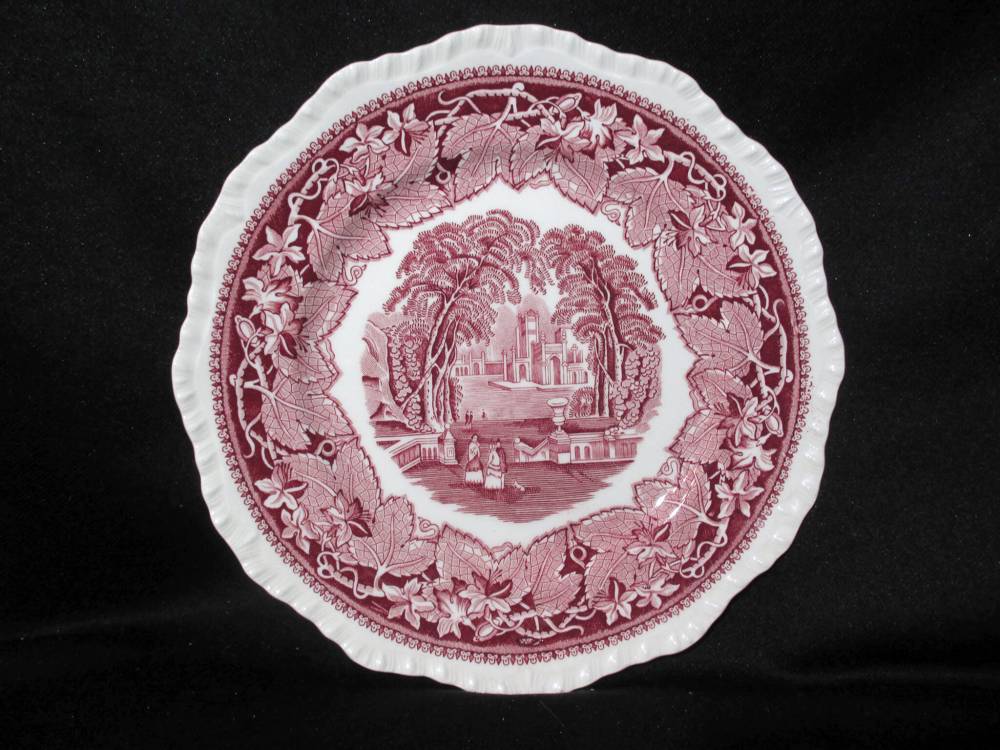
Masons Vista pink luncheon plate. (missingpieces.com)
When this inheritance arrived on my doorstep, having been shipped from my family home in Ontario, I was overwhelmed. I stood in my second-floor bedroom, in front of its bay window, knowing that if I went to answer the door, the world I had known with my mother in it was at an end. Her treasures would become mine. In accepting them, I would have to reconfigure my own living space, for I had rebelled against any kind of formal dining room. There was to be none in my house. I had created two living rooms and an oval table in the kitchen for meal times.
As the will would have it, my mother’s dining room suite arrived along with the china. The ironies of my argument with the roles women were obliged to take on within a patriarchal culture sharpened as boxes were unpacked and the second living room dismantled to make room for the dining room furniture. Somehow I could not refuse that reconfiguration, though I knew well the cost imposed for my mother, her worth curtailed, her identity tethered to role restrictions a 1950s worldview imposed. I also knew, however, that my emerging identity as a heterosexual woman in a late-20th-century culture could untie, in part at least, the strings that bound my mother to second place and servitude, and could forge a space where my sons, my husband, and myself shared more equal rights.
In re-imaging how this “new” dining room table would accommodate such equality, I remember pivotal stories the Pink Vista sparks. While my mother had wanted to go to university, that option was denied. Her father sent her off to become a dental assistant, a training she did not want; her brother went on to the University of Toronto. He was a gifted mathematician, but my mother was a gifted pianist, wonderfully insightful, a creatrix, and a force of nature in her own right. As a baby boomer, I had been raised within the constraints that so often overwhelmed and diminished her life, but I had been allowed to go to university (even if it was only understood as a means toward marriage).
And as waves of feminism interrogated the prevailing bigotry and cruelty that undermined women’s rights, I increasingly found myself capable of embracing and actualizing dreams of a profession, an outside-the-home place where I might flourish even in the midst of “glass-ceilinged” restrictions that persist well into this 21st century. My children remind me that the balancing of my roles as wife, mother and educator was never easy. The Superwoman expectations flourishing in my time overwhelmed. But the stages of feminism unfolding cautioned against such flurry — understood increasingly the systemic inequities that required women to ignore their own well-being and worth so that they might “compete.”
In considering this Pink Vista inheritance, I think about what I might do with it now. As a late lifer, I am not very interested in setting what some call a “pretty table”, but my offer to package and send/deliver the collection to my sons, while acknowledged, is declined. If, however I say I will give it away — all 150 pieces of it — my eldest becomes nostalgic, though adamant still that if such packing boxes approach his front door, he will not yield.
I yielded. In so doing, the Pink Vista grows in its capacity to hold meaning. I recall how it was shelved in the kitchen cupboard beside the sink in my family home. I remember when it became our “everyday” china. I’m not sure why that happened, because it had been well out of reach to four fast-growing, too-close-together and “reckless” children, but it seemed that, suddenly one day, we were allowed to use it for other than those special and festive events which involved outsiders — company — where my mother put her best foot forward and we “almost” behaved.
Perhaps we were old enough; perhaps, somewhat defeated by the claims of the everyday and the unending work cycle it imposed, my mother tossed what had been the cracked and dull everyday dishes she’d relied on, and said, “What the hell” or “Why the hell not,” and in so doing broke the boundary that separated offspring and outsiders. (I don’t know. I never asked about that either.) I simply remember being allowed to use a Pink Vista salad plate for an after-school snack. I felt elegant. I felt as if I’d somehow come of age, been allowed to vote. I also remember the sound my mother made when a “good” dish chipped or broke — part of the risk of putting the Pink Vista collection to ordinary use. And I remember that when we ran out of tea mugs or cereal bowls over time, without the internet as a site for missing pieces, my mother would give up trying to replace them.
In this way, I have inherited the incomplete; I know I could reconstitute a set of this or that, but I rather like the unfinished tale these stories tell. I no longer remember who broke what, but the “Tsk” in my mother’s voice, the white-knuckled approach she took to the edge of the kitchen sink so that she would not fly off her handle, those moments reverberate.

At the same time, my mother was an artist of the everyday. Her aesthetic sensibility found expression in set design: the precise rotation of cushions on the couch in the living room (preserved as much as possible as a “parlour” for company, which left us with a den we could not all fit into at the same time); the quirky colour combinations in the kitchen (cantaloupe and coral); the fanciful dressing of a turkey; the twist of what became her world-class sweet buns. Her artistry found satisfaction in the setting of the pretty table as if a canvas, even as that “picture” was so easily consumed.
I think of my own kitchen (interestingly painted in curry and burgundy, echoing in its own way the cantaloupe and coral); the glass-fronted cabinets, which showcase Pink Vista pieces. I remember the enthusiasm with which my husband greeted what looked to be a Pink Vista plate or cup in a British heritage film we were watching together, as if he then belonged to the period when it was so clear — an immigrant, second-generation survivor of the Holocaust who had never willingly entered a 19th-century British novel — he did not.
How intriguing these attachments we form. How solid they become over time. How impossible then, for me to abandon the Pink Vista entirely — to give it away though I know it could find a family and festive table elsewhere.
I consider options; tell my children that I might begin a Pink Vista installation for the garden — break and reassemble various pieces to make bird feeders or towers, the edge of a fish pond though I do not have a fish pond, perhaps a wrap for the lilac tree… I have many ideas and I believe in White Gorilla Glue, though perhaps another epoxy is best. I am not sure — not sure of the glue, not sure of this possible repurposing. But I think of my mother, her artistry even in the midst of often overwhelming constraints, and wonder if she might find in my creative revisioning a tribute to her own imagining in a world that was never as kind as it should have been. And of course, I long to ask her.
debbieschnitzer@mts.net
Deborah Schnitzer
Winnipeg writer Deborah Schnitzer explores life lessons from women in their Third Act.
Our newsroom depends on a growing audience of readers to power our journalism. If you are not a paid reader, please consider becoming a subscriber.
Our newsroom depends on its audience of readers to power our journalism. Thank you for your support.