Memories of a maverick

St. Boniface-born Greenpeace co-founder fondly remembered in essay collection

Advertisement

Advertise with us

Robert (“Bob”) Hunter is an undeservedly unheralded figure in Manitoba.

Read this article for free:


or

Already have an account? Log in here »

To continue reading, please subscribe:

Subscribe and receive a limited-edition Free Press branded hat or tote.

Digital Subscription

One year of digital access for only $205*

  • Enjoy unlimited reading on winnipegfreepress.com
  • Read the E-Edition, our digital replica newspaper
  • Access News Break, our award-winning app
  • Play interactive puzzles

*First annual payment billed as $205.00 + GST for one year. This annual subscription will automatically renew at $233.00 + GST every 52 weeks (10% off the regular annual price of $259.35). Offer available to new and qualified returning subscribers only. Cancel any time.

To continue reading, please subscribe:

Add Free Press access to your Brandon Sun subscription for only an additional

$1 for the first 4 weeks*

  • Enjoy unlimited reading on winnipegfreepress.com
  • Read the E-Edition, our digital replica newspaper
  • Access News Break, our award-winning app
  • Play interactive puzzles
Start now

*Your next Brandon Sun subscription payment will increase by $1.00 and you will be charged $17.95 plus GST for four weeks. After four weeks, your payment will increase to $24.95 plus GST every four weeks.

Hey there, time traveller!
This article was published 03/06/2023 (1216 days ago), so information in it may no longer be current.

Robert (“Bob”) Hunter is an undeservedly unheralded figure in Manitoba.

Ontario has twice honoured the pioneering environmental activist and co-founder of Greenpeace in its landscapes.

It created the 400-acre Bob Hunter Memorial Park in the greater Toronto area. And Toronto city council later named a 17-hectare municipal park near Scarborough Bob Hunter Greenspace.
The Canadian Press files
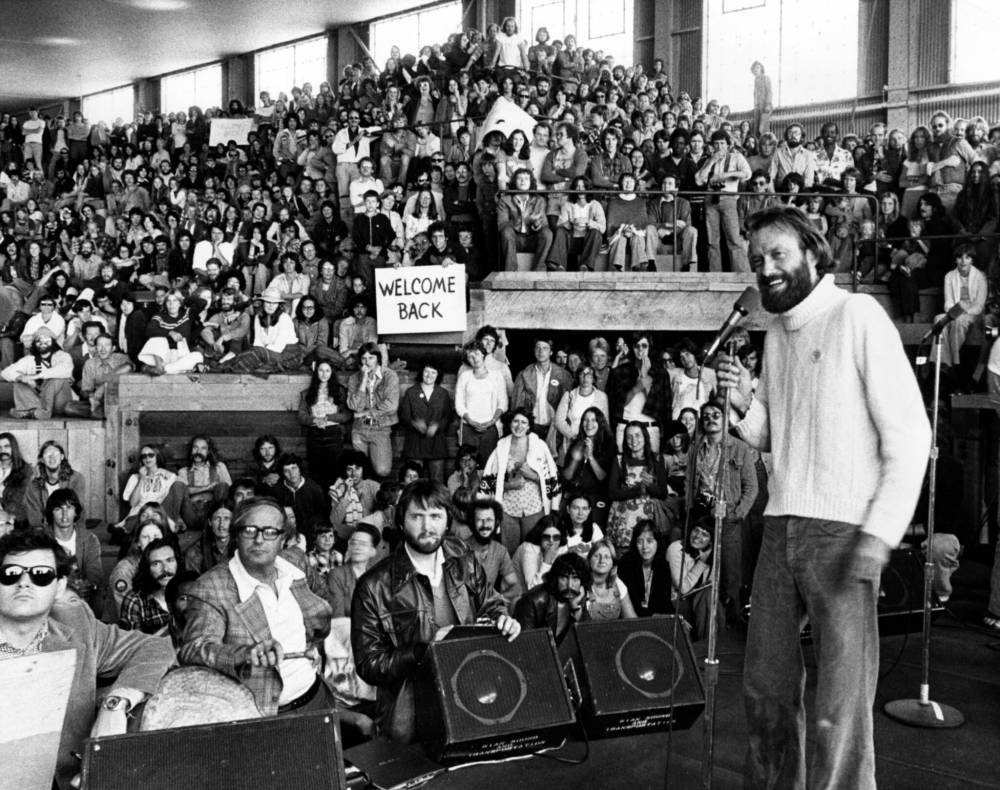
                                In this 1976 photo, Greenpeace co-founder Bob Hunter addresses a crowd of 2,000 supporters in Vancouver at a rally following the Greenpeace VII anti-whaling expedition.

The Canadian Press files

In this 1976 photo, Greenpeace co-founder Bob Hunter addresses a crowd of 2,000 supporters in Vancouver at a rally following the Greenpeace VII anti-whaling expedition.

But the native son of St. Boniface, who got his start as a reporter for the Winnipeg Tribune, has nada here to recognize him.

Hunter’s life was heroic (he died in 2005) in the sense that it was lived with high moral purpose.

The “mindbomb” of title was a strategic creation of Hunter the ex-journalist-turned-eco-activist.

As his arch environmental-activist colleague and sometime rival Paul Watson puts it in the book’s introduction: “He knew how to create a story and how to keep the story energized and relevant, and he had absolutely no qualms about inserting himself into the narrative.

“He was an absolute master of gonzo journalism. Bob coined the term ‘mindbomb,’ which was the 1970s equivalent of going viral.”

Hunter was front and centre for all of Greenpeace’s media-frenzied eco-warrior conflicts — the 1971 voyage to halt U.S. nuclear tests at Amchitka Island off the Alaska coast, the 1975 north Pacific anti-whaling campaign and the 1976 campaign to halt the “whitecoat” harp-seal pup slaughter off Labrador’s coast. Greenpeace ultimately prevailed in all three conflicts, in no small part due to Hunter’s media-savvy heroics and communications.

But he wasn’t just an environmental warrior.

People forget he was also a writer. He authored 14 books and won a 1991 Governor General’s Award for literature for his book Occupied Canada: A Young White Man Discovers His Unsuspected Past.

Almost inevitably in a collection of 55 pieces by almost as many different authors (a few did double or triple duty as contributors and his widow, Bobbi Hunter, contributed a half-dozen pieces and a preface), the quality of the writing typically varies wildly.

Not so much here. The collection’s mini essays and remembrances are almost uniformly good, a few exceptionally so.

In many ways this is biography and history via anecdote — and what great anecdotes.
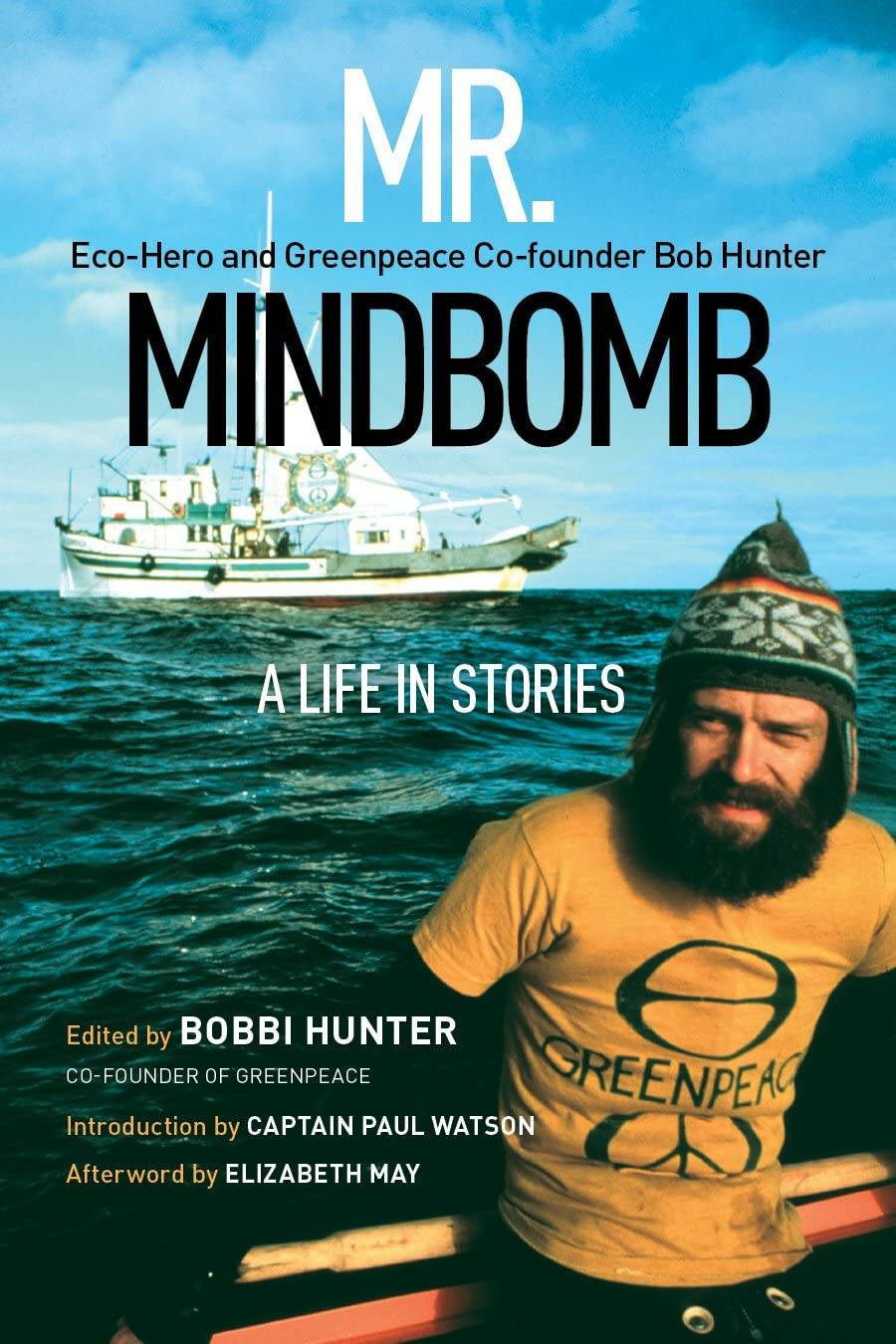
Mr Mindbomb

Mr Mindbomb

They nicely trace the birth of the environmental movement in Canada via the medium of Hunter’s personality and story, with remembrances of moments and events that range from high drama to soap opera.

A couple of the best pieces feel like, or are about, conversations with Hunter. Conversations that are at once comfortable and engaging, yet perceptive and knowledgeable.

And a couple of the best pieces are also by guys with Winnipeg roots.

Physicist and writer Walt Patterson’s accounts of his and Hunter’s meetings and doings in 1960s England is a particularly warm remembrance. Likewise that of another former Winnipegger, the founder of X-Kalay — Canada’s first residential treatment centre for addicts, alcoholics and ex-cons — Dave Berner, whose recollections of his local teenage encounters with Hunter foreshadow the public environmental activist he became.

The net effect of these lucid, literate and sometimes comic short pieces is to leave you greatly admiring Bob Hunter.

And that’s the book’s express intention.

Douglas J. Johnston is a Winnipeg lawyer and writer.
Report Error Submit a Tip

More Stories

Manitoba PCs choose Narth as interim leader; ‘deeply hurt’ Khan blasts former caucus colleagues

Carol Sanders 7 minute read Preview

Manitoba PCs choose Narth as interim leader; ‘deeply hurt’ Khan blasts former caucus colleagues

Carol Sanders 7 minute read Tuesday, Sep. 29, 2026

Manitoba’s Progressive Conservative caucus chose MLA Konrad Narth as interim party leader Tuesday to replace Obby Khan, who quit a day earlier after he said he was stabbed in the back by a small group of caucus members plotting in secret to oust him.

Read
Tuesday, Sep. 29, 2026

Truck carrying mail, milk and alcohol to isolated N.B. island held at U.S. border

The Canadian Press 4 minute read Preview

Truck carrying mail, milk and alcohol to isolated N.B. island held at U.S. border

The Canadian Press 4 minute read Updated: Yesterday at 3:14 PM CDT

CAMPOBELLO ISLAND - A truck carrying supplies for an isolated New Brunswick island linked to the rest of Canada by U.S. roads was turned back at the international border Tuesday, says the local member of Parliament. 

New Brunswick South MP John Williamson said U.S. border officials stopped the truck bound for Campobello Island, N.B., because it was carrying milk and alcohol. Importing those items into the United States is prohibited under new rules that went into effect Tuesday as part of the ongoing trade war.

The only land link to the picturesque island, best known as the summer retreat of former U.S. president Franklin Delano Roosevelt, is a bridge to the town of Lubec, Maine. From there it's an 80-kilometres drive to the next border crossing at Calais, Maine, where the truck was stopped.

Williamson said the truck typically travels to the island every weekday, carrying mail and goods for the island's less than 1,000 residents under a special Canada Border Services Agency licence. The truck is sealed with a customs tag guarantying it will not stop on the way to the island.

Read
Updated: Yesterday at 3:14 PM CDT

Ferraro gets call-up to the Jets

Mike McIntyre 6 minute read Preview

Ferraro gets call-up to the Jets

Mike McIntyre 6 minute read Updated: Yesterday at 6:56 PM CDT

Landon Ferraro vividly recalls the moment his NHL career came to an extremely painful end — Oct. 20, 2017, in downtown Winnipeg.

“My last play was a breakaway on Connor Hellebuyck,” Ferraro told the Free Press this week.

“I tried to poke the puck past the first D. It was me and (Dustin) Byfuglien chasing it down. I thought he was going to throw me across the ice, so I tried to cut in on him, and he moved. I overextended, and I literally ripped my abductor off the bone and gave myself a hernia.”

Ferraro — at the time playing forward for the visiting Minnesota Wild — said he managed to get off a weak shot that hit the Jets goaltender square in the chest. But his 77th appearance in the big leagues would be his last following previous stops with Detroit (which drafted him 32nd overall in 2009) and Boston.

Read
Updated: Yesterday at 6:56 PM CDT

Bombers coach happy to be back at work after backbreaking loss to Argos

Taylor Allen 6 minute read Preview

Bombers coach happy to be back at work after backbreaking loss to Argos

Taylor Allen 6 minute read Tuesday, Sep. 29, 2026

It’s the first practice day after a backbreaking loss.

The Winnipeg Blue Bombers are in a challenging predicament with four games remaining — starting Saturday on the road against the Montreal Alouettes (11-3) — that leaves their playoff aspirations far from solidified.

And yet, head coach Mike O’Shea makes his way behind the podium, looks out at a room of reporters and is grinning ear to ear.

Why so happy?

Read
Tuesday, Sep. 29, 2026

Obsessed stalker who shot, killed young woman at bus stop in 1993 dies behind bars at age 74

Erik Pindera 3 minute read Preview

Obsessed stalker who shot, killed young woman at bus stop in 1993 dies behind bars at age 74

Erik Pindera 3 minute read Tuesday, Sep. 29, 2026

A Winnipeg man who stalked a woman for several years before shooting her dead in the street in 1993 has died in Stony Mountain prison.

On Monday, 74-year-old Ronald Edd Bell died of apparent natural causes at the federal prison just north of Winnipeg, the Correctional Service of Canada said.

Bell had been in prison since May 30, 1994, when he was given a life sentence with no chance of parole for 18 years for killing Terry-Lyn Babb, 25, on Jan. 21, 1993.

Bell walked up behind an unsuspecting Babb, who was waiting at a bus stop at Sherbrook Street and Wolseley Avenue, and shot her in the head with a pistol in front of horrified witnesses, says the Free Press report of his sentencing hearing.

Read
Tuesday, Sep. 29, 2026

Who has been invited to the table?

Stephen Borys 6 minute read Preview

Who has been invited to the table?

Stephen Borys 6 minute read 2:01 AM CDT

Last Friday, I spoke at Booth University College’s inaugural Honour and Hope Harvest Dinner in support of Shelter U. I had been asked to speak about the power of art in the community, a subject I have spent much of my professional life thinking about — as a museum director, writer and teacher, and now through my consulting work with Civic Muse.

What continues to interest me is not simply what museums, universities and other public institutions do, but whether their work actually matters — whether they make a difference in the lives of the people and communities around them.

Preparing for the evening brought me back to an even more fundamental question: Who has been invited in?

One of my museum mentors used to remind me that institutions often begin the conversation about public engagement too late. Before engagement comes the welcome, and before the welcome comes the invitation. We can create extraordinary buildings, exhibitions and programs and say that everyone is welcome. But unless people believe that these places are also meant for them, many will never cross the threshold.

Read
2:01 AM CDT