Winnipeg eyes on Toronto

Local firm brings beauty to concrete jungle

Advertisement

Advertise with us

A Winnipeg architecture firm has installed three pairs of eyes to watch over one of Toronto’s busiest intersections.

Read this article for free:


or

Already have an account? Log in here »

To continue reading, please subscribe:

Subscribe and receive a limited-edition Free Press branded hat or tote.

Digital Subscription

One year of digital access for only $205*

  • Enjoy unlimited reading on winnipegfreepress.com
  • Read the E-Edition, our digital replica newspaper
  • Access News Break, our award-winning app
  • Play interactive puzzles

*First annual payment billed as $205.00 + GST for one year. This annual subscription will automatically renew at $233.00 + GST every 52 weeks (10% off the regular annual price of $259.35). Offer available to new and qualified returning subscribers only. Cancel any time.

To continue reading, please subscribe:

Add Free Press access to your Brandon Sun subscription for only an additional

$1 for the first 4 weeks*

  • Enjoy unlimited reading on winnipegfreepress.com
  • Read the E-Edition, our digital replica newspaper
  • Access News Break, our award-winning app
  • Play interactive puzzles
Start now

*Your next Brandon Sun subscription payment will increase by $1.00 and you will be charged $17.95 plus GST for four weeks. After four weeks, your payment will increase to $24.95 plus GST every four weeks.

Hey there, time traveller!
This article was published 01/08/2023 (1137 days ago), so information in it may no longer be current.

A Winnipeg architecture firm has installed three pairs of eyes to watch over one of Toronto’s busiest intersections.

They aren’t surveillance cameras or photo-radar machines to monitor for any potential crimes in the area. The giant peepers at the corner of York Street and Lakeshore Boulevard have a more lighthearted purpose.

Boom Town — a creation of Winnipeg firm 5468796 Architecture and Office in Search Of, a Toronto firm headed by two former Winnipeggers — won a 2022 design competition that includes three “costumed” boom trucks, called Boom Buddies and adorned with giant eyes, which have made their homes at the intersection.

The installation, which was completed earlier this summer, has also seen four sets of dirty, aging girders and beams on a section of the Gardiner Expressway turned iridescent blue, using paint and special vinyl coverings.

“Hopefully this will touch a lot of people who walk through (the area) in their daily lives, and make them smile and make them appreciate the surroundings they’re in,” says Johanna Hurme, a co-founder of 5468796 Architecture.

The googly-eyed boom trucks and bright blue paint have added colour to an area defined by the large concrete and steel supports that hold up the Gardiner Expressway, an elevated freeway built in 1958 that has become a symbol for Toronto’s traffic problems, aiding in the perception of downtown’s concrete-jungle vibe.

Boom trucks, also known as cherry-pickers, are commonplace near the Gardiner, as workers use them to inspect and repair the overhead roadway. The Winnipeg firm, along with Brandon Bergem and Jeffrey Garcia of Office in Search Of, used them as inspiration for the design, Hurme says.

They’re named Trekker, Tinker and Trooper.

5468796 ARCHITECTURE AND OFFICE IN SEARCH OF 
Pedestrians in Toronto gather beneath a rainbow-hued Boom Buddy, part of Winnipeg firm 5468796 Architecture’s Boom Town creation set up in the Big Smoke.
5468796 ARCHITECTURE AND OFFICE IN SEARCH OF

Pedestrians in Toronto gather beneath a rainbow-hued Boom Buddy, part of Winnipeg firm 5468796 Architecture’s Boom Town creation set up in the Big Smoke.

The installation is part of a program to reconnect downtown Toronto to Lake Ontario by the Bentway — a Toronto non-profit that aims to revitalize and create safer public spaces under the Gardiner Expressway — the City of Toronto and the Waterfront Business Improvement Area.

Boom Town adds an element of joy and excitement and achieves the vibrancy that the design competition called for,” the jury that selected Boom Town writes on the Bentway’s website. “In addition to the use of cherry-pickers as ‘ambassadors’ of the work being done on the Gardiner Expressway, this proposal was clever, has a strong understanding of the site and tells a story.”

Location is a buzzword in real estate but it also applies to art and design. It would be difficult for Boom Town to have a better spot in Toronto: the York-Lakeshore intersection is within walking distance of famous landmarks such as the CN Tower, Toronto’s Harbourfront, Rogers Centre and Union Station.

“It’s super-fun to be able to see it come to life,” Hurme says. “It’s become very Instragrammable, if that’s a word.”

The Boom Buddies are more than just googly eyes. The pieces of construction equipment are meant to be dressed up for special occasions.
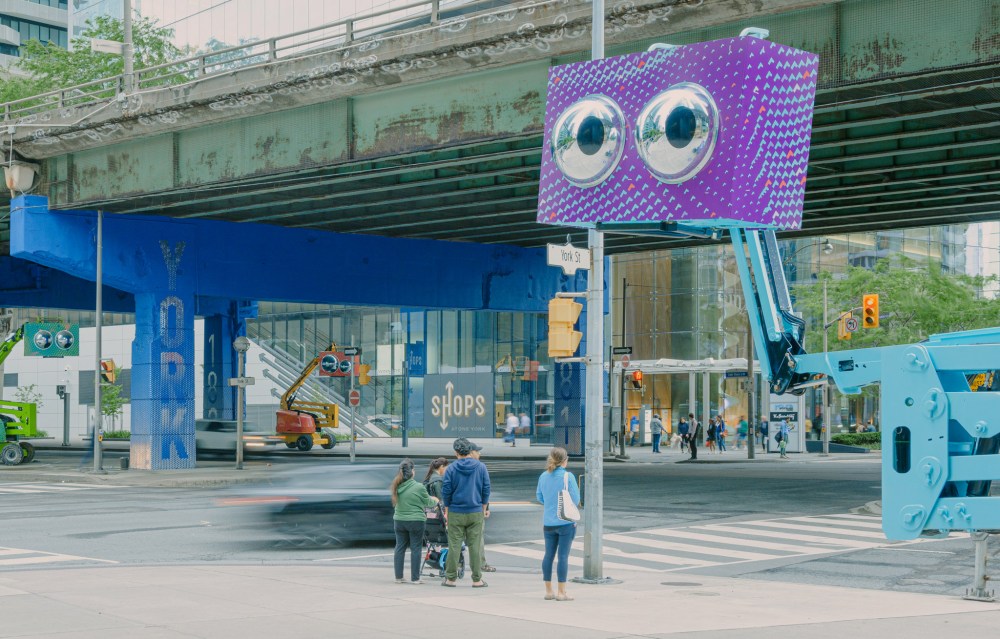
The Boom Town installation is part of a project to revitalize and create safer public spaces under Toronto’s Gardiner Expressway. (Remi Carreiro photo)

They made a colourful debut to mark Toronto’s recent Pride celebrations, as pool noodles transformed the cherry-pickers into rainbow-coloured cousins of Animal, the Muppets’ lovable monster known for his frenetic drumming style.

“We found them to be very anthropomorphic figures. We thought if we somehow dress them up, they become more lively actors under the Gardiner,” Hurme says, adding there are plans for Halloween and Christmas costumes.

“Just let it be fun and engaging for kids and the public at large and hopefully put a smile on people’s faces.”

The project, which has a three- to five-year lifespan, had a $289,000 budget, Hurme says, but the rental of the boom trucks was only a small fraction of the cost compared with colouring the bents.

The googly-eyed creations were inspired by boom trucks, also known as cherry-pickers. (Remi Carreiro photo)

“As weird as it sounds, because it’s just paint and vinyl, it was actually the bigger cost. That has to do with stopping traffic, making a traffic plan while the work is going on and being able to pay crews for work off-hours to avoid rush hour,” Hurme says.

If companies had hobbies, then Boom Town would be the pastime of 5468796 Architecture’s staff, which typically focuses its energies on multi-family housing units in downtown Winnipeg and the Exchange District, most notably the 2021 conversion of the James Avenue Pumping Station into apartments, offices and a restaurant.

Boom Town is “not a big moneymaker or something that would sustain our office and our crew of 20 for a long time, but certainly it’s been fun for the entire team to be involved in this project,” Hurme says.

“There’s a lot faster turnaround to see it from the idea stage to completion, so from that perspective, it would be more on the fun side of what we do every day.”

Alan.Small@winnipegfreepress.com

Twitter: @AlanDSmall


Alan Small

Alan Small
Reporter

Alan Small was a journalist at the Free Press for more than 22 years in a variety of roles, the last being a reporter in the Arts and Life section.

Our newsroom depends on a growing audience of readers to power our journalism. If you are not a paid reader, please consider becoming a subscriber.

Our newsroom depends on its audience of readers to power our journalism. Thank you for your support.

Report Error Submit a Tip

More Stories

Supportive housing operator sued after man with dementia walks away

Erik Pindera 4 minute read Preview

Supportive housing operator sued after man with dementia walks away

Erik Pindera 4 minute read Yesterday at 6:00 AM CDT

The Public Guardian and Trustee of Manitoba is suing a health services company after a man with dementia under its care allegedly wandered away from an apartment it operates for vulnerable people and was later found face down in a puddle — unresponsive, hypothermic and severely injured.

The public trustee — a provincial government agency that, among other duties, makes financial and personal care decisions for vulnerable adults who cannot do so themselves — filed the lawsuit against Cambridge Health Inc. and a related numbered company in the Court of King’s Bench earlier this month.

The agency did so on behalf of a now-38-year-old man, who has been under its care since 2018, as a result of his frontotemporal dementia. The disease often starts in mid-life, rather than old age, as is the case with most other forms of dementia.

The lawsuit alleges the man, who resided at a Henderson Highway apartment complex where Cambridge Health operated a supportive residence for people with complex behavioural health issues, was in a common area of the home at about 4:30 p.m. on April 3 last year.

Read
Yesterday at 6:00 AM CDT

U of M students call for ban on far-right group

Maggie Macintosh 4 minute read Preview

U of M students call for ban on far-right group

Maggie Macintosh 4 minute read Yesterday at 6:00 AM CDT

Some University of Manitoba students are calling on their school to ban a far-right group from campus after posters promoting mass deportations were found during the summer break.

More than 50 people rallied on Wednesday, the first day of classes, to make known their concerns about a group called the Dominion Society of Canada.

The protest was organized after a supporter of the self-described nationalist group posted a video over the Labour Day weekend that shows him putting up flyers in Fort Garry.

“Canada is a really beautiful country and I have been welcomed here by a lot of beautiful people and it’s been amazing, but when I see harmful rhetoric online and now, on campus, it gives me a lot of anxiety,” said Ela Ancheta, an arts major at U of M.

Read
Yesterday at 6:00 AM CDT

Artist’s inspired work brings Métis story back to Portage and Main

Conrad Sweatman 8 minute read Preview

Artist’s inspired work brings Métis story back to Portage and Main

Conrad Sweatman 8 minute read 6:00 AM CDT

Jennine Krauchi calls them the “grandmothers.”

“They speak to you very silently. You never hear a word, but they speak,” Krauchi says, referring to the antique pieces of Métis needlework she’s carefully studied for years — a craft passed down across generations, with the pieces themselves sometimes serving as the instructive elders.

But there’s few precedents for her latest art project: a 85-foot-wide by 32-foot-high chain curtain of Métis needlework — teeming with wild flowers, infinity symbols, berries and other motifs paying tribute to Métis heritage and renewal — that drapes over the historic Bank of Montreal’s neoclassical facade.

That building, at 335 Main St., will soon bear another title: Red River Métis National Heritage Centre or La Plas Taanshi kaa-Ishipamachihoyaahk, its Michif name.

Read
6:00 AM CDT

‘Huge resource gaps’: judge shortage leads to circuit court cuts

Dean Pritchard 4 minute read Preview

‘Huge resource gaps’: judge shortage leads to circuit court cuts

Dean Pritchard 4 minute read Wednesday, Sep. 9, 2026

A shortage of judges is forcing Manitoba’s provincial court to slash sittings across the province.

The court announced in a notice to the profession Wednesday that it will be reducing the number of annual court sittings at nine rural circuit locations and St. Boniface provincial court in Winnipeg by 68 sittings, effective April 1, 2027.

The reductions are necessary to balance “access to justice needs with the complement of judicial resources currently insufficient to maintain the current court schedule,” said the notice, signed by provincial court Chief Judge Ryan Rolston.

Affected circuit courts include Altona, Arborg, Beausejour, Easterville, Cranberry Portage, Lundar, Grand Rapids, Moose Lake, and Pine Falls.

Read
Wednesday, Sep. 9, 2026

Assisted living could alleviate ‘bed block’

Jesse Hajer and Tom Simms 5 minute read 2:00 AM CDT

There is a severe shortage of public and non-profit rent-geared-to-income/services-geared-to-income assisted-living housing for older adults in Manitoba. Seniors assisted living is a form of housing that includes rent, food, laundry and cleaning services.

Presently, the provincial government almost exclusively relies on the private market to provide assisted-living housing for seniors. Monthly private-market assisted-living housing rent for seniors ranges from $3,000 to $6,000 per month. The total income for an individual older adult receiving old age security (OAS) and guaranteed income supplement (GIS) pensions is less than $2,000 per month.

It is clear that low- and fixed-income seniors are not able to afford private-market assisted-living housing, resulting in the premature entry of these older adults into long-term care homes because seniors assisted-living housing is not publicly subsidized, whereas long-term care facilities do provide income-based subsidies.

Low- and fixed-income seniors are also experiencing a food affordability crisis which is negatively impacting their health and well-being. An enhanced assisted-living housing program that includes congregate meals would play an important role in addressing this growing affordability problem, along with reducing social isolation and loneliness.

Letters, Sept. 11

7 minute read Preview

Letters, Sept. 11

7 minute read Updated: 8:07 AM CDT

In his letter to the editor — "Both education systems work", Sept. 9 — Paulo Borges states he “pays 100 per cent” of his school taxes, even though his children do not attend public school. I don’t think he’s unique — all property owners pay the full amount of school taxes, regardless of family status. He went on to suggest he “saved” the government money.

Read
Updated: 8:07 AM CDT