

Weak script casts pall on war biopic
But Mirren soldiers on with devoted portrayal of Golda Meir

Advertisement
Read this article for free:
or
Already have an account? Log in here »
To continue reading, please subscribe:
Monthly Digital Subscription
$1 per week for 24 weeks*
- Enjoy unlimited reading on winnipegfreepress.com
- Read the E-Edition, our digital replica newspaper
- Access News Break, our award-winning app
- Play interactive puzzles
*Billed as $4.00 plus GST every four weeks. After 24 weeks, price increases to the regular rate of $19.95 plus GST every four weeks. Offer available to new and qualified returning subscribers only. Cancel any time.
Monthly Digital Subscription
$4.99/week*
- Enjoy unlimited reading on winnipegfreepress.com
- Read the E-Edition, our digital replica newspaper
- Access News Break, our award-winning app
- Play interactive puzzles
*Billed as $19.95 plus GST every four weeks. Cancel any time.
To continue reading, please subscribe:
Add Free Press access to your Brandon Sun subscription for only an additional
$1 for the first 4 weeks*
*Your next subscription payment will increase by $1.00 and you will be charged $16.99 plus GST for four weeks. After four weeks, your payment will increase to $23.99 plus GST every four weeks.
Read unlimited articles for free today:
or
Already have an account? Log in here »
Hey there, time traveller!
This article was published 24/08/2023 (976 days ago), so information in it may no longer be current.
While this movie’s simple, succinct title might suggest a focus on Golda Meir, sometimes called the Iron Lady of Israel, this is not a big biopic covering decades of her life.
Instead, Golda (in English and Hebrew, with subtitles) concentrates almost entirely on a 21-day period around the 1973 Yom Kippur War.
It’s not a standard war movie, either. There are no directly observed battle scenes. The drama is closed-in and claustrophobic, tense and terse, as it follows a series of high-level meetings, urgent phone calls and hallway walk-and-talks. There are scenes in a darkened operations room, with government officials and military men poring over grainy aerial plans and listening to radio transmissions.
Director Guy Nattiv (Skin) and scripter Nicholas Martin (who’s worked mostly on British TV) use these self-imposed limitations to look at a specific hinge-point for Meir (played by Helen Mirren) and the state she led.
The decision to centre the story on one national crisis gives the film a distinct mood and feel, which those sweeping cradle-to-grave biopics often lack.
But there are drawbacks. It’s difficult to just parachute into the middle of the Arab-Israeli conflict; it will help if you know something of that complicated history going in.
And though we get some sense of the challenges Meir faced as a leader — she’s usually the only woman in the room, apart from the stenographer — it would help to understand more about how she got there.
Casting the non-Jewish Mirren in the title role comes as controversies have broken out on social media concerning so-called “Jewface.” (And, really, this is not a great term for this, no matter what side of the issue you’re on.)
Bleecker Street Helen Mirren stars as the Iron Lady of Israel, Golda Meir.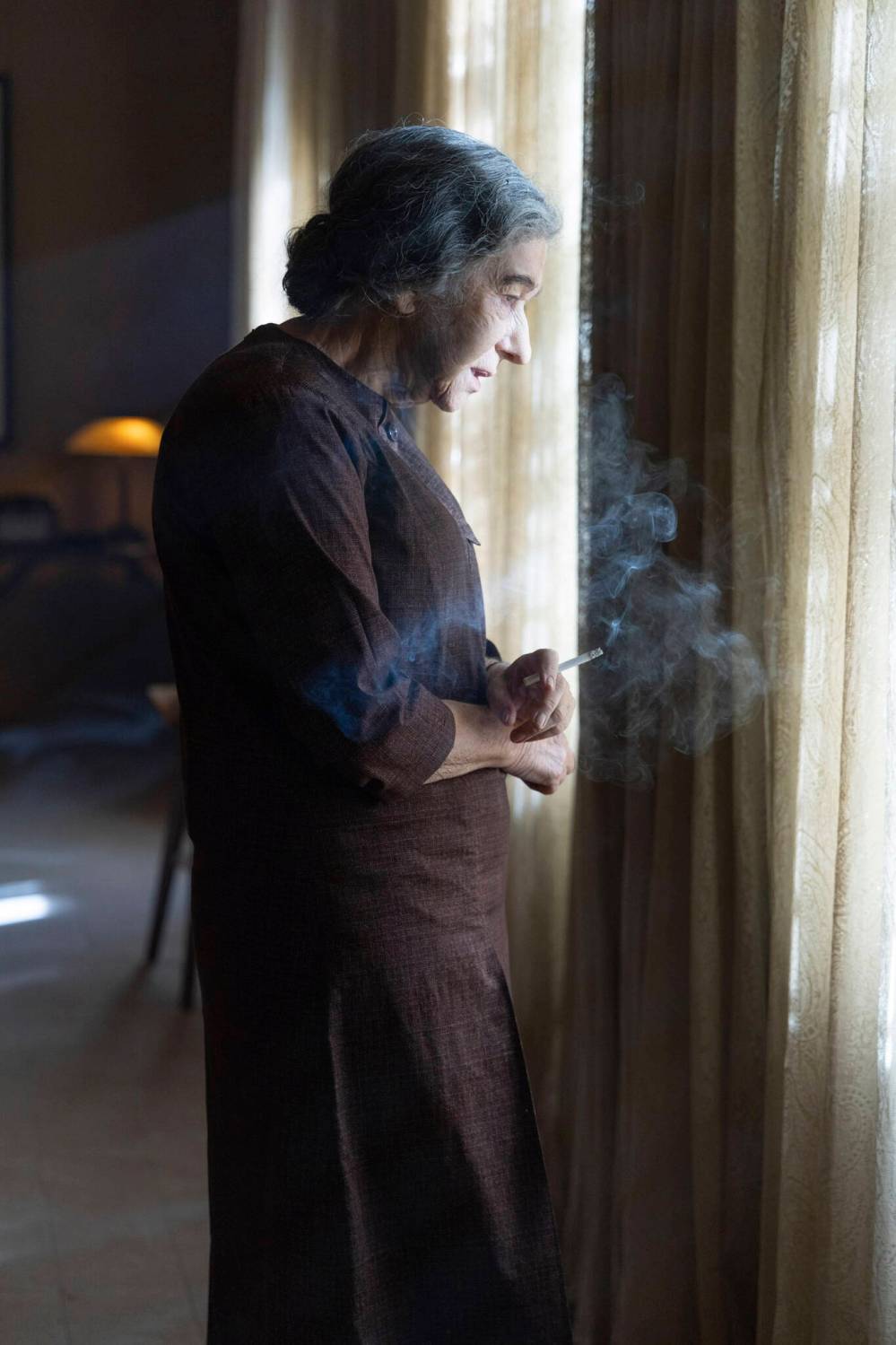
There have been complaints about Bradley Cooper putting on a prosthetic nose to play Jewish-American composer and conductor Leonard Bernstein in the upcoming film Maestro. Bernstein’s children have responded with a statement that their father did, in fact, have “a nice, big nose.”
The sensitivity is understandable — noses have been a trope of anti-Semitic caricatures going back to the medieval period. But it’s also reductive to suggest there’s an identifiable “Jewish nose.”
In this case, Mirren has taken on the specific look of a specific individual, with layers of latex prosthetics that happen to convey Golda Meir’s nose but also her deeply lined face and swollen ankles. Mirren has also adopted an accent that catches some of Meir’s personal history. (She was born in Kyiv and raised in Milwaukee.)
And while the debate about non-Jews playing iconic Jewish historical figures continues, Mirren does bring undeniable star power to the role — and 70-something women who are still considered stars are exceedingly rare in the movies. Even under the prosthetics, the Oscar-winner manages to embody and express the gravitas of a wartime leader who knows she will make decisions that will result in death and loss.
Written text at the beginning of the film states that Meir was chosen to be “a caretaker prime minister” in 1969. (That “care” is sometimes expressed in a literal, grandmotherly sort of way: during one fraught meeting, she brings out a streusel coffee cake and some plates.) But during her tenure, Meir is forced to confront an existential threat to her country, even as she is undergoing debilitating cancer treatments, which she insists on keeping secret.
We see some of her wit, her resolve, her understanding. But most of the secondary characters around her fail to register — we don’t get much sense of their motives or viewpoints — so there isn’t much dramatic friction.
Bleecker Street Helen Mirren brings star power to the role of Golda Meir, although some have criticized the part going to a non-Jewish actor.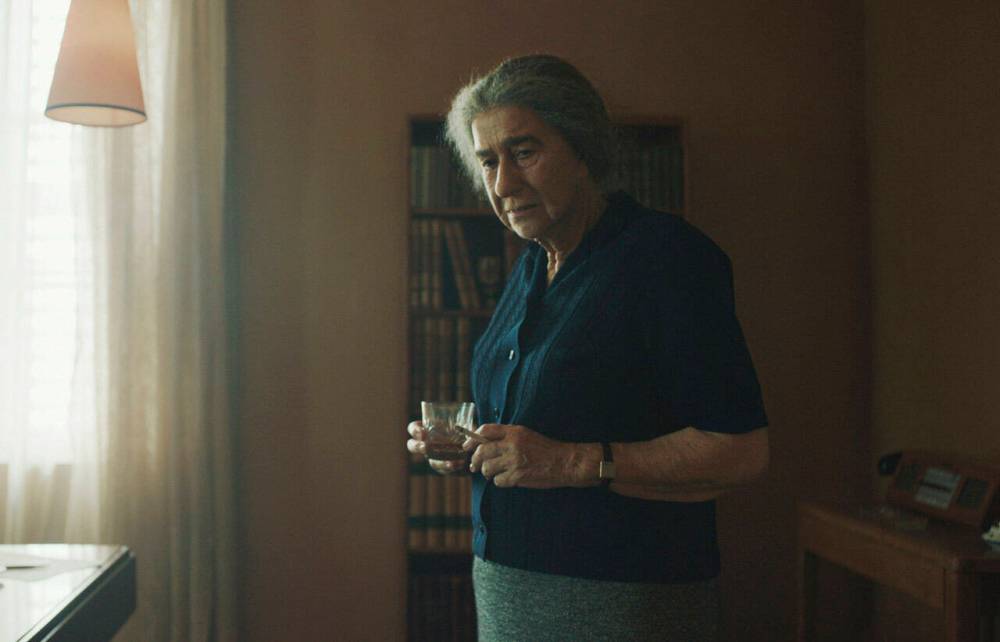
Golda’s best scenes are with Henry Kissinger (Liev Schreiber), with whom she has a decidedly tricky relationship. Kissinger is dealing with the Watergate scandal at home while attempting to navigate America’s diplomatic position in the Middle East. He tells Meir, “You must remember that first, I am an American, second, I am secretary of state, and third, I am a Jew.” But, as she replies: “Henry, you forget that in Israel, we read from right to left.”
In this wry scene — she insists on feeding him borscht, whether he wants it or not — and a later, much more hostile phone conversation with Kissinger, we see what Mirren could do if she had more to work with.
Amid the mostly careful period realism, Nattiv tries on a few art-house flourishes — a dark dream sequence, some heavy symbolism involving dead birds, cigarettes as an almost constant motif. Golda smokes non-stop, lighting one cigarette from another, leaving overflowing ashtrays everywhere. At one point, the smoke rises up above her, obscuring her face, merging with the explosions seen outside the city, transforming into an eerie visual representation of the fog of war.
In another surreal juncture, we see Mirren as Meir watching television news footage of the actual Meir during later peace talks with Egyptian leader Anwar Sadat. This feels like a deliberate and self-aware gesture — to ask questions about how we represent history. But it’s a risk: in the real-life news coverage, we see an energy and spark this sharply focused but often flat film can’t quite catch.
alison.gillmor@freepress.mb.ca
Studying at the University of Winnipeg and later Toronto’s York University, Alison Gillmor planned to become an art historian. She ended up catching the journalism bug when she started as visual arts reviewer at the Winnipeg Free Press in 1992.
Our newsroom depends on a growing audience of readers to power our journalism. If you are not a paid reader, please consider becoming a subscriber.
Our newsroom depends on its audience of readers to power our journalism. Thank you for your support.
Movie review
Golda
Starring Helen Mirren
● Polo Park
● 100 minutes
● PG
★★★ out of five
Cinematically, Golda doesn’t altogether avoid a TV-movie stodginess — it looks a bit drab, with some duff effects and uneven staging. But it has a businesslike running time and doesn’t waste it.
— Tim Robey, Daily Telegraph
Mirren portrays Meir in her darkest days at the height of the 1973 Yom Kippur War with empathy and loving subtlety. It’s hard to imagine anyone doing it better and this is territory that was once mined by Ingrid Bergman…
— G. Allen. Johnson, San Francisco Chronicle
Most of Nattiv’s film is a dry and frustrating affair.
— Barry Hertz, Globe and Mail
Studying at the University of Winnipeg and later Toronto’s York University, Alison Gillmor planned to become an art historian. She ended up catching the journalism bug when she started as visual arts reviewer at the Winnipeg Free Press in 1992.
Our newsroom depends on a growing audience of readers to power our journalism. If you are not a paid reader, please consider becoming a subscriber.
Our newsroom depends on its audience of readers to power our journalism. Thank you for your support.
Advertisement Advertise With Us
Advertisement Advertise With Us