Unleashing Shakespeare
We Quit Theatre delivers a no-holds-barred Bard

Advertisement
Read this article for free:
or
Already have an account? Log in here »
To continue reading, please subscribe:

Digital Subscription
One year of digital access for only $205*
- Enjoy unlimited reading on winnipegfreepress.com
- Read the E-Edition, our digital replica newspaper
- Access News Break, our award-winning app
- Play interactive puzzles
*First annual payment billed as $205.00 + GST for one year. This annual subscription will automatically renew at $233.00 + GST every 52 weeks (10% off the regular annual price of $259.35). Offer available to new and qualified returning subscribers only. Cancel any time.
To continue reading, please subscribe:
Add Free Press access to your Brandon Sun subscription for only an additional
$1 for the first 4 weeks*
- Enjoy unlimited reading on winnipegfreepress.com
- Read the E-Edition, our digital replica newspaper
- Access News Break, our award-winning app
- Play interactive puzzles
*Your next Brandon Sun subscription payment will increase by $1.00 and you will be charged $17.95 plus GST for four weeks. After four weeks, your payment will increase to $24.95 plus GST every four weeks.
Read unlimited articles for free today:
or
Already have an account? Log in here »
Hey there, time traveller!
This article was published 08/09/2023 (1119 days ago), so information in it may no longer be current.
Studying Shakespeare’s First Folio might seem tame, but it can get a little bit hairy, says Gislina Patterson.
Ever since it was published 400 years ago, scholars have pored over the Bard’s collection of prose and poetry with Talmudic severity, finding points of disagreement embedded within every noun, verb, comma and period.
Warring camps emerge, rabidly defending their own theories.
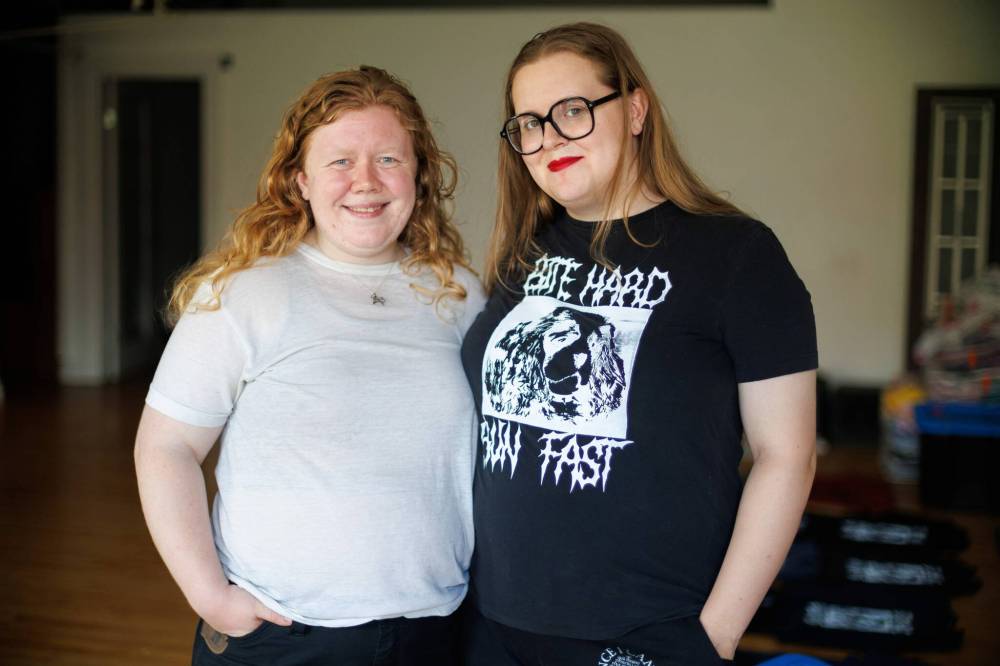
I am your spaniel, the latest show from We Quit Theatre’s Gislina Patterson (left) and Dasha Plett, will be playing at the Output from Sept. 9 to 17.
Unsurprisingly, there’s quite a bit to chew on in the world’s most famous playwright’s enduring body of work.
“People can find very specific clues and extrapolate their own meanings,” says Patterson, 30, who co-founded the We Quit Theatre company with Dasha Plett. “It’s totally imprecise.”
And it’s enough to drive a person mad.
Patterson can attest to that. He has spent hundreds of hours diving into research rabbit holes, searching for hidden meaning and fresh insight.
“I went through a serious First Folio phase,” he says sheepishly.
Relatively early on, Patterson fixated on one line spoken by Helena to Demetrius in A Midsummer Night’s Dream, a four-word avowal that could easily be read as submission or confession: “I am your spaniel.”
That line led Patterson and Plett to develop We Quit’s newest show, a “conspiracy-theorist metal concert crossed with a clown show” starring Patterson as a fictionalized version of himself, an overzealous university professor delivering an introductory lecture that turns … feral.
I am your spaniel, or A Midsummer Night’s Dream by William Shakespeare by Gislina Patterson runs at Videopool’s the Output today through Sept. 17.
“It’s a long title, we’re sorry,” says Plett, 29.
As a duo, Plett and Patterson have an out-of-the-black-box approach to theatre-making.
“There are no rules except for the ones we make ourselves,” Plett says.
Since collaborating for the first time in 2018, they have produced one show called 805-4821 entirely on an overhead projector, a “group reading exercise” that functioned as a trans coming-out for Patterson. During the pandemic, the show was reproduced completely within a Google Doc.
For the Stratford Festival, they also produced a low-fi, low-stakes talk show called Men Explain Things To Us … And We Like It!, produced in the vein of a broadcast for the transgressive adult programmer Adult Swim.
I am your spaniel began four years ago with a staged reading at the Prairie Theatre Exchange’s Festival of New Works under a different title, presented as a high school book report prepared by a student who develops their own non-traditional understanding of A Midsummer Night’s Dream.
“The idea was about applying a really sort of skewed personal lens to a work that was a very well-known, canonical text,” Patterson says. For both Patterson and Plett, that meant applying a queer and trans perspective to the comedy, while playing with the truth that theatre-goers bring their own experiences to bear each time the curtain goes up.
Soon, the show settled into its current setup, posturing Patterson as the fictionalized lecturer, trying to capture students’ imaginations. When the pandemic started, class moved to Zoom, developed during residencies with the Stratford Festival, Toronto’s SummerWorks Festival and the London Ontario Media Arts Association as part of its Queer Frontiers series.
After running for the first time at this year’s SummerWorks Festival, the show now returns to Plett and Patterson’s hometown, making it one of the first productions to run the COVID gamut, moving from live to digital and back again.
For Patterson, who wrote the show with Plett’s dramaturgical assistance, i am your spaniel became not just an examination of A Midsummer Night’s Dream, but an economic and social analysis of Shakespeare’s era as reflected in the play, which became less and less funny over time.
“The more I worked with it, the more I found it extremely frustrating,” says Patterson of the comedy, which centres on the wedding of Duke Theseus of Athens and the Amazon queen Hippolyta. “One of the main things it’s about is maintaining the structure of the family as a method of control over children, and the flow of capital between families.”
During his research, Patterson says he resembled the famous meme of the actor Charlie Day of It’s Always Sunny in Philadelphia fame, standing in front of a convoluted pegboard with a devilish look on his face, trying to connect the dots between seemingly unrelated events.

His research might have seemed crazy, he says. Index cards were taped to the wall. A chalkboard was dirtied by conspiracy theories. And in requisitioning props, he bought a red leather leash from a local antique store.
When asked by the shopkeeper which furry friend the restraint was intended for, Patterson was met with a bemused look when he said it was for himself.
The leash is an apt metaphor for We Quit’s approach to the sometimes rigid world of theatre, says Plett.
“What we really want to do as artists is be able to choose our own restraints.”
ben.waldman@winnipegfreepress.com
Ben Waldman is a National Newspaper Award-nominated reporter on the Arts & Life desk at the Free Press. Born and raised in Winnipeg, Ben completed three internships with the Free Press while earning his degree at Ryerson University’s (now Toronto Metropolitan University’s) School of Journalism before joining the newsroom full-time in 2019. Read more about Ben.
Every piece of reporting Ben produces is reviewed by an editing team before it is posted online or published in print — part of the Free Press‘s tradition, since 1872, of producing reliable independent journalism. Read more about Free Press’s history and mandate, and learn how our newsroom operates.
Our newsroom depends on a growing audience of readers to power our journalism. If you are not a paid reader, please consider becoming a subscriber.
Our newsroom depends on its audience of readers to power our journalism. Thank you for your support.
Theatre Preview
I am your spaniel, or A Midsummer Night’s Dream by William Shakespeare by Gislina Patterson
Saturday through Sept. 17
Videopool — The Output (100 Arthur St.), 7 p.m.
90 minutes, no intermission; masks required for all shows
Tickets pay-what-you-can, available at Eventbrite.com
Ben Waldman is a National Newspaper Award-nominated reporter on the Arts & Life desk at the Free Press. Born and raised in Winnipeg, Ben completed three internships with the Free Press while earning his degree at Ryerson University’s (now Toronto Metropolitan University’s) School of Journalism before joining the newsroom full-time in 2019. Read more about Ben.
Every piece of reporting Ben produces is reviewed by an editing team before it is posted online or published in print — part of the Free Press‘s tradition, since 1872, of producing reliable independent journalism. Read more about Free Press’s history and mandate, and learn how our newsroom operates.
Our newsroom depends on a growing audience of readers to power our journalism. If you are not a paid reader, please consider becoming a subscriber.
Our newsroom depends on its audience of readers to power our journalism. Thank you for your support.
Advertisement Advertise With Us
Advertisement Advertise With Us
History
Updated on Saturday, September 9, 2023 9:41 AM CDT: Minor copy edit