Cronenberg-phile honoured to supply limited-edition commentary
Vatnsdal’s knowledge of Canadian horror perfect fit for Crimes of the Future

Advertisement
Read this article for free:
or
Already have an account? Log in here »
To continue reading, please subscribe:

Digital Subscription
One year of digital access for only $205*
- Enjoy unlimited reading on winnipegfreepress.com
- Read the E-Edition, our digital replica newspaper
- Access News Break, our award-winning app
- Play interactive puzzles
*First annual payment billed as $205.00 + GST for one year. This annual subscription will automatically renew at $233.00 + GST every 52 weeks (10% off the regular annual price of $259.35). Offer available to new and qualified returning subscribers only. Cancel any time.
To continue reading, please subscribe:
Add Free Press access to your Brandon Sun subscription for only an additional
$1 for the first 4 weeks*
- Enjoy unlimited reading on winnipegfreepress.com
- Read the E-Edition, our digital replica newspaper
- Access News Break, our award-winning app
- Play interactive puzzles
*Your next Brandon Sun subscription payment will increase by $1.00 and you will be charged $17.95 plus GST for four weeks. After four weeks, your payment will increase to $24.95 plus GST every four weeks.
Read unlimited articles for free today:
or
Already have an account? Log in here »
Hey there, time traveller!
This article was published 14/09/2023 (1100 days ago), so information in it may no longer be current.
In 1981, David Cronenberg made an actor’s head explode, turning a 10-year-old boy in Winnipeg into a lifelong fan.
Caelum Vatnsdal heard backlash about the cranial combustion in Cronenberg’s film Scanners before he saw the scene on VHS a year or so later, but the gross-out concept was enough to make him a devotee of the Canadian director best known for films — Videodrome, Rabid and The Brood — fleshed out with sinister moments of “body horror.”
A pre-adolescent Vatnsdal, who went on to become a filmmaker and cinema historian in his own right, might have dreamed of some day collaborating directly with Cronenberg.
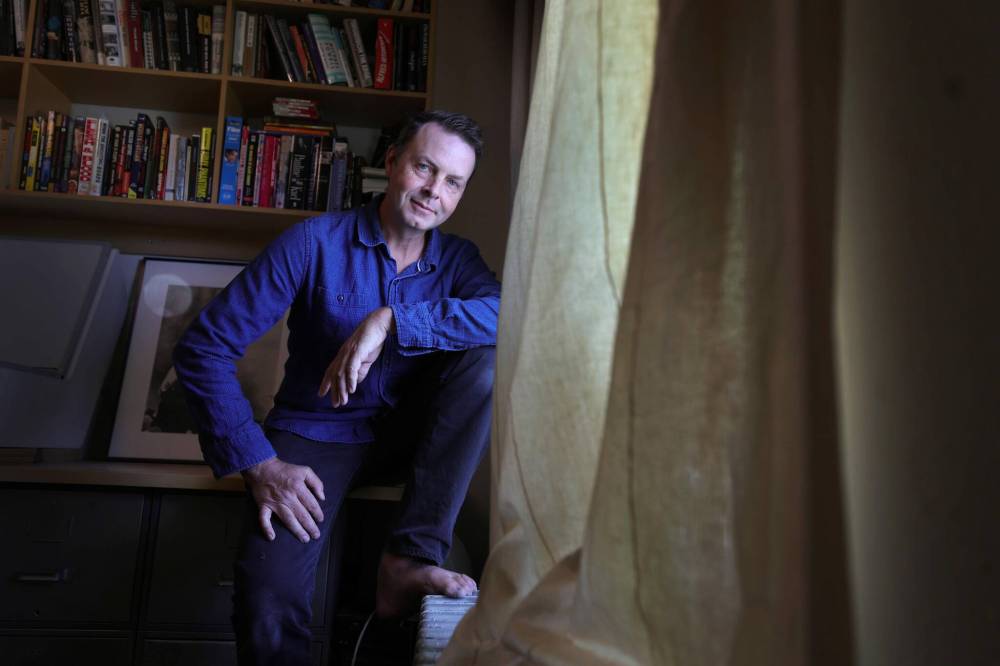
RUTH BONNEVILLE / WINNIPEG FREE PRESS
Winnipeg filmmaker and cinema historian Caelum Vatnsdal provides the audio commentary on a limited edition release of David Cronenberg’s Crimes of the Future.
Now, at 52 years old, he’s come damn close.
Vatnsdal provides audio commentary on a limited edition of Cronenberg’s 2022 feature Crimes of the Future, released Monday by the U.K. distribution company Second Sight.
The company chose Vatnsdal because of his extensive knowledge of the director’s filmography and his cinema scholarship; he wrote the book — They Came from Within — on Canadian horror movies, along with award-winning books on filmmaker Guy Maddin and prolific character actor Dick Miller.
All that experience aside, providing audio commentary proved to be challenging.
“It’s very difficult to talk in a sustained way about a movie you had nothing to do with making,” he says. “Talking about a movie you’ve made yourself would be pretty easy. But talking about one movie (for 108 minutes) without being redundant or regurgitating all the material already written about that movie or that filmmaker is really hard.”
Adding pressure to the situation was Vatnsdal’s long-standing admiration of Cronenberg, whom he once interviewed for the bygone Winnipeg arts weekly Uptown.
“I try not to have heroes, but if I did have one, it would probably be Cronenberg,” he says.
Indeed, the director’s name appears more than 170 times in They Came From Within, a book that got its title from the American title of Cronenberg’s 1975 film, released here as Shivers. Still, Vatnsdal consulted as much study material as possible — even interviewing cinematographer Douglas Koch — to further understand the film, which he saw for the first time last June with his dad.
His first impressions of Crimes of the Future were that it was an interesting, modern film that served as Cronenberg’s “unobnoxious” celebration of his own career, which has often fixated on the grotesque intersection of humanity and technology. “If he was a band, this would be a greatest hits album,” he says.
The film, which stars Viggo Mortensen, Léa Seydoux and Kristen Stewart, is set in the future, and is centred on a man named Saul Tenser (Mortensen) whose body spontaneously grows new organs.
Former Free Press film critic Randall King referred to the film as “occasionally shocking and squirm-inducing” in a 3 1/2-star review.
“It’s definitely not a film for everyone,” Vatnsdal says. “It might make some people barf, but I thought it was really solid.”
When it came time to record the commentary, Vatnsdal used an impromptu home studio — a sauna — and relied on bullet-point notes to develop free-flowing descriptions and background information to enhance the viewing experience. As the action quickly gets strange, Vatnsdal serves as a stand-in for audience confusion.
‘Of course, we’re wondering, ‘What’s going on? Why is this boy eating a trash can?’” Vatnsdal says around the three-minute mark. “My question is, why is he eating a trash can that sits beside the toilet?
“Being a plastic eater is one thing, but you should be choosy about the plastic you eat, I think.”
The limited-edition Blu-ray has sold out, reviews have been positive, and there’s already been interest in Vatnsdal providing audio commentary for another Cronenberg film down the road, he says.
But when he eventually watches his contributor copy of Crimes of the Future, Vatnsdal will do so without the company of his own narration.
“Like many people, I don’t like the sound of my own voice,” he says.
ben.waldman@winnipegfreepress.com
Ben Waldman is a National Newspaper Award-nominated reporter on the Arts & Life desk at the Free Press. Born and raised in Winnipeg, Ben completed three internships with the Free Press while earning his degree at Ryerson University’s (now Toronto Metropolitan University’s) School of Journalism before joining the newsroom full-time in 2019. Read more about Ben.
Every piece of reporting Ben produces is reviewed by an editing team before it is posted online or published in print — part of the Free Press‘s tradition, since 1872, of producing reliable independent journalism. Read more about Free Press’s history and mandate, and learn how our newsroom operates.
Our newsroom depends on a growing audience of readers to power our journalism. If you are not a paid reader, please consider becoming a subscriber.
Our newsroom depends on its audience of readers to power our journalism. Thank you for your support.
Ben Waldman is a National Newspaper Award-nominated reporter on the Arts & Life desk at the Free Press. Born and raised in Winnipeg, Ben completed three internships with the Free Press while earning his degree at Ryerson University’s (now Toronto Metropolitan University’s) School of Journalism before joining the newsroom full-time in 2019. Read more about Ben.
Every piece of reporting Ben produces is reviewed by an editing team before it is posted online or published in print — part of the Free Press‘s tradition, since 1872, of producing reliable independent journalism. Read more about Free Press’s history and mandate, and learn how our newsroom operates.
Our newsroom depends on a growing audience of readers to power our journalism. If you are not a paid reader, please consider becoming a subscriber.
Our newsroom depends on its audience of readers to power our journalism. Thank you for your support.
Advertisement Advertise With Us
Advertisement Advertise With Us