Profound truth
Filmmaker Dinae Robinson’s documentary series offers authentic account of post-colonial history with Indigenous voices

Advertisement
Read this article for free:
or
Already have an account? Log in here »
To continue reading, please subscribe:
Digital Subscription
One year of digital access for only $1.44 a week*
- Enjoy unlimited reading on winnipegfreepress.com
- Read the E-Edition, our digital replica newspaper
- Access News Break, our award-winning app
- Play interactive puzzles
*Billed as $5.77 plus GST every four weeks. After 52 weeks, price increases to the regular rate of $19.95 plus GST every four weeks. Offer available to new and qualified returning subscribers only. Cancel any time.
To continue reading, please subscribe:
Add Free Press access to your Brandon Sun subscription for only an additional
$1 for the first 4 weeks*
- Enjoy unlimited reading on winnipegfreepress.com
- Read the E-Edition, our digital replica newspaper
- Access News Break, our award-winning app
- Play interactive puzzles
*Your next Brandon Sun subscription payment will increase by $1.00 and you will be charged $17.95 plus GST for four weeks. After four weeks, your payment will increase to $24.95 plus GST every four weeks.
Read unlimited articles for free today:
or
Already have an account? Log in here »
Hey there, time traveller!
This article was published 28/09/2023 (1115 days ago), so information in it may no longer be current.
With her newest documentary, Dinae Robinson set out to accomplish a seemingly simple task that has nonetheless escaped generations of filmmakers in Canada: to tell the truth about Indigenous history on this land.
Robinson, a Winnipeg-born Ojibwa filmmaker, and her producing partners Rebecca Gibson, Kyle Irving and Lisa Meeches were so committed to that ideal that they named the film True Story, a titular promise of an authentic, unvarnished narrative, closely examining the relationships between Indigenous people, settlers and the land they share.
To that end, Robinson and her co-writer Gibson, a co-owner of the Winnipeg-based production company Eagle Vision, made sure all the interviewees shaping that narrative — including local ones, such as University of Winnipeg history professor Karen Froman, two-spirit educator Albert McLeod, writer and scholar Tasha Spillett, and former national chief Phil Fontaine — were all Indigenous, too.
“I think that what makes it different (from previous documentaries) is that it’s told strictly by Indigenous people,” says Robinson. “We don’t have any non-Indigenous voices talking about Indigenous people or their stories. It’s all Indigenous people telling the story from their point of view.”
The first part of the documentary debuted on the History Channel last year; the second, also produced by Eagle Vision, airs for the first time Saturday, timed to première on the National Day for Truth and Reconciliation as millions of Canadians reckon with the ongoing legacy of colonization and genocide against Indigenous Peoples.
Though she only began working on the True Story series last year, the production has been years in the making for the 37-year-old Robinson, a member of Swan Lake First Nation and the granddaughter of a residential school survivor.
Robinson, who grew up in Winnipeg’s south end, knew from a young age she wanted to work in film. “I always wanted to be a storyteller,” she says.
After high school, she attended Winnipeg’s Academy of Broadcasting for Film and Television. It was there that she met Gibson, who eventually would give Robinson her first professional writing opportunities. Later, through a CBC mentorship program for Indigenous storytellers, she met filmmaker Lisa Meeches, who also serves as an executive director on True Story.
While forging her career in film, Robinson was compelled to get a degree in Indigenous studies from the University of Winnipeg. She has written for the APTN/CBC series Taken, a true-crime series about the MMIWG epidemic, and is showrunner for the APTN series 7th Gen, focusing on young Indigenous leaders across the country.
Robinson was able to combine lessons from her formal education, cultural upbringing and film career to develop True Story, a project she feels is both necessary and urgent. In making True Story Part Two, Robinson and a five-person team travelled across the country starting in June, working on an accelerated timeline to squeeze nearly 150 years of history — starting with the implementation of the Indian Act in 1876 — into 90 minutes.
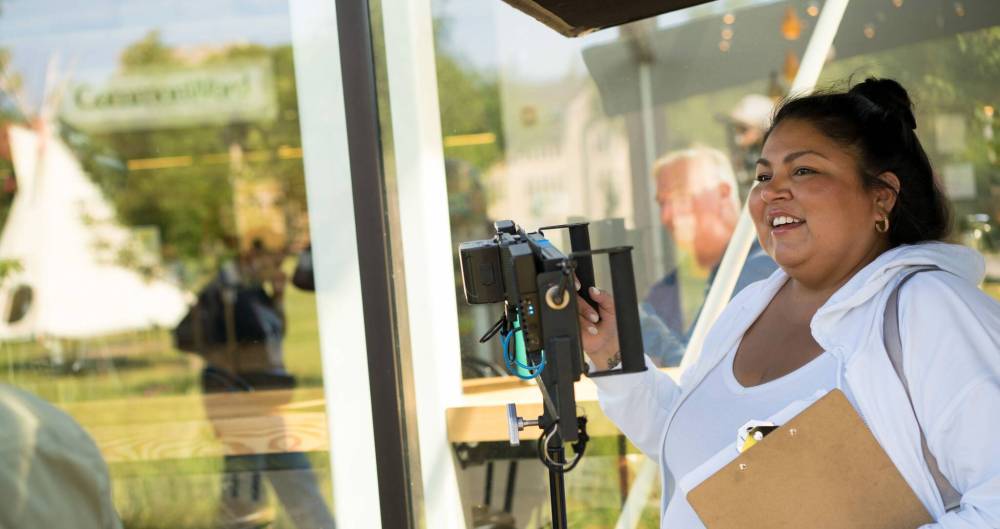
SUPPLIED
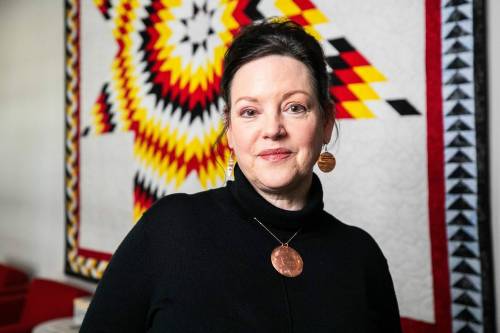
‘It’s all Indigenous people telling the story from their point of view,’ says Dinae Robinson, director of the documentary True Story.
It’s a tall order, but Robinson and crew, along with their narrator, actor Kaniehtiio Horn, manage to give a detailed, nuanced account of post-colonial Indigenous history in Canada.
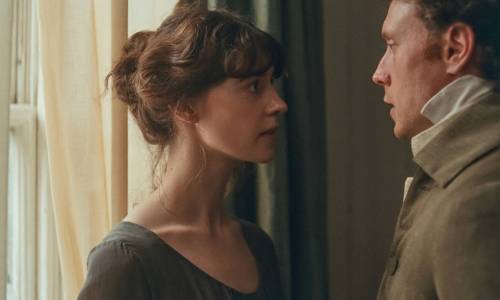
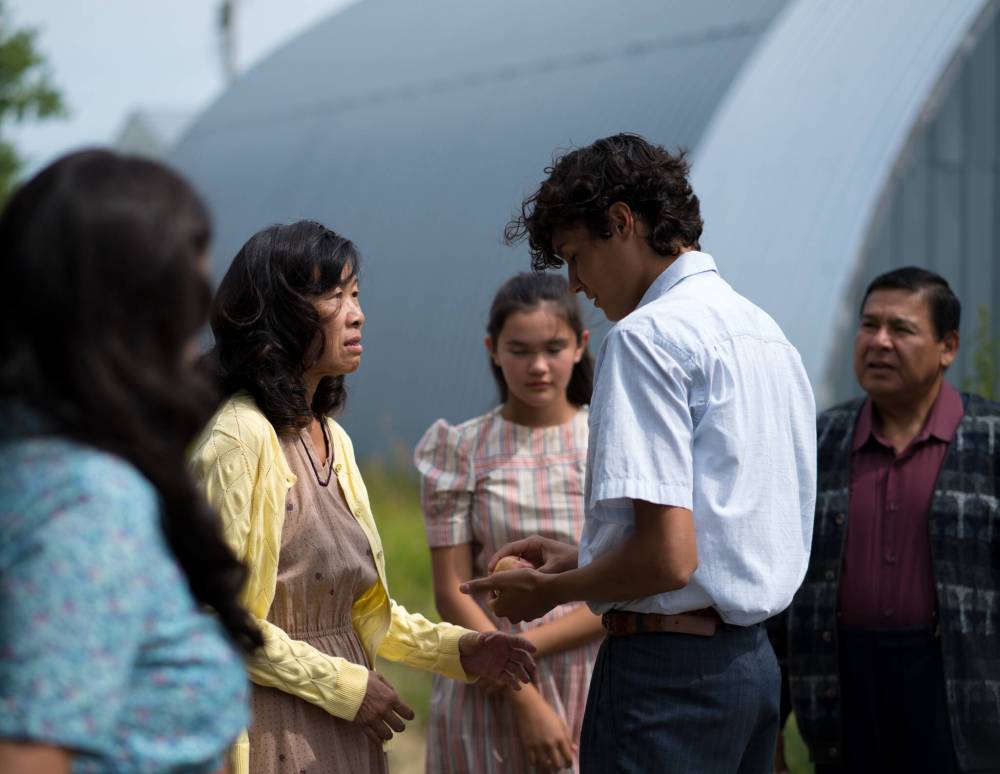
To illuminate a history that she says has often been misrepresented, Robinson employs a mixture of archival footage, new interviews, and re-enactments of scenes in residential schools, of the ’60s Scoop, and of landmark political moments such as the Meech Lake Accords.
For Robinson, True Story is a project with profound personal meaning. She was able to cast her own son as the “lookout” in a scene depicting a family holding a potlatch ceremony with the Indian agent looming, and her own grandmother in one particularly moving scene where a young girl morphs into an elder in the blink of an eye, a “dedication to her story of surviving residential school.”
Robinson gets emotional as she describes the experience of casting her own family members in moments of such pain, recognizing the power of being able to document ceremonies, Indigenous language and stories when only a few generations ago, such acts would have been considered illegal.

“I think we’re just at the beginning of seeing reconciliation happening. It’s going to take a long time. You can see (how far there is to go) with the refusal to search the landfill,” Robinson says
Visible in the documentary are signs imploring Manitoba’s provincial government to search the Prairie Green Landfill for the remains of two Indigenous women — Marcedes Myran and Morgan Harris — believed to be victims of the same alleged serial killer. This week, the Progressive Conservatives unveiled advertisements touting their refusal to conduct a search as a core campaign promise ahead of the Oct. 3 election.
“That shows a government who isn’t taking reconciliation seriously,” Robinson says. “Reconciliation is searching the landfill, expressing the history of residential schools instead of denying (it.) True reconciliation cannot happen until Indigenous people can be safe and not targeted for violence, and until their deaths are taken seriously.
“I think that shows there’s still a lot of work that needs to be done,” she adds.
ben.waldman@winnipegfreepress.com
Ben Waldman is a National Newspaper Award-nominated reporter on the Arts & Life desk at the Free Press. Born and raised in Winnipeg, Ben completed three internships with the Free Press while earning his degree at Ryerson University’s (now Toronto Metropolitan University’s) School of Journalism before joining the newsroom full-time in 2019. Read more about Ben.
Every piece of reporting Ben produces is reviewed by an editing team before it is posted online or published in print — part of the Free Press‘s tradition, since 1872, of producing reliable independent journalism. Read more about Free Press’s history and mandate, and learn how our newsroom operates.
Our newsroom depends on a growing audience of readers to power our journalism. If you are not a paid reader, please consider becoming a subscriber.
Our newsroom depends on its audience of readers to power our journalism. Thank you for your support.
TV preview
True Story Parts One and Two
Directed by Dinae Robinson
● History Channel
● Saturday, 6 p.m. and 8 p.m.
Resources
The Free Press asked True Story director Dinae Robinson to list a few resources she suggests seeking out in addition to her documentary.
1. Indigenous Writes: A Guide to First Nations, Métis & Inuit Issues in Canada by Chelsea Vowel
2. The Inconvenient Indian by Thomas King
3. In Search of April Raintree by Beatrice Mosioner
4. 21 Things You May Not Know About the Indian Act by Bob Joseph
5. Kaneshsatake: 270 Years of Resistance, directed by Alanis Obomsawin
6. Thunder Bay, a docuseries by Ryan McMahon
7. Rumble: The Indians Who Rocked the World, directed by Catherine Bainbridge and Alfonso Maiorana
8. We Were Children, directed by Tim Wolochatiuk
Ben Waldman is a National Newspaper Award-nominated reporter on the Arts & Life desk at the Free Press. Born and raised in Winnipeg, Ben completed three internships with the Free Press while earning his degree at Ryerson University’s (now Toronto Metropolitan University’s) School of Journalism before joining the newsroom full-time in 2019. Read more about Ben.
Every piece of reporting Ben produces is reviewed by an editing team before it is posted online or published in print — part of the Free Press‘s tradition, since 1872, of producing reliable independent journalism. Read more about Free Press’s history and mandate, and learn how our newsroom operates.
Our newsroom depends on a growing audience of readers to power our journalism. If you are not a paid reader, please consider becoming a subscriber.
Our newsroom depends on its audience of readers to power our journalism. Thank you for your support.
Advertisement Advertise With Us
Advertisement Advertise With Us