Mending the cracks
Penning psychological thriller helped Canadian author fight through own mental-health demons

Advertisement
Read this article for free:
or
Already have an account? Log in here »
To continue reading, please subscribe:

Digital Subscription
One year of digital access for only $205*
- Enjoy unlimited reading on winnipegfreepress.com
- Read the E-Edition, our digital replica newspaper
- Access News Break, our award-winning app
- Play interactive puzzles
*First annual payment billed as $205.00 + GST for one year. This annual subscription will automatically renew at $233.00 + GST every 52 weeks (10% off the regular annual price of $259.35). Offer available to new and qualified returning subscribers only. Cancel any time.
To continue reading, please subscribe:
Add Free Press access to your Brandon Sun subscription for only an additional
$1 for the first 4 weeks*
- Enjoy unlimited reading on winnipegfreepress.com
- Read the E-Edition, our digital replica newspaper
- Access News Break, our award-winning app
- Play interactive puzzles
*Your next Brandon Sun subscription payment will increase by $1.00 and you will be charged $17.95 plus GST for four weeks. After four weeks, your payment will increase to $24.95 plus GST every four weeks.
Read unlimited articles for free today:
or
Already have an account? Log in here »
Hey there, time traveller!
This article was published 10/10/2023 (1083 days ago), so information in it may no longer be current.
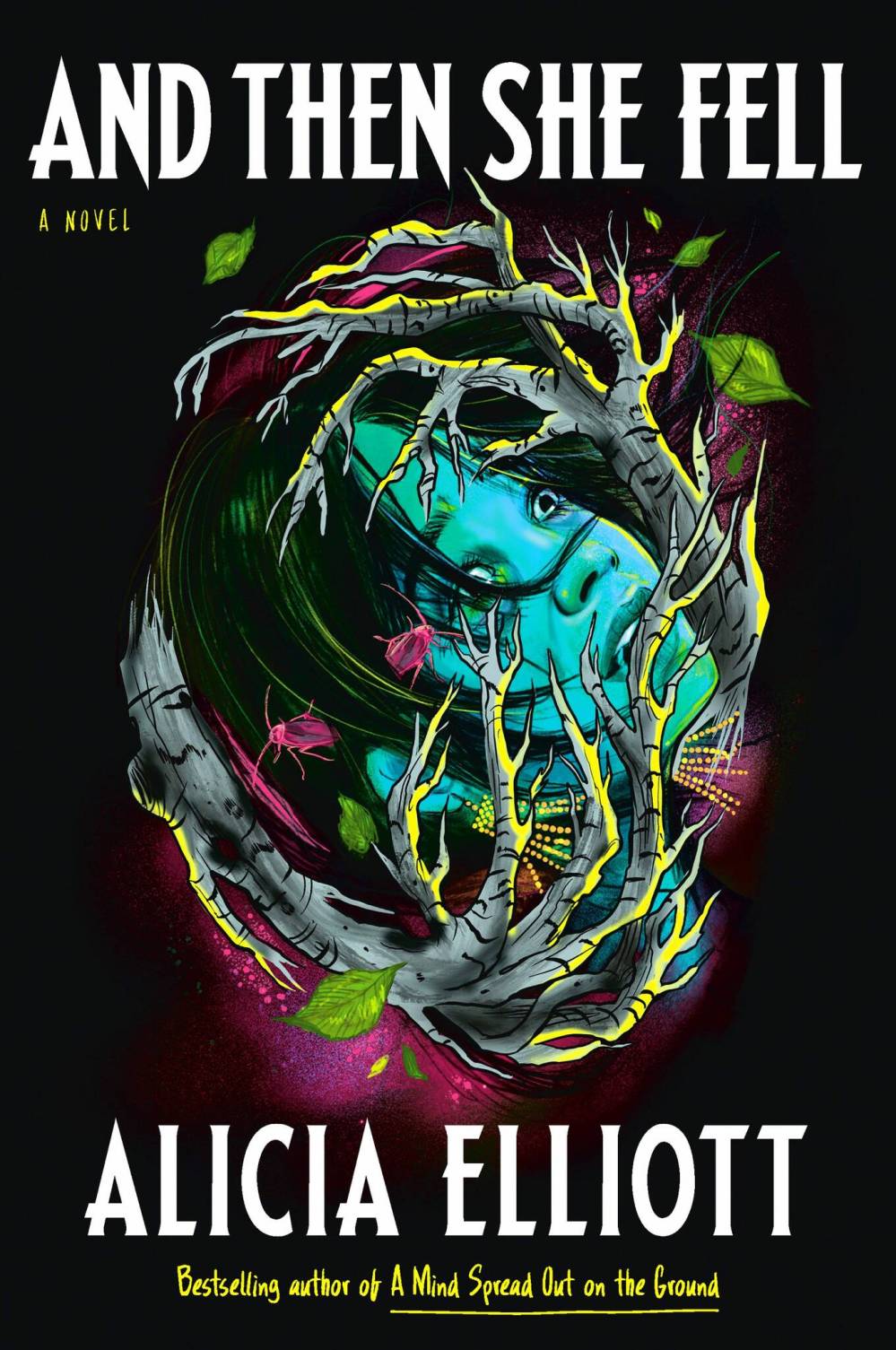
In And Then She Fell, the chilling debut novel by Mohawk author Alicia Elliott, we meet Alice, a young Mohawk woman whose life looks perfect from the outside. A supportive husband. A cherub-cheeked new baby daughter. A new house in Toronto.
But Alice is unravelling. She’s struggling to bond with her baby. She’s hearing voices and experiencing horrific hallucinations. She feels like she is being surveilled by her white neighbours.
All the while, she’s trying to carry out the urgent task the voices are compelling her to do, for her survival and that of her little girl.
COLE BURSTON / THE CANADIAN PRESS And Then She Fell author Alicia Elliott explores themes of motherhood, Indigenous trauma, grief and psychosis in her debut novel.
With And Then She Fell, released last month via Doubleday Canada, the Brantford, Ont.-based Elliott pulls many threads — Indigenous storytelling, intergenerational trauma, polite Canadian racism, motherhood, grief, postpartum psychosis — and expertly braids them into a taut psychological thriller that, at its core, explores the idea of madness.
Elliott, who will read from her book in an appearance at McNally Robinson Grant Park on Wednesday at 7 p.m., has explored mental illness previously in her work, most notably in her bestselling 2019 essay collection A Mind Spread Out on the Ground, in which she writes about her mother’s struggles with bipolar disorder.
But though she’d seen what happened to her mother, Elliott didn’t fully understand it until she went through her own descent into madness in the summer of 2020.
“When I had my own manic episode and psychotic episode, I realized that really, at the bottom of the barrel, are people who are deemed to be ‘crazy,’” Elliott says. “And their experiences are not considered valid or true; they’re not considered reliable narrators, they’re considered liars.”
Literary preview
An Evening wth Alicia Elliott
Wednesday, Oct. 11, 7 p.m.
McNally Robinson Grant Park
Co-presented by The Winnipeg International Writers’ Festival as part of THIN AIR 2023.
Fiction afforded Elliott, 35, the freedom to explore the subject of madness, as well as all the ways in which people are dismissed, disbelieved and gaslit, without having to make herself the main character.
“The power of fiction, too, though, is that you draw those people into the experience so fully that ideally, they are with the characters through all of this,” she says. “Because they know the character so well and care about the character so much, all of a sudden, they have a different view of madness when they come out the other end.”
Madness is deliberately not used as a “gotcha” device — “…and she was crazy the whole time!” — the way it so often is in psychological thrillers. Instead, readers are with Alice on her journey. Her pain and fear are palpable; we feel her distress with her. It doesn’t really matter if her delusions are real or not; they feel real to her.
Elliott wanted to incorporate some horror elements, since so many of the novel’s themes lend themselves well to the genre, such as the trauma of childbirth — which Elliott says is “basically like a David Cronenberg movie” — and the isolation of motherhood, especially in an individualistic society.
Alice mourns the community that would have surrounded her with care back home on the rez; she feels trapped in her house with her fussy baby, whom Alice is convinced hates her.
“I was thinking a lot about the Gothic and what that looks like in a house,” Elliott says. “Like how in early motherhood, you’re in this house, in the middle of a neighbourhood or whatever, and there’s all these people around and it’s sunny, but it still feels like you’re in a gothic fairy tale where you can’t get out and you don’t know what to do.”
Having your spirit forever trapped in a whitewashed version of your story is also a kind of horror. Pocahontas, the 1995 animated Disney film, serves as a leitmotif throughout the novel. At several points, Alice believes Pocahontas, the cartoon avatar for the real Matoaka, is talking to her through the television screen.
“I remember when Pocahontas came out, me and all my cousins, and my aunts and my sister, we were all like, ‘Oh, my God, she’s a Native princess,’” Elliott says. “When you don’t have any representation to look to, any representation is going to bear the weight of everything. As young kids, we’re like, ‘This is amazing, this is so great,’ not understanding, of course, because we’re kids, how the story was twisted, and repurposed for very particular reasons, that the actual person who was known as Pocahontas, or Matoaka, her actual history is totally gone in favour of this fantasy that makes it so that white people are considered good at the end of the day.”
Speaking of the idea of Good White People, Alice’s husband, Steve, is a guy who thinks he gets it but definitely doesn’t get it. He’s taking Mohawk language classes for his wife and daughter, but he’s also doing it for his own clout. He’s silent when one of his academic colleagues relentlessly grills Alice at a dinner party about whether or not genocide is really the best word to describe what’s happening to missing and murdered Indigenous women.
ALEX JACOBS-BLUM PHOTO Alicia Elliott’s debut novel, And Then She Fell, is now on store shelves.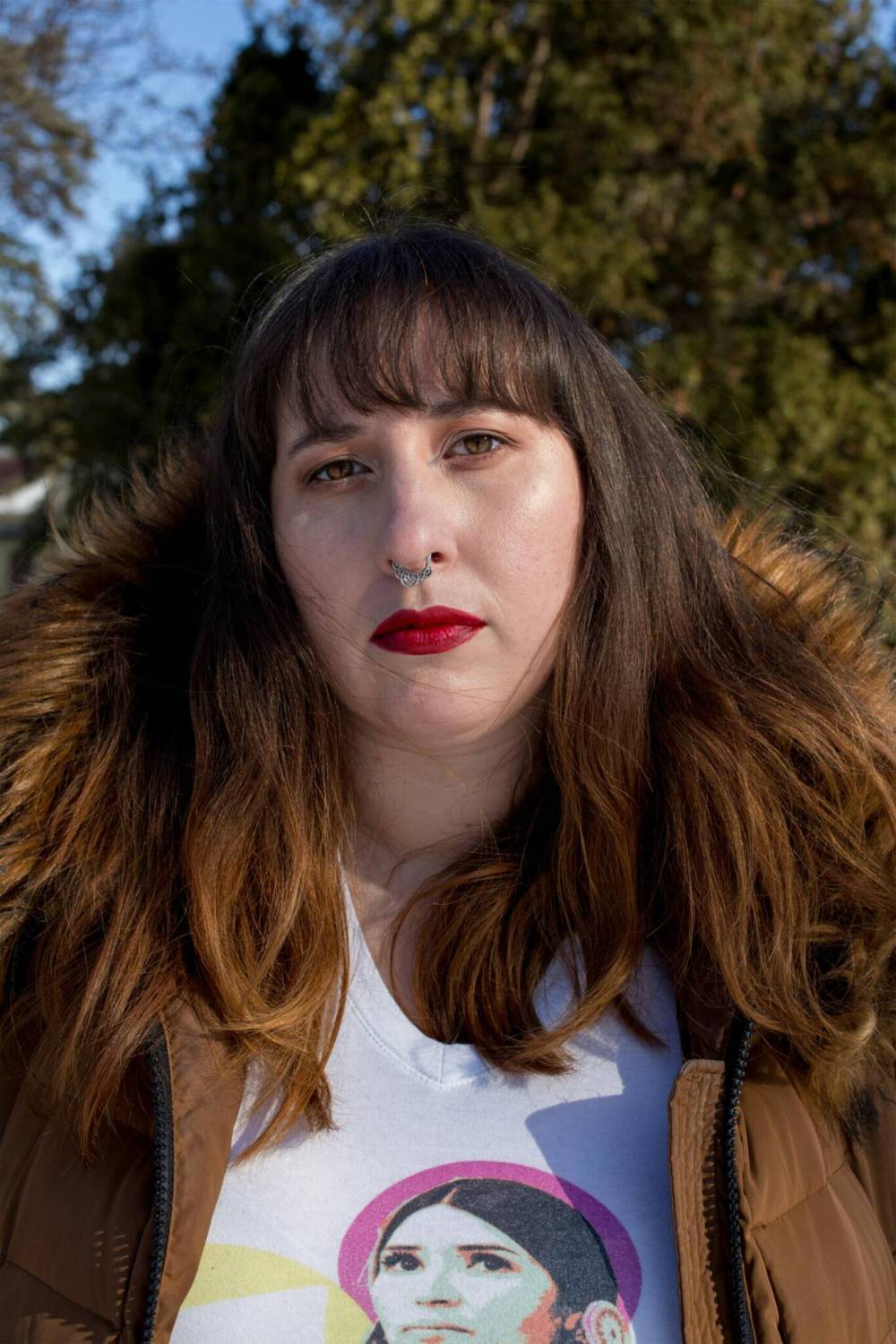
“I really didn’t want (Steve) to just be so easy, like, ‘Oh, he’s just an asshole’ but instead be a little bit more murky,” Elliott says. “It’s not like he’s like being outwardly abusive to her or anything. But we understand, because we’re seeing it through Alice’s eyes, that there are things that are bubbling underneath the surface, that are unsaid, that are really interfering with the relationship and causing cracks.
“And those are also, in some ways, the kinds of the cracks that are found in that kind of liberal Canadian ideology of reconciliation — all we have to do is check off these boxes, and then you should be good, so why are you still looking at us? You want something more? We already did the land acknowledgement, we bought the orange T-shirt, we bought the Tim Hortons reconciliation doughnut.
“It’s always about the surface, and how things look on the surface, and not about actually having communication about what building a trusting relationship actually looks like.”
The book’s surrealist ending, which will not be spoiled here, is incredibly moving, and a bridge back to the author’s own experiences and those of her mother.
“I had always been so terrified that within my genes was this landmine that was going to go off, and it did,”– Alicia Elliott
“I had always been so terrified that within my genes was this landmine that was going to go off — and it did,” Elliott says.
She doesn’t know if it will happen again. But in writing Alice’s way through, she’s finding her own.
“I have to reconfigure what that means in terms of what my future looks like, and not looking at it as this tragedy because I have an illness, that that’s going to be it for me,” she says. “That there’s never going to be any light or possibility or meaning to my life, because I have this illness.
“And so, thinking through what do I need to know or understand so that I can move forward. Because Alice is in the same situation and she needed to have something to keep her grounded, and be like, you know what? Yes, maybe this is something that’s happening to me. But it doesn’t mean that that’s all that I am. It doesn’t take away the fact that I matter, and my life has meaning and that my experiences have meaning.”
jen.zoratti@winnipegfreepress.com
Jen Zoratti is a columnist and feature writer working in the Arts & Life department, as well as the author of the weekly newsletter NEXT. A National Newspaper Award finalist for arts and entertainment writing, Jen is a graduate of the Creative Communications program at RRC Polytech and was a music writer before joining the Free Press in 2013. Read more about Jen.
Every piece of reporting Jen produces is reviewed by an editing team before it is posted online or published in print – part of the Free Press‘s tradition, since 1872, of producing reliable independent journalism. Read more about Free Press’s history and mandate, and learn how our newsroom operates.
Our newsroom depends on a growing audience of readers to power our journalism. If you are not a paid reader, please consider becoming a subscriber.
Our newsroom depends on its audience of readers to power our journalism. Thank you for your support.
Jen Zoratti is a columnist and feature writer working in the Arts & Life department, as well as the author of the weekly newsletter NEXT. A National Newspaper Award finalist for arts and entertainment writing, Jen is a graduate of the Creative Communications program at RRC Polytech and was a music writer before joining the Free Press in 2013. Read more about Jen.
Every piece of reporting Jen produces is reviewed by an editing team before it is posted online or published in print – part of the Free Press‘s tradition, since 1872, of producing reliable independent journalism. Read more about Free Press’s history and mandate, and learn how our newsroom operates.
Our newsroom depends on a growing audience of readers to power our journalism. If you are not a paid reader, please consider becoming a subscriber.
Our newsroom depends on its audience of readers to power our journalism. Thank you for your support.
Advertisement Advertise With Us
Advertisement Advertise With Us