Fine, ferocious unfolding in Scorsese’s Flower Moon

Advertisement
Read this article for free:
or
Already have an account? Log in here »
To continue reading, please subscribe:

Digital Subscription
One year of digital access for only $205*
- Enjoy unlimited reading on winnipegfreepress.com
- Read the E-Edition, our digital replica newspaper
- Access News Break, our award-winning app
- Play interactive puzzles
*First annual payment billed as $205.00 + GST for one year. This annual subscription will automatically renew at $233.00 + GST every 52 weeks (10% off the regular annual price of $259.35). Offer available to new and qualified returning subscribers only. Cancel any time.
To continue reading, please subscribe:
Add Free Press access to your Brandon Sun subscription for only an additional
$1 for the first 4 weeks*
- Enjoy unlimited reading on winnipegfreepress.com
- Read the E-Edition, our digital replica newspaper
- Access News Break, our award-winning app
- Play interactive puzzles
*Your next Brandon Sun subscription payment will increase by $1.00 and you will be charged $17.95 plus GST for four weeks. After four weeks, your payment will increase to $24.95 plus GST every four weeks.
Read unlimited articles for free today:
or
Already have an account? Log in here »
Hey there, time traveller!
This article was published 20/10/2023 (1068 days ago), so information in it may no longer be current.
Tragic, stately, sombre, bluntly violent, Martin Scorsese’s new epic is a crime drama set in the vast spaces of the American West and the intimate corners of the heart.
Difficult, flawed, in some ways deliberately, necessarily frustrating, Killers of the Flower Moon earns its more than three-hour runtime, reframing the cinematic representation of U.S. history in a way that resonates, uncomfortably, into the present.
Based on the carefully researched non-fiction book by David Grann, with a screenplay by Scorsese and veteran scripter Eric Roth, the film centres on a spate of murders among the Osage Nation.
After a forcible relocation to northern Oklahoma, which relegated them to poor farming land, the Osage became some of the richest people in the world at the turn of the 20th century when that land was found to contain massive oil fields. Money was shared through “headrights” — stakes in the profits of the Osage Mineral Estate.
This historical backstory is filled in through 1920s newsreel-style black-and-white footage, which shows wealthy Indigenous people golfing in stylish plus-fours, driving sporty roadsters, attending prestigious colleges, images that are presented as something exotic and strange.
This is Scorsese’s first indication that he’s not just telling a story: He’s examining the question of who tells stories and how, an issue that also implicates his own work.
The Osage Nation becomes prosperous, but that prosperity brings the buzzards, says the Osages’ leader, Chief Bonnicastle (Yancey Red Corn). By government decree, the funds of many Osage people are controlled by white guardians, a paternalistic system that leads to grift, graft and eventually, death.
Shootings and poisonings of Osage men and women are covered up as suicides, accidents or the results of “wasting disease,” with the victims’ money, land and headrights often transferred to white men.
Ernest Burkhart (frequent Scorsese collaborator Leonardo DiCaprio), who has come back to Oklahoma after serving in the First World War, starts to work with his uncle, Bill Hale (Robert De Niro), a local cattleman.
Bill, who likes to be called King – that’s the first sign of trouble — encourages Ernest in his courtship of Mollie Kyle (Lily Gladstone of Certain Women and First Cow), a young woman from a wealthy Osage family.
Bill’s manipulative merging of family and money is gradually revealed as something far more sinister. Death follows death, in a conspiracy of silence that involves lawyers, doctors, morticians, insurance men and sheriffs.
It takes the arrival of a stranger in town, Tom White (Jesse Plemons) of the Bureau of Investigation, a forerunner of the FBI, to begin to unravel what’s going on.
This narrative is played out with lots of ambiguity and not much explanation. The characters, their relationships and motivations can be hard to read, and some of the Indigenous characters remain particularly opaque, though Gladstone possesses enough perceptive presence to compensate for a role that sometimes feels underwritten.
Scorsese collaborated closely with the Osage Nation on this project, which was filmed on Osage land, with Osage people working as cast, crew and consultants. Ultimately, though, the film’s thematic focus is the corruption and self-deception of the white characters.
De Niro is, of course, an old hand at projecting violent menace, but this portrayal of bland, smooth, self-satisfied evil is one of the most chilling things he’s ever done.
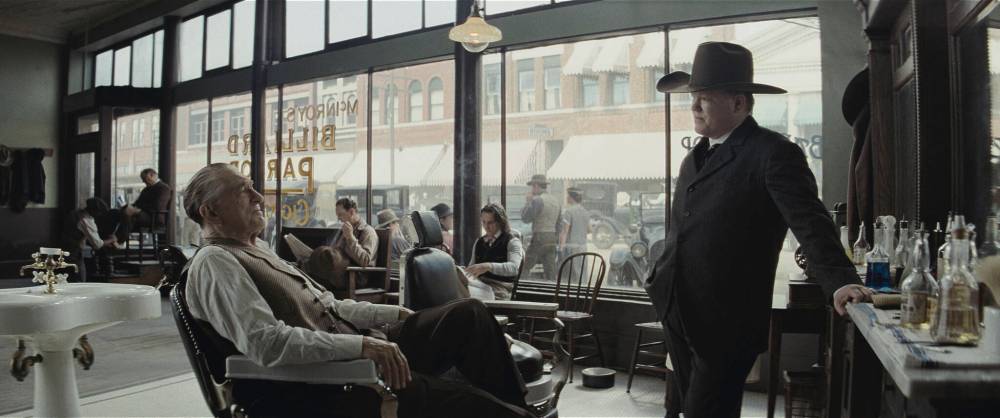
Apple TV+
Robert De Niro (left) and Jesse Plemons in Killers of the Flower Moon, now in theatres.
Full of phoney benevolence, Hale calls the Osage a noble people but suggests they’re “sickly,” using the myth of “the vanishing Indian” to cover over his resentment, greed and need for power.
This reckoning with the stories we tell ourselves has been a recurring issue in Scorsese’s recent films. The Irishman, for example, scrupulously unpacked the self-mythologizing gangster codes of loyalty and honour, implicitly challenging the filmmaker’s own earlier representations of that world.
The weakest link in the cast is DiCaprio. I’ve never quite understood Scorsese’s infatuation with DiCaprio, and I find many of the actor’s mumble-mouthed period performances mannered and distracting. But the real issue here is that the 48-year-old DiCaprio plays a character who was 23 when he married Mollie. (In the film, people keep calling him “son.”)
Ernest and Mollie’s love for each other is presented as the story’s hinge-point, but DiCaprio’s casting makes it harder to pass off their union as a youthful rush that sweeps up the otherwise steady Mollie.

Later, though, DiCaprio’s performance works. With that petulant lower lip, that curdled boyishness, he conveys Ernest’s weakness and passivity. Caught between his genuine love for his wife and the pull of his powerful uncle, we can watch Ernest spinning a story to somehow square the things he’s doing.
The film’s overall story, meanwhile, remains purposely open-ended and incomplete, a reminder that this is a historical film whose issues can’t be comfortably relegated to the past.
In the work’s unusual epilogue, the Osage murders are turned once again into narrative, in this case a perky live broadcast of a 1950s true-crime radio drama.
And there is an appearance by the 80-year-old Scorsese himself, who approaches the mic and addresses the camera in a way that feels poignant and elegiac, and that seems to face both the limitation and the crucial power of cinematic storytelling.
alison.gillmor@winnipegfreepress.com
Studying at the University of Winnipeg and later Toronto’s York University, Alison Gillmor planned to become an art historian. She ended up catching the journalism bug when she started as visual arts reviewer at the Winnipeg Free Press in 1992.
Our newsroom depends on a growing audience of readers to power our journalism. If you are not a paid reader, please consider becoming a subscriber.
Our newsroom depends on its audience of readers to power our journalism. Thank you for your support.
MOVIE REVIEW
Killers of the Flower Moon
Starring Leonardo DiCaprio, Lily Gladstone and Robert De Niro
● Grant, McGillivray, Kildonan, Polo, St. Vital
● 206 minutes, 14A
★★★★1/2 out of five
WHAT OTHERS ARE SAYING…
Until an ending that finds a surreal way to tell us the final fates of these real-life “characters,” Killers of the Flower Moon is a handsome, almost stately movie. Scorsese is a great stylist, but he takes a back seat, insisting that we give this forgotten story the attention it has deserved for the past century.
— Chris Hewitt, Star Tribune
We won’t spoil the ingenious epilogue in which Scorsese ties up the loose narrative ends with another significant cameo. But the fact that this epilogue comes after, oh, 200 minutes of expertly sustained tension is just another sign that in the latter years of his career, Scorsese is upping the ante — in terms of scale, yes, but also ambition.
— Jocelyn Noveck,
The Associated Press
As a work of history and heightened political consciousness, Killers of the Flower Moon is beyond reproach; it dramatizes a grievous truth — about the depravity, destruction and self-deception that undergird the American idea — that has been buried for too long, especially in movies.
— Ann Hornaday,
Washington Post
Armed with a stellar ensemble led by frequent Scorsese collaborators Leonardo DiCaprio and Robert De Niro – with a stunning breakthrough performance by Lily Gladstone – Flower Moon is a gripping story about true love and white greed that wrestles with America’s complicated history concerning … Indigenous people.
— Brian Truitt, USA Today
Killers of the Flower Moon may not be a traditional gangster picture, but it’s completely in tune with the stories of corrupt, violent men that Scorsese has explored for a half-century. And yet there’s also a sense of age in Scorsese’s work here, the feeling that he’s using this horrifying true story to interrogate how we got to where we are a hundred years later. How did we allow blood to fertilize the soil of this country?
— Brian Tallerico, RogerEbert.com
Studying at the University of Winnipeg and later Toronto’s York University, Alison Gillmor planned to become an art historian. She ended up catching the journalism bug when she started as visual arts reviewer at the Winnipeg Free Press in 1992.
Our newsroom depends on a growing audience of readers to power our journalism. If you are not a paid reader, please consider becoming a subscriber.
Our newsroom depends on its audience of readers to power our journalism. Thank you for your support.
Advertisement Advertise With Us
Advertisement Advertise With Us