At the front line of imagination, experience
Method meets the madness and emotion of war in battle-hardened romcom

Advertisement
Read this article for free:
or
Already have an account? Log in here »
To continue reading, please subscribe:

Digital Subscription
One year of digital access for only $205*
- Enjoy unlimited reading on winnipegfreepress.com
- Read the E-Edition, our digital replica newspaper
- Access News Break, our award-winning app
- Play interactive puzzles
*First annual payment billed as $205.00 + GST for one year. This annual subscription will automatically renew at $233.00 + GST every 52 weeks (10% off the regular annual price of $259.35). Offer available to new and qualified returning subscribers only. Cancel any time.
To continue reading, please subscribe:
Add Free Press access to your Brandon Sun subscription for only an additional
$1 for the first 4 weeks*
- Enjoy unlimited reading on winnipegfreepress.com
- Read the E-Edition, our digital replica newspaper
- Access News Break, our award-winning app
- Play interactive puzzles
*Your next Brandon Sun subscription payment will increase by $1.00 and you will be charged $17.95 plus GST for four weeks. After four weeks, your payment will increase to $24.95 plus GST every four weeks.
Read unlimited articles for free today:
or
Already have an account? Log in here »
Hey there, time traveller!
This article was published 04/11/2023 (1052 days ago), so information in it may no longer be current.
One of the key facets of Method acting, as set out by the Russian dramatist Konstantin Stanislavski’s “system” of training, is perezhivanie, which encourages actors to embody their roles as though they were lived realities, erasing the border between imagination and experience to establish a oneness between character and performer.
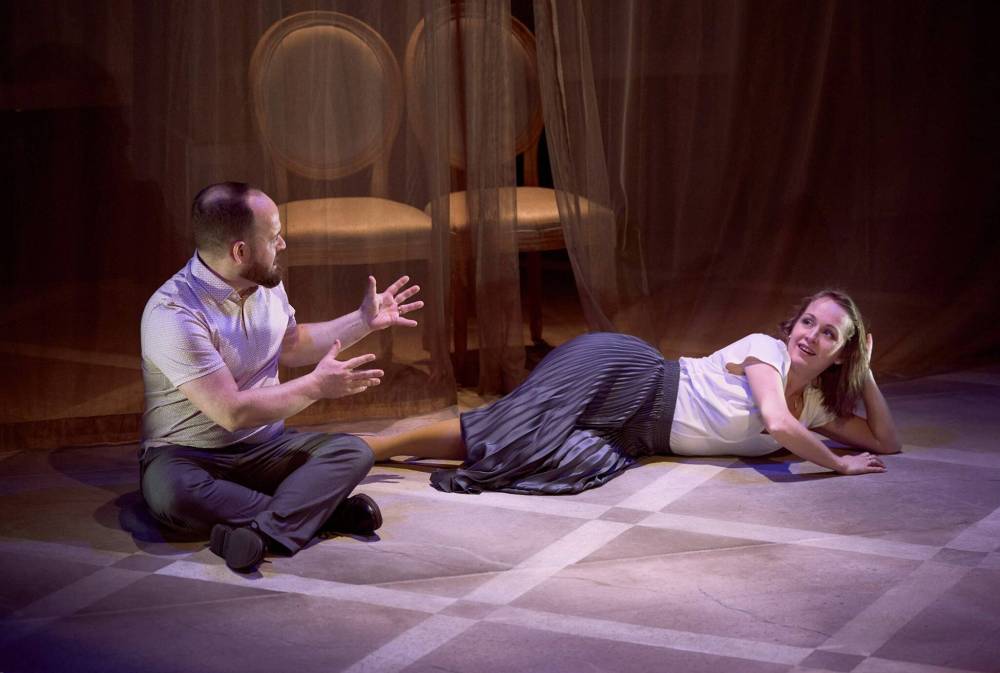
Matthew MacKenzie and Mariya Khomutova do precisely that in the triumphant, hilarious and moving First Métis Man of Odesa, a star-crossed, windswept, war-torn romcom that waltzes back and forth across the threshold that separates dreams from nightmares.
MacKenzie, an often autobiographical Edmontonian playwright of Métis descent, is not an actor, he tells the audience at the very beginning of the performance. “But in this play, a true story, I perform the role of myself,” he says.
Alexis McKeown photo
As co-writers of First Métis Man of Odesa, real-life couple and onstage duo, Matthew MacKenzie and Mariya Khomutova are irresistibly charming.
Khomutova, on the other hand, is “three handshakes away” from Stanislavski, a devotee to the classics who prefers to keep her affective memories to herself.
The production begins in 2018, when Matt and Masha met while workshopping a play based on the experiences of Ukrainians in the nascent stages of the Russian invasion.
“I’m not sure that writing a play based on the real words of real people can be art,” Masha admits at a point when their relationship is purely professional.
“Reality can be art,” Matt replies.
“So, if I want to write a play about myself, and the events that truly happened in my life, it will be art?” she asks.
“If you experience something remarkable enough, or terrible enough, sure.”
This conversation functions as a thematic prologue for Matt and Masha’s relationship as it develops from innocent crush to a full-fledged romance, blossoming amid strife. As co-writers, as a real-life couple and as an onstage duo, MacKenzie and Khomutova are irresistibly charming, two sparrows caught on the same turbulent breeze, answering the problems of living through the solutions of creative interrogation.
The two-hander format is brilliantly executed, with the two actors speaking with, and not to, the audience on a steadily rocking storytelling see-saw. Directed by Lianna Makuch, every punchline hits the gut with simplicity and clarity, the laughter fuelled by the actors’ selfless delivery.
MacKenzie’s self-declared lack of acting chops proves to be a strength rather than a weakness. With a matter-of-fact, stupefied oratory style and an all-too-relatable inability to do anything “normal” with his hands, the actor, when standing alone, strikes a rich vein of comedic oil beneath an awkward surface, akin to the comedian Mike Birbiglia.
It’s a perfect complement to Khomutova’s Masha, whom Matt describes as a “goddamn hobbit goddess.”
“Masha is the first person I’ve ever met in the whole world with dance moves equally as unorthodox as my own,” Matt says. Unlike Matt, Khomutova is an effortlessly graceful performer, in full command of her character’s mobility, which is later restricted by unexpected circumstances: a bout of morning sickness, a global pandemic and the outbreak of war.
After a picture-perfect first half following the two lovers as they attempt to reunite, First Métis Man shifts to domestic comedy when the couple finally find themselves living under the same roof with their son, Ivan, and Masha’s unseen mother, Olga, who has joined them in their Toronto apartment.
This familiar war at home is juxtaposed subtly and resolutely with the abstract, distant war on the home front, with Matt standing guard in front of Ivan’s door to block his mother-in-law from interrupting his precious few minutes of sleep, a sentry at the border preventing an unwanted invasion.
The set, once immovable and fixed, falls into disrepair as war unfolds, with a central supporting column moving forward to represent Olga’s presence and to signal the potential loss of a keystone of Masha and Matt’s relationship. The curtain sags, and one of the two ornamental windows at the back of the set is set askew, giving it the look of a tombstone rather than a source of sunshine. The production design by Daniela Masellis is restrained and assured: nothing is permanent, everything is real.

The lighting, including traditional spotlights and cross lighting, creates loving silhouettes from Matt and Masha’s tableaux, while more specialized projections, designed by Amelia Scott, are immersive and beautifully deployed.
When the couple pops champagne, projections of bubbles evoke airiness and possibility. When bombs fall, projections of rolling clouds encroach, and the stage floor is blanketed in spine-tingling static electricity. Along with Aaron Macri’s haunting and jubilant sound design, the director Makuch manages to capture the tenuousness of an unlikely relationship and the ways in which war ensnares the senses.
“Everyone I have known has had their lives torn,” Masha says, after recounting her bridesmaid’s escape from the besieged city of Mariupol. “‘Before’ and ‘after.’”
Set in the here and the now, First Métis Man of Odesa mends the fraying fabric with the thread of life itself.
ben.waldman@winnipegfreepress.com
Ben Waldman is a National Newspaper Award-nominated reporter on the Arts & Life desk at the Free Press. Born and raised in Winnipeg, Ben completed three internships with the Free Press while earning his degree at Ryerson University’s (now Toronto Metropolitan University’s) School of Journalism before joining the newsroom full-time in 2019. Read more about Ben.
Every piece of reporting Ben produces is reviewed by an editing team before it is posted online or published in print — part of the Free Press‘s tradition, since 1872, of producing reliable independent journalism. Read more about Free Press’s history and mandate, and learn how our newsroom operates.
Our newsroom depends on a growing audience of readers to power our journalism. If you are not a paid reader, please consider becoming a subscriber.
Our newsroom depends on its audience of readers to power our journalism. Thank you for your support.
Theatre review
First Métis Man of Odesa
● Tom Hendry Warehouse
● To Nov. 18
● Tickets at royalmtc.ca
★★★★★ out of five
Ben Waldman is a National Newspaper Award-nominated reporter on the Arts & Life desk at the Free Press. Born and raised in Winnipeg, Ben completed three internships with the Free Press while earning his degree at Ryerson University’s (now Toronto Metropolitan University’s) School of Journalism before joining the newsroom full-time in 2019. Read more about Ben.
Every piece of reporting Ben produces is reviewed by an editing team before it is posted online or published in print — part of the Free Press‘s tradition, since 1872, of producing reliable independent journalism. Read more about Free Press’s history and mandate, and learn how our newsroom operates.
Our newsroom depends on a growing audience of readers to power our journalism. If you are not a paid reader, please consider becoming a subscriber.
Our newsroom depends on its audience of readers to power our journalism. Thank you for your support.
Advertisement Advertise With Us
Advertisement Advertise With Us