Iconic Brahms concerto delivers drama, passion
Calgary conductor leads WSO in night of classics and new works
Advertisement
Read this article for free:
or
Already have an account? Log in here »
To continue reading, please subscribe:

Digital Subscription
One year of digital access for only $205*
- Enjoy unlimited reading on winnipegfreepress.com
- Read the E-Edition, our digital replica newspaper
- Access News Break, our award-winning app
- Play interactive puzzles
*First annual payment billed as $205.00 + GST for one year. This annual subscription will automatically renew at $233.00 + GST every 52 weeks (10% off the regular annual price of $259.35). Offer available to new and qualified returning subscribers only. Cancel any time.
To continue reading, please subscribe:
Add Free Press access to your Brandon Sun subscription for only an additional
$1 for the first 4 weeks*
- Enjoy unlimited reading on winnipegfreepress.com
- Read the E-Edition, our digital replica newspaper
- Access News Break, our award-winning app
- Play interactive puzzles
*Your next Brandon Sun subscription payment will increase by $1.00 and you will be charged $17.95 plus GST for four weeks. After four weeks, your payment will increase to $24.95 plus GST every four weeks.
Read unlimited articles for free today:
or
Already have an account? Log in here »
Hey there, time traveller!
This article was published 05/11/2023 (1049 days ago), so information in it may no longer be current.
The Winnipeg Symphony Orchestra celebrated two of its most beloved musicians Saturday night, when it presented the inaugural concert in its Saturday Classics series, Appalachian Spring & Brahms’s Double Concerto.
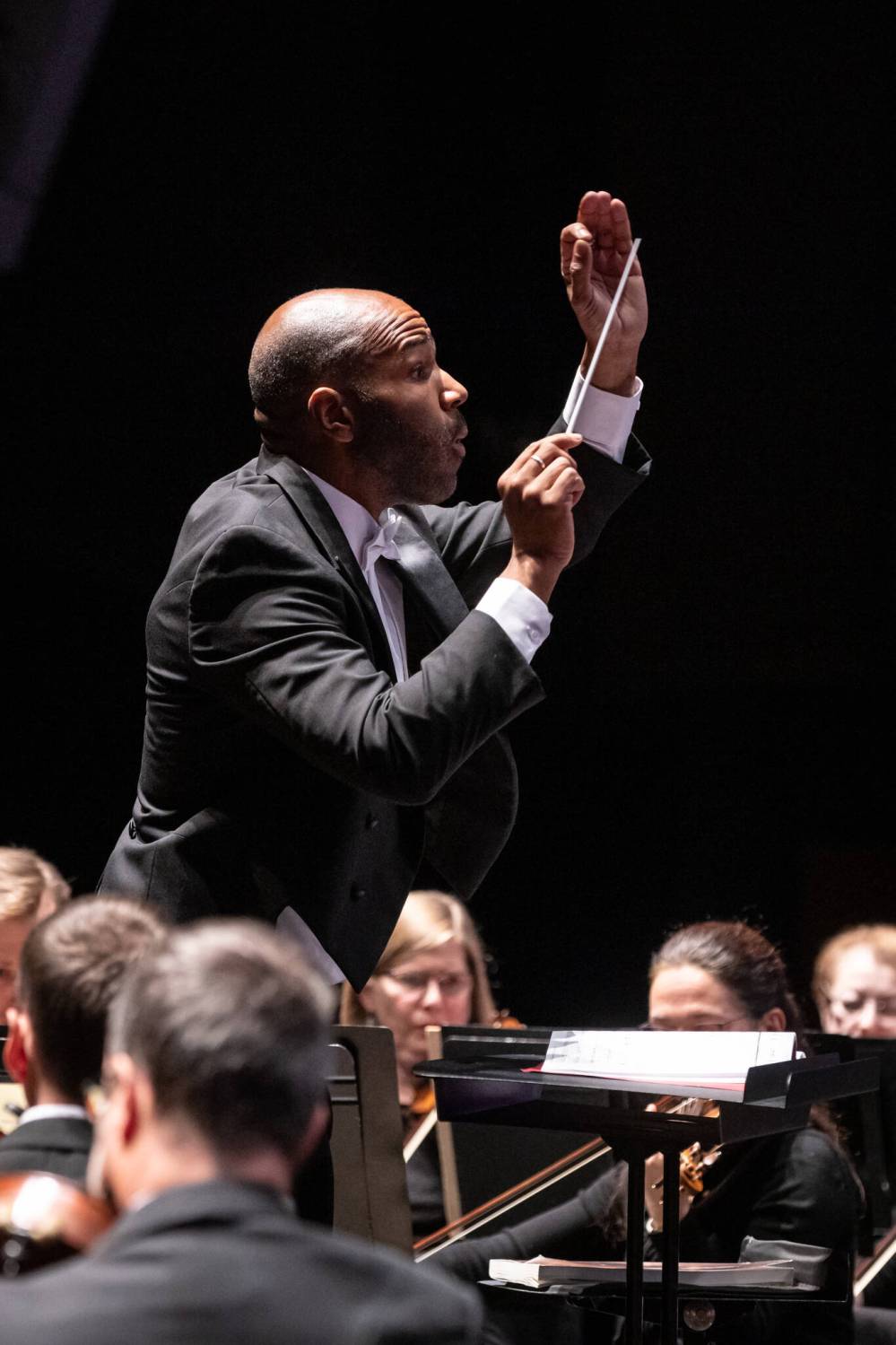
The weekend concert attended by 1,445 listeners also marked the WSO debut of internationally acclaimed Canadian guest conductor Daniel Bartholomew-Poyser, who led the eclectic program featuring more contemporary works alongside classical chestnuts.
Hailed as one of Canada’s most outstanding violinists, WSO concertmaster Gwen Hoebig has graced this stage with her consummate artistry for an astonishing 36 years. Not far behind her, principal cellist Yuri Hooker has lent his refined musicianship to the organization for an equally remarkable 24 years.
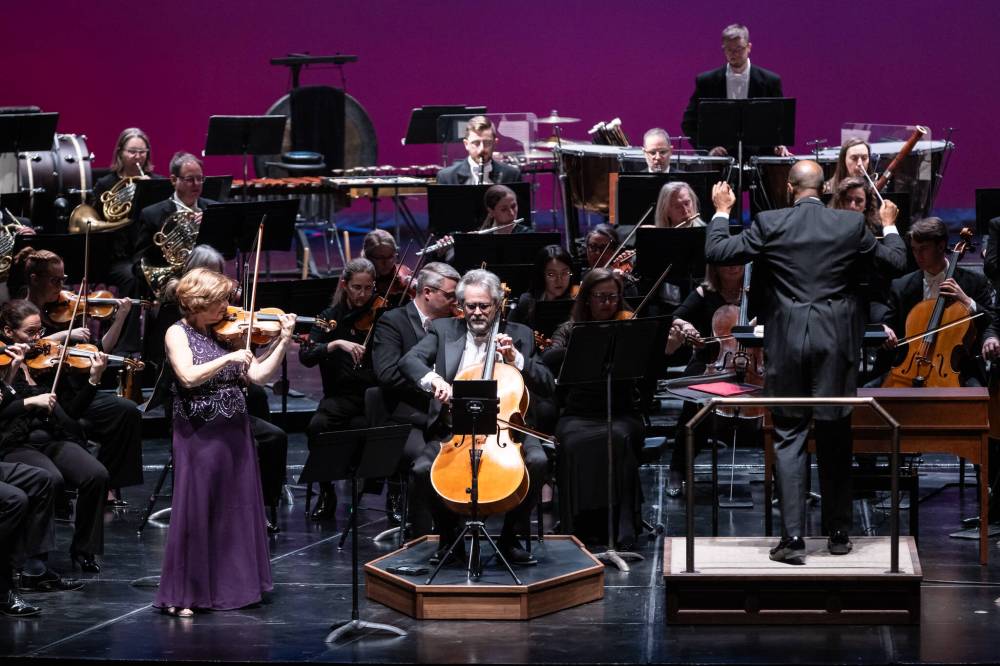
Both players regularly perform together in their own chamber group, the Clearwater Quartet, and their simpatico artistic sensibility and rapport were palpable throughout their performance of Brahms’s mighty Concerto for Violin, Cello and Orchestra in A minor, Op. 102, colloquially known as the “Double.”
Hoebig — who has played this work since her teens — last performed it in 2007 with her U.S.-based brother, cellist Desmond Hoebig; Saturday evening provided an opportunity to hear the German composer’s final concerto played in a “real” concert hall.
Those with long memories will recall the entire orchestra was transplanted to an alternative venue owing to extenuating circumstances for that earlier concert. However, it did not dampen the siblings’ enthralling performance; it remains one of this writer’s favourites.
Following the orchestral tutti’s short introduction during the Allegro, Hooker, in his debut performance of the three-movement work, immediately pounced on his opening declamatory cadenza, though it could have projected more fully.
This led quickly to Hoebig’s own assertive principal theme before the duo entwined their lines together as though in spirited conversation, both infusing their performance with requisite drama and passion, a hallmark of the Romantic-era composer’s style.
The second movement, Andante, provides repose from the previous storms, with the duo now melding their string parts together as equal partners. It also provided greater opportunity to hear Hoebig’s lyrical, singing tone sail over the orchestra, punctuated by Hooker’s defiant cello, which created compelling interplay.
The third movement, Vivace non troppo — a Hungarian-flavoured rondo inspired by the homeland of the work’s original dedicatee, violinist Joseph Joachim — rollicked along, with Hooker tossing off its repetitive, percussive motto with gusto, picked up and matched note for note by Hoebig.
The concerto itself is fraught with perils, not least of all its ferociously difficult technical demands, including knotty quadruple stops and wide leaps across the fingerboard for the cellist.
This particular performance also called for symphony musicians who have built careers perfecting the art of blending in with their section mates to step into the limelight as featured soloists; one can expect Hooker’s interpretation, suffering from slight intonation issues at times in his uppermost register, to grow more assured and luminous in years to come.
Despite these quibbles, these treasured artists received a roaring standing ovation, three curtain calls and and cries of bravo by the enamoured crowd.
Acclaimed Sri Lankan-born Canadian composer Dinuk Wijeratne’s Polyphonic Lively — premièred by Symphony Nova Scotia in 2006 and inspired by Paul Klee’s same-titled painting — would be right at home on the Winnipeg New Music Festival stage.
The maestro kept a firm baton on the musicians throughout the kaleidoscopic work, which bristles with with taut energy, but has too many ideas packed into its 13 minutes; it feels scattershot and just plain exhausting.
The second half of the program featured “Papa” Haydn’s surprisingly tempestuous Symphony No. 39 in G minor, Hob 1:39 as a crisp palate cleanser, before closing with Aaron Copland’s Pulitzer-prize winning Appalachian Spring: Suite, which had its genesis as a ballet score created for legendary American choreographer Martha Graham in 1943-44.
The Calgary-born Bartholomew-Poyser led the players through its programmatic journey of a young pioneer couple’s trials and tribulations living on a Pennsylvanian farm. Its final section, based on the iconic Shaker melody Simple Gifts, was eloquently delivered, including a fine opening solo by principal clarinettist Micah Heilbrunn.
As expected, the audience rose to its feet following an unusually lengthy, hushed pause after the maestro’s baton was laid to rest and the sweet sounds of silence filled the hall.
holly.harris@shaw.ca
Holly Harris writes about music for the Free Press Arts & Life department.
Our newsroom depends on a growing audience of readers to power our journalism. If you are not a paid reader, please consider becoming a subscriber.
Our newsroom depends on its audience of readers to power our journalism. Thank you for your support.