Epic of uncertainty
Sprawling biopic doesn’t seem to know what to make of iconic French emperor

Advertisement
Read this article for free:
or
Already have an account? Log in here »
To continue reading, please subscribe:

Digital Subscription
One year of digital access for only $205*
- Enjoy unlimited reading on winnipegfreepress.com
- Read the E-Edition, our digital replica newspaper
- Access News Break, our award-winning app
- Play interactive puzzles
*First annual payment billed as $205.00 + GST for one year. This annual subscription will automatically renew at $233.00 + GST every 52 weeks (10% off the regular annual price of $259.35). Offer available to new and qualified returning subscribers only. Cancel any time.
To continue reading, please subscribe:
Add Free Press access to your Brandon Sun subscription for only an additional
$1 for the first 4 weeks*
- Enjoy unlimited reading on winnipegfreepress.com
- Read the E-Edition, our digital replica newspaper
- Access News Break, our award-winning app
- Play interactive puzzles
*Your next Brandon Sun subscription payment will increase by $1.00 and you will be charged $17.95 plus GST for four weeks. After four weeks, your payment will increase to $24.95 plus GST every four weeks.
Read unlimited articles for free today:
or
Already have an account? Log in here »
Hey there, time traveller!
This article was published 23/11/2023 (1028 days ago), so information in it may no longer be current.
For the last two centuries, the reputation of Napoleon Bonaparte has fluctuated. Is he a monster, a madman, a master tactician? The scourge of Europe or its liberator? A revolutionary hero or a power-crazed tyrant?
Recently, the man showed up as a joke on the HBO show Succession, when it was revealed that the Napoleonica-obsessed Connor Roy had purchased the French leader’s dried-up penis at auction. There was Old Boney, reduced to being the ridiculous hobby of the series’ silliest character, his manhood compared to “a strip of beef jerky.”
Leave it to veteran helmer Ridley Scott (Alien, Blade Runner, Thelma and Louise, Gladiator) to make Napoleon big again — really big — in a 159-minute saga packed with beauty, blood and spectacle.
Aidan Monaghan / Apple Original Films / Columbia Pictures / Sony Pictures
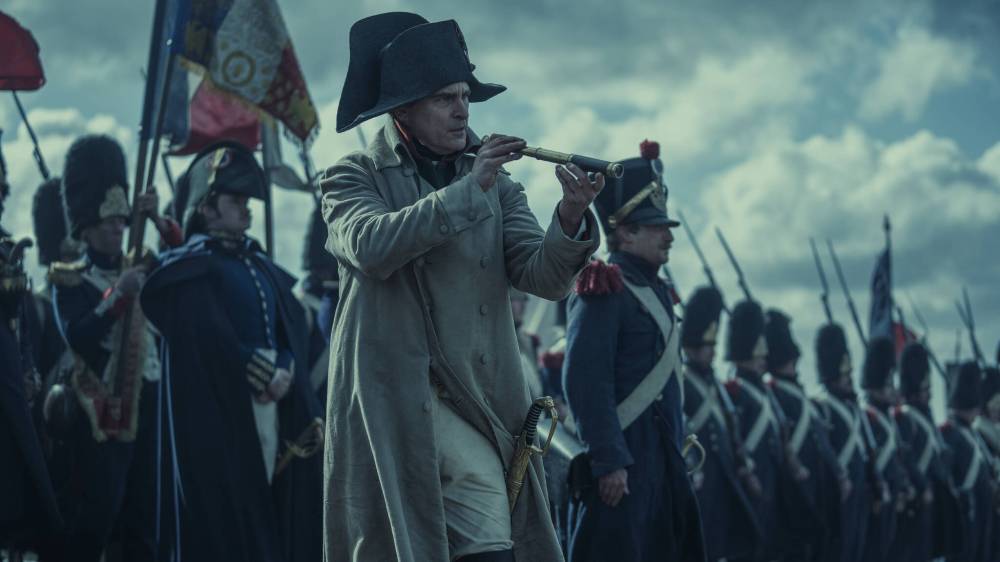
Joaquin Phoenix is hampered by an uneven script in portraying French emperor Napoleon Bonaparte.
Unfortunately, this piece of cinematic Napoleonica is a grand mess of a movie, occasionally astonishing but mostly just confused.
Tracking Napoleon’s swift rise and stretched-out fall, the script from David Scarpa (All the Money in the World and the TV series The Man in the High Castle) feels both packed and oddly empty, too long and not long enough.
We see Napoleon (Joaquin Phoenix of The Master, The Joker, Beau Is Afraid) building on a military victory at the siege of Toulon to rise in the army, then going on to take swathes of Europe and the Middle East. We see him navigating late 18th- and early 19th-century French politics — a quagmire of revolts, uprisings, coups, corruption and rapidly shifting ideals and alliances — to become First Consul and then Emperor.
Even as he’s conquering the world, however, he seems unable to hold the heart of his wife, the shrewd, gorgeously imperious Josephine (The Crown’s Vanessa Kirby).
Their love affair is transformed by Scarpa into a kooky, vaguely kinky psychodrama — at times comically overheated and at points rather poignant. The two meet at the so-called Survivors’ Ball, held by aristocrats who had lived through Robespierre’s Reign of Terror, where Josephine’s prison haircut gives her the look of a punk princess.
Their passionate union soon descends into a cycle of fights and reconciliations, and finally into a kind of parting “for the good of France.” (Gwyneth has nothing on Josephine when it comes to “conscious uncoupling.”)
Kirby, as always, is electrifying to watch, and Phoenix is his unpredictable self, his take on Napoleon feeling modern and weird, given to abrupt tonal detours.
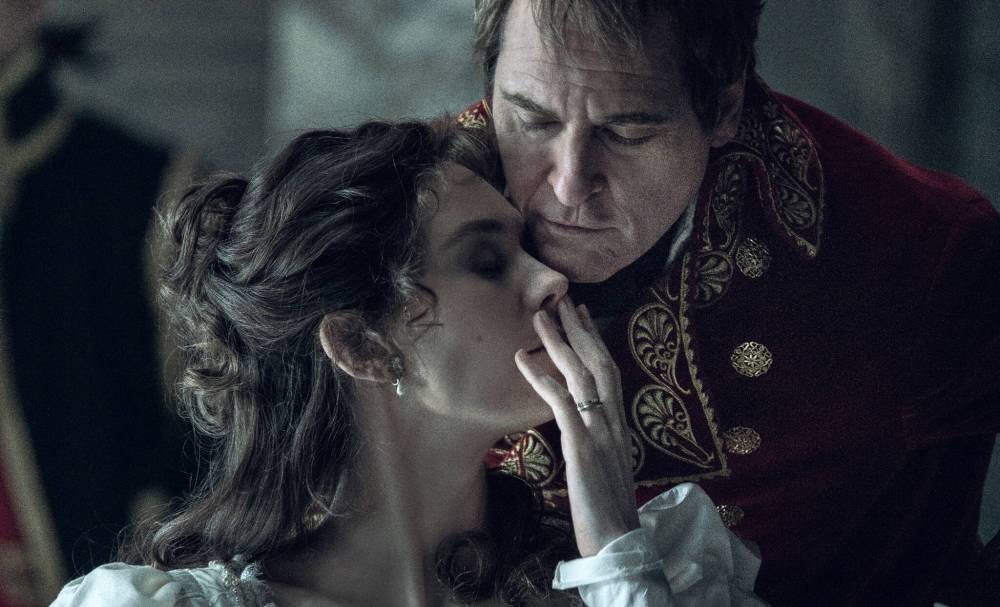
Vanessa Kirby is electrifying as Josephine, Napoleon’s suffering wife.
This approach is fascinating when it works and frustrating when it doesn’t.
“You think you’re so great just because you have boats,” Napoleon bursts out at the British ambassador at one point, sounding like a petulant eight-year-old boy.
One night at the dinner table, he declares, hilariously, that “destiny has brought me this lamb chop.” But is Napoleon in on the joke?
The unevenness in Phoenix’s performance is partly a scripting issue. The film’s sense of its central character, his mission and motives, remains amorphous.
We never really understand what fuels Napoleon’s need for conquest, either politically or psychologically. He wants to prove he’s not “a Corsican ruffian unfit for higher office,” and a brief conversation with his brother suggests he might also be desperate to impress their mother (Sinead Cusack), who has maybe eight lines of dialogue here and still manages to terrify.

But overall, the film doesn’t know what to do with Napoleon. Sometimes it seems like a serious epic designed to shine up his well-established mythology. At other times, it feels like a sneaky comic challenge to the Great Man theory of history, puncturing Napoleon’s sense of world-historical fate — his belief that he is the inheritor of Alexander the Great and Caesar — with glimpses into his awkwardness and overcompensations.
The film is on much firmer ground in its depiction of the military campaigns, where Scott’s craft overcomes Scarpa’s uncertainty. Fans of the Battle of Austerlitz will find everything they want here, and maybe more, as Scott delivers expertly conceived, shot and edited war scenes, created almost entirely with practical effects. There are very few CGI cheats here, with the film using actual human actors, not pixels, to embody the deep horror and visceral physical brutality of war.
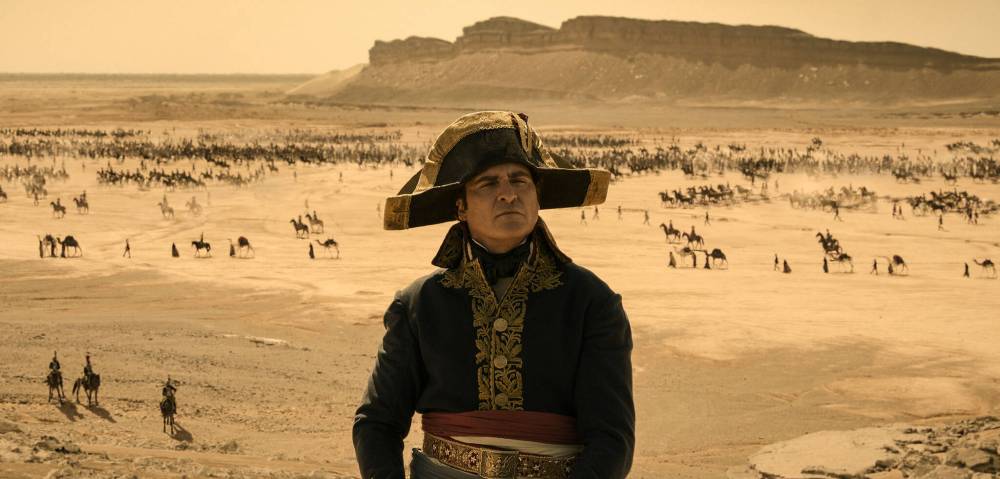
Ridley Scott’s mastery of the widescreen is evident in the carefully crafted battle scenes.
Scott combines the larger sweep of tactics with close, kinetic camerawork that brings the viewer right into the chaos of hand-to-hand combat, with the ugly deaths and the screaming horses slipping in blood.
It’s an accomplishment, but a difficult one to take in at this particular moment. With the world currently at war, real war, some viewers might find these cinematic battle scenes hit differently.
alison.gillmor@winnipegfreepress.com
Studying at the University of Winnipeg and later Toronto’s York University, Alison Gillmor planned to become an art historian. She ended up catching the journalism bug when she started as visual arts reviewer at the Winnipeg Free Press in 1992.
Our newsroom depends on a growing audience of readers to power our journalism. If you are not a paid reader, please consider becoming a subscriber.
Our newsroom depends on its audience of readers to power our journalism. Thank you for your support.
Movie review
Napoleon
Starring Joaquin Phoenix and Vanessa Kirby
● Grant Park, Kildonan Place, McGillivray, Polo Park, St. Vital
● 14 A
● 159 minutes
★★1/2 out of five
Other Voices
There is genuine comedy here and also a real measure of pathos. Too often, though, Napoleon’s withering condemnation of its subject feels less like a meaningful conclusion than a narrative dodge, a convenient way to sidestep a more trenchant, complicated look at Napoleon’s political legacy.
— Justin Chang, Los Angeles Times
Ridley Scott — the Wellington of cinema — has created an outrageously enjoyable cavalry charge of a movie, a full-tilt biopic of 21/2 hours in which Scott doesn’t allow his troops to get bogged down mid-gallop in the muddy terrain of either fact or metaphysical significance, the tactical issues that have defeated other filmmakers.
— Peter Bradshaw, The Guardian
“History,” said Napoleon Bonaparte, “is a set of lies agreed upon.” That sound you hear 200 years later is Ridley Scott banging his fist on a table with appreciation before shooting a scene in which the man known as “The Nightmare of Europe” literally fires a cannon at the Great Pyramid of Giza.
— Adam Nayman, The Ringer
Studying at the University of Winnipeg and later Toronto’s York University, Alison Gillmor planned to become an art historian. She ended up catching the journalism bug when she started as visual arts reviewer at the Winnipeg Free Press in 1992.
Our newsroom depends on a growing audience of readers to power our journalism. If you are not a paid reader, please consider becoming a subscriber.
Our newsroom depends on its audience of readers to power our journalism. Thank you for your support.
Advertisement Advertise With Us
Advertisement Advertise With Us