

Lovers in a dangerous time: telephonic drama daring
AIDS crisis revisited in bold work

Advertisement
Read this article for free:
or
Already have an account? Log in here »
To continue reading, please subscribe:
Monthly Digital Subscription
$0 for the first 4 weeks*
- Enjoy unlimited reading on winnipegfreepress.com
- Read the E-Edition, our digital replica newspaper
- Access News Break, our award-winning app
- Play interactive puzzles
*No charge for 4 weeks then price increases to the regular rate of $19.00 plus GST every four weeks. Offer available to new and qualified returning subscribers only. Cancel any time.
Monthly Digital Subscription
$4.75/week*
- Enjoy unlimited reading on winnipegfreepress.com
- Read the E-Edition, our digital replica newspaper
- Access News Break, our award-winning app
- Play interactive puzzles
*Billed as $19 plus GST every four weeks. Cancel any time.
To continue reading, please subscribe:
Add Free Press access to your Brandon Sun subscription for only an additional
$1 for the first 4 weeks*
*Your next subscription payment will increase by $1.00 and you will be charged $16.99 plus GST for four weeks. After four weeks, your payment will increase to $23.99 plus GST every four weeks.
Read unlimited articles for free today:
or
Already have an account? Log in here »
Hey there, time traveller!
This article was published 28/11/2023 (753 days ago), so information in it may no longer be current.
Eric Plamondon’s Palucheur, a French-language adaptation of the late Robert Chesley’s Jerker, an opus of queer love in San Francisco’s Castro District, is voyeuristic, bold, graphic and unforgettable.
A stubborn candle that refuses to be extinguished, Palucheur — which runs at Théâtre Cercle Molière to Dec. 9 — is a telephonic drama of tenuous connection and the fantasy of liberation, its source material written in the mid-1980s as contemporaneous documentary evidence of love at a time of excruciating, all-encompassing grief.
In 1985, according to the Centers for Disease Control, there was an 89 per cent increase in AIDS diagnoses in the United State over the year before. The mortality rate for adults with AIDS was 51 per cent.
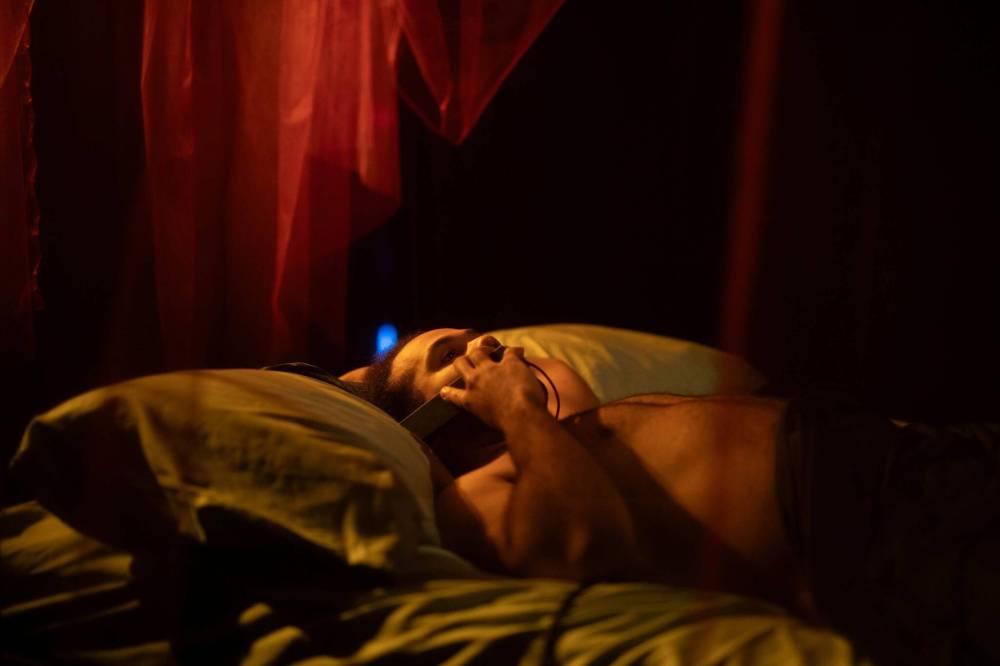
Sarah Lamontagne photo
David Bélizaire as Mike in Eric Plamondon’s Palucheur, a French-language adaptation of the late Robert Chesley’s Jerker.
One in two.
This is the world in which Mike and J.R. (remarkably and bravely embodied by David Bélizaire and Sébastien Bertrand) exist. Both arrived in the Castro years earlier in the afterglow of Stonewall and before Harvey Milk was met with bullets. For a few years, they enjoyed the riches of a cobblestoned village, roaming to the top of San Francisco’s rolling hills after years spent defiantly climbing upward.
That peak was short-lived.
Now, Mike and J.R. find themselves alone in their own beds, paralyzed by an unspoken fear that they might never again find meaningful connection, their freedom shackled by an unforgiving retrovirus that arrives with the authority of a death sentence.
Palucheur begins when Bertrand’s J.R., wearing nothing but yellow short-shorts and an “obligatory moustache”, picks up his rotary phone and dials a number given to him weeks earlier at the club by Bélizaire’s Mike, a much younger man who doesn’t remember handing out his digits.
Mike picks up, half-asleep, and within a few short exchanges, he and J.R. are having phone sex, beginning a series of 20 conversations that are by turns sexual, convivial, breathless, life-affirming and utterly devastating.
The calls spare no detail — they’re raw, unvarnished, descriptive and messy — and are not written with the prude in mind. During Saturday night’s show, one couple got up and left right before Mike’s first orgasm, which comes four minutes into the show.
It’s a shame, because they missed out on a delicate love story of safe sex transcribed in reverse, beginning with pleasure and ending in pain, opening with a diamond-clear ring and ending with the flatline of a dial tone.
Chesley’s original script and adaptor-director Plamondon’s 105-minute version (without intermission) rely heavily on gradual exposition, requiring an audience prepared to bear witness and not look away.
Staged in a bi-frontal orientation, Palucheur seats audience members in three rows on either lengthwise side of Joe Kalturnyk’s set, a pair of queen-size beds facing each other toe to toe. J.R. and Mike can’t see each other, but the audience can see everything, peering through layers of red tulle that evoke a harem, a canopy and a silo, dividing the two actors into opposing chambers of the heart.
By retaining a sense of shared anonymity between his stars and granting the audience a voyeuristic vantage point, director Plamondon reminds us of the privilege of the freedom of sexuality, which Mike and J.R. no longer can enjoy. Even as their love story develops, they never even suggest meeting one another.
Bélizaire and Bértrand, who are both completely naked at times, deserve applause for their honesty, tenderness and passion. Their phone calls, given even more electricity by the static hum of microphones placed on the receivers, don’t waste breath, and the actors dance through challenging erotic dialogue that serves as verbal epistolary art.

Sarah Lamontagne photo
Admist the AIDS crisis, Sébastien Bertrand as J.R. can only talk to his lover on the phone.
They give themselves over fully to the work, which is lit by Max Mummery’s lighting design, both ominous and serene. After the seventh phone call, sumptuous red and orange are replaced by the clinical glow of a fluorescent light, dangling above both beds.
The mood is often informed by sound designer Sarah Michaelson’s score, which thrums from nightclub to fairy-tale forest. If one doesn’t need to follow along with the English transcription, it is revealing to simply listen to J.R. and Mike’s conversation as it rests atop Michaelson’s sonic bedding.
Divided into 20 chapters, J.R. and Mike’s relationship is as much about brotherhood as it is about romantic fantasy, a truth that feels at first transgressive but reveals itself to be necessary. These men have no choice but to rely on the power of imagination in the face of fear.
“A friend told me yesterday that when he jerks off, he imagines it’s four or five years ago, before all this,” J.R. tells Mike. “He can’t even fantasize about a man unless it’s before … our current situation.
“He’s scared, too. So what does that leave us? Not much.
“Except maybe the best thing, the thing that can’t be destroyed,” J.R. continues.
“Caring for each other. Even if we’re all doomed. Loving can’t be killed. It’s stronger than death. That’s why even if I can’t hold you in my arms, just telling you that I want to … It’s something. It helps.”
All performances are subtitled in English and French. Reserve tablets for subtitles at 204-233-8053.
ben.waldman@winnipegfreepress.com
Ben Waldman is a National Newspaper Award-nominated reporter on the Arts & Life desk at the Free Press. Born and raised in Winnipeg, Ben completed three internships with the Free Press while earning his degree at Ryerson University’s (now Toronto Metropolitan University’s) School of Journalism before joining the newsroom full-time in 2019. Read more about Ben.
Every piece of reporting Ben produces is reviewed by an editing team before it is posted online or published in print — part of the Free Press‘s tradition, since 1872, of producing reliable independent journalism. Read more about Free Press’s history and mandate, and learn how our newsroom operates.
Our newsroom depends on a growing audience of readers to power our journalism. If you are not a paid reader, please consider becoming a subscriber.
Our newsroom depends on its audience of readers to power our journalism. Thank you for your support.
Theatre review
Palucheur
● Théâtre Cercle Molière
● To Dec. 9
● Tickets at cerclemoliere.com
★★★★1/2 out of five
Ben Waldman is a National Newspaper Award-nominated reporter on the Arts & Life desk at the Free Press. Born and raised in Winnipeg, Ben completed three internships with the Free Press while earning his degree at Ryerson University’s (now Toronto Metropolitan University’s) School of Journalism before joining the newsroom full-time in 2019. Read more about Ben.
Every piece of reporting Ben produces is reviewed by an editing team before it is posted online or published in print — part of the Free Press‘s tradition, since 1872, of producing reliable independent journalism. Read more about Free Press’s history and mandate, and learn how our newsroom operates.
Our newsroom depends on a growing audience of readers to power our journalism. If you are not a paid reader, please consider becoming a subscriber.
Our newsroom depends on its audience of readers to power our journalism. Thank you for your support.
Advertisement Advertise With Us
Advertisement Advertise With Us