Shape-shifting landscape beautiful and foreboding
Exhibition highlights changes in Canada’s North

Advertisement
Read this article for free:
or
Already have an account? Log in here »
To continue reading, please subscribe:

Digital Subscription
One year of digital access for only $205*
- Enjoy unlimited reading on winnipegfreepress.com
- Read the E-Edition, our digital replica newspaper
- Access News Break, our award-winning app
- Play interactive puzzles
*First annual payment billed as $205.00 + GST for one year. This annual subscription will automatically renew at $233.00 + GST every 52 weeks (10% off the regular annual price of $259.35). Offer available to new and qualified returning subscribers only. Cancel any time.
To continue reading, please subscribe:
Add Free Press access to your Brandon Sun subscription for only an additional
$1 for the first 4 weeks*
- Enjoy unlimited reading on winnipegfreepress.com
- Read the E-Edition, our digital replica newspaper
- Access News Break, our award-winning app
- Play interactive puzzles
*Your next Brandon Sun subscription payment will increase by $1.00 and you will be charged $17.95 plus GST for four weeks. After four weeks, your payment will increase to $24.95 plus GST every four weeks.
Read unlimited articles for free today:
or
Already have an account? Log in here »
Hey there, time traveller!
This article was published 30/11/2023 (1018 days ago), so information in it may no longer be current.
When one lingers on Robert Kautuk’s 2020 work Ice Break (instead of Iceberg), an aerial photograph layered over a light box, the sea ice starts to shapeshift into other things.
It looks like a fragment of bone, a whale’s vertebrae perhaps, stark white against an inky pool of darkness. Or it looks like a rock hurtling through outer space, a Star Wars set piece leaving behind a constellation of stars in its aquamarine wake.
Sea ice is a dynamic photography subject. It’s also a dramatic harbinger of climate change.

Robert Kautuk’s Ice Break (instead of Iceberg) is a photo taken by a drone in 2020.
Both of those ideas come together in Dark Ice, a touring exhibition by the Ottawa Art Gallery on view now at WAG-Qaumajuq.
Curated by the OAG’s Rebecca Basciano, Dark Ice features the work of Kautuk, a Kangiqtugaapik, Nunavut-based photographer who uses drones to capture aerial photographs and videos of his community, and Ottawa’s Leslie Reid, an established painter and photographer whose work focuses on the North.
A sense of urgency hums through Dark Ice. The effects of climate change are intensely visual up north, which makes them much more difficult to ignore.
“I think a lot of people down south can just slough it off,” Basciano says over the phone from Ottawa. “But Inuit are at the forefront of what is happening and they’re seeing these changes a lot more rapidly.
“The problem is, a lot of researchers go up north and gather all this data, and then don’t share it with those communities.”
This, Basciano points out, is a lingering effect of colonization, where knowledge becomes yet another resource to extract.
Projects, even well-meaning ones, might be set up without community consultation, or they disturb wildlife instead of observing it.
Basciano hopes the exhibition can be an example of a way forward, a dialogue between North and South, Inuit and settlers.
“Hopefully, the images grip the visitor and draw them into a conversation that’s very complex,” she says.
Neither artist had worked together or exhibited together prior to Dark Ice. Kautuk works at the Ittaq Heritage and Research Centre, where he encourages Inuit-led research.
Reid, meanwhile, has conducted research in the Arctic through the Canadian Forces Artists Program and the Canada C3 expedition. While the pair bring different perspectives to their shared subject matter, their works are in seamless conversation with each other.
Basciano had been talking to Reid about showing her northern-focused work.
“Her father was an RCAF pilot who took aerial mapping pictures of the North, so she’s always had this in her mind to retrace his flights and delve into this.”
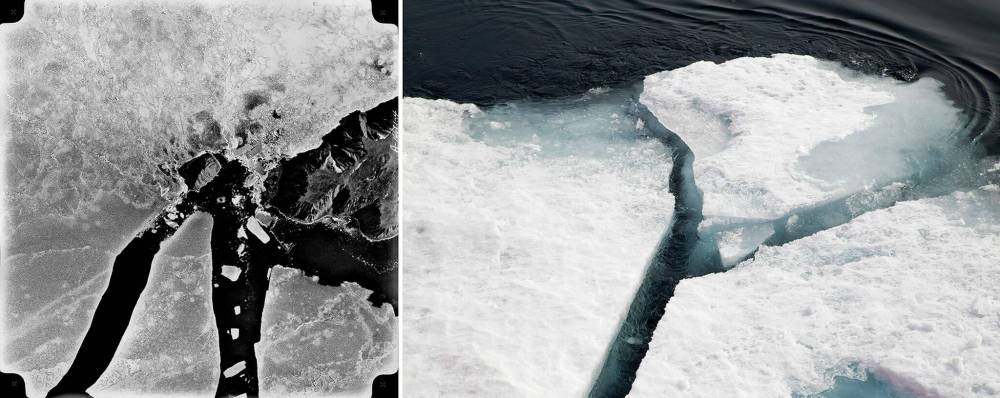
Leslie Reid’s Through Time, Through Space 2, 2020.
Neither Reid nor Basciano was interested in telling the story of climate change in the North without including an Inuit perspective.
“We would just be following the footsteps of the past, instead of making a change,” Basciano says.
And so, Basciano tapped Kautuk, whose work she was familiar with — particularly his aerial shot of hunters preparing walruses, the bright-red blood cutting dramatic swaths over the snow and pooling in the water like a bruise. (That 2016 piece, After Cutting Up Two Walruses, Iglulik, is on view in Dark Ice.)
Right away, he was on board.
“Robert has never been a part of an exhibition before, in the sense that he had never printed his work,” Basciano says. “He’s so used to seeing images digitally or as part of magazines and newspapers. He’s been on the cover of Inuit Art Quarterly, we’ve seen his work everywhere, but it’s really hard to print up north.”

Dark Ice uses light boxes to striking effect; the backlit glow through the ice adds another dimension to the photographs.
Basciano urges viewers to look for those contrasts.
“There’s light and dark, fragility and strength. There’s cycles — geological cycles, but also seasons, day and night. I think the beauty comes through in the contrasts,” she says.
Basciano will be hosting a curator talk tonight at 6 p.m. at WAG-Qaumajuq, with light refreshments served beforehand. The event is open to the public and included with regular admission.
jen.zoratti@winnipegfreepress.com
Jen Zoratti is a columnist and feature writer working in the Arts & Life department, as well as the author of the weekly newsletter NEXT. A National Newspaper Award finalist for arts and entertainment writing, Jen is a graduate of the Creative Communications program at RRC Polytech and was a music writer before joining the Free Press in 2013. Read more about Jen.
Every piece of reporting Jen produces is reviewed by an editing team before it is posted online or published in print – part of the Free Press‘s tradition, since 1872, of producing reliable independent journalism. Read more about Free Press’s history and mandate, and learn how our newsroom operates.
Our newsroom depends on a growing audience of readers to power our journalism. If you are not a paid reader, please consider becoming a subscriber.
Our newsroom depends on its audience of readers to power our journalism. Thank you for your support.
Exhibition preview
Dark Ice
By Leslie Reid and Robert Kautuk
● WAG-Qaumajuq
● To May 26, 2024
Jen Zoratti is a columnist and feature writer working in the Arts & Life department, as well as the author of the weekly newsletter NEXT. A National Newspaper Award finalist for arts and entertainment writing, Jen is a graduate of the Creative Communications program at RRC Polytech and was a music writer before joining the Free Press in 2013. Read more about Jen.
Every piece of reporting Jen produces is reviewed by an editing team before it is posted online or published in print – part of the Free Press‘s tradition, since 1872, of producing reliable independent journalism. Read more about Free Press’s history and mandate, and learn how our newsroom operates.
Our newsroom depends on a growing audience of readers to power our journalism. If you are not a paid reader, please consider becoming a subscriber.
Our newsroom depends on its audience of readers to power our journalism. Thank you for your support.
Advertisement Advertise With Us
Advertisement Advertise With Us