Some kind of wonderful
Carole King musical a greatest hits package

Advertisement
Read this article for free:
or
Already have an account? Log in here »
To continue reading, please subscribe:
Digital Subscription
One year of digital access for only $1.44 a week*
- Enjoy unlimited reading on winnipegfreepress.com
- Read the E-Edition, our digital replica newspaper
- Access News Break, our award-winning app
- Play interactive puzzles
*Billed as $5.77 plus GST every four weeks. After 52 weeks, price increases to the regular rate of $19.95 plus GST every four weeks. Offer available to new and qualified returning subscribers only. Cancel any time.
To continue reading, please subscribe:
Add Free Press access to your Brandon Sun subscription for only an additional
$1 for the first 4 weeks*
- Enjoy unlimited reading on winnipegfreepress.com
- Read the E-Edition, our digital replica newspaper
- Access News Break, our award-winning app
- Play interactive puzzles
*Your next Brandon Sun subscription payment will increase by $1.00 and you will be charged $17.95 plus GST for four weeks. After four weeks, your payment will increase to $24.95 plus GST every four weeks.
Read unlimited articles for free today:
or
Already have an account? Log in here »
Hey there, time traveller!
This article was published 12/01/2024 (1013 days ago), so information in it may no longer be current.
If a 16-year-old Carol Klein had started her career as a songwriter in 2024, she might have uploaded a sing-along version of It Might as Well Rain Until September to her TikTok account and hoped for the best.
Thankfully, that’s not the story told in Beautiful, the Royal Manitoba Theatre Centre and Segal Centre’s soaring chronicle of collaboration, partnership and the creative explosion made possible by waves meeting at exactly the right time, in precisely the right place, leading to a sonic boom in the American pop music canon.
When Carol affixed an ’e’ to the end of her given name and changed her surname to King, it was still the late 1950s, and the plucky, spotlight-weary New Yorker — played here with modest panache, gentle power and natural virtuosity by Tess Benger — could still march into the offices of Aldon Music, a pop-music factory churning out hits as the music world underwent a mid-century industrial revolution.

EMELIA HELLMAN PHOTO
Tess Benger plays Carole King in Beautiful
When Benger’s King arrives at Aldon to meet exec Donny Kirshner (a lovely Cory Wojcik, playing the famed executive as a rose with false thorns) she sells her first song on the spot. There’s something more human, more direct and more thrilling about this anti-algorithmic transaction: it’s a story that King repeatedly willed into existence.
Directed with sharply observed humour by RMTC artistic director Kelly Thornton, with musical direction by Floydd Ricketts, Beautiful is a nostalgic testament to the power of creative risk-taking and artistic vulnerability. It’s also a subtle tribute to working motherhood and a keen, toe-tapping reminder that the term “solo artist” is an illusory concept.
Beautiful runs through the impressive songwriting output of King and her lyricist husband Gerry Goffin (Darren Martens, taking on an ethically challenging role with guts) from their Brill Building heyday through the release of King’s Grammy-winning breakthrough Tapestry. But unlike other “jukebox” musicals such as Mamma Mia!, built around the songs of ABBA, Beautiful emphasizes the creative process behind the hits, presenting each of its nearly 30 songs and musical snippets as they are conceptualized and realized by King, Goffin and their scene-stealing colleagues Cynthia Weil and Barry Mann (a marvellous Laura Olafson and a surprisingly sensitive Mike Melino).
In the lead role, Benger is sunny and warm, evoking the exact range of emotions audiences feel when listening to King’s music. Like Benger, Olafson, one of the city’s most consistently excellent performers, has immaculate chemistry with each of her co-stars. Weil and Mann are fashioned in the tradition of writing partners such as Adolph Green and Betty Comden, jostling and teasing one another like that duo’s on-screen stand-ins Oscar Levant and Nanette Fabray in the Fred Astaire-starring Broadway satire The Band Stand, another story about the music industry in transition.
As much as the production is defined by its musical numbers, under Thornton’s direction, there is no forgetting the creation of that art is labour-intensive, not snatched from thin air but summoned from lived experience. Each song produced by King, Goffin, Weil and Mann are drawn from their own relationships and struggles.
When she sits at the piano, Benger is usually positioned with her side facing the audience, revealing a crouched-over physicality instantly recognizable to any worker who’s ever clacked away at a keyboard. And when Martens’ Goffin is stuck, he lays down on the couch to close his eyes and think. Viewed together, the two postures highlight the bodily and spiritual impact of the creative act.
During the production’s first act, as King and Goffin remain behind the scenes, many of their songs are performed for a who’s-who of 1960s Black pop groups, including the Drifters and the Shirelles, who sing Some Kind of Wonderful and Will You Still Love Me Tomorrow? It’s during these group performances when the work of choreographer Jaz Sealey shines as brightly as Hugh Conacher’s flashy lighting design.
Sealey, a Broadway veteran late of the Royal Winnipeg Ballet, nails the gestural peculiarities of the era’s style of group choreography, an often restrictive, yet highly replicable form of touch-and-go footwork designed for mass appeal. Performer Jeremy Carver-James deserves recognition for his witty, effusive brand of movement, a glowing physical embodiment of the genre fluidity inherent to that era’s sound that captures precisely what Sealey intended.
The sound is made possible by Ricketts’ ensemble, including keyboardists Andrew St. Hilaire and Rachel Cameron, drummer Brendan Thompson, bassist Julian Bradford, trumpeter Shane Hicks and Janice Finlay on the reeds. Jazz guitarist Larry Roy was the perfect choice.
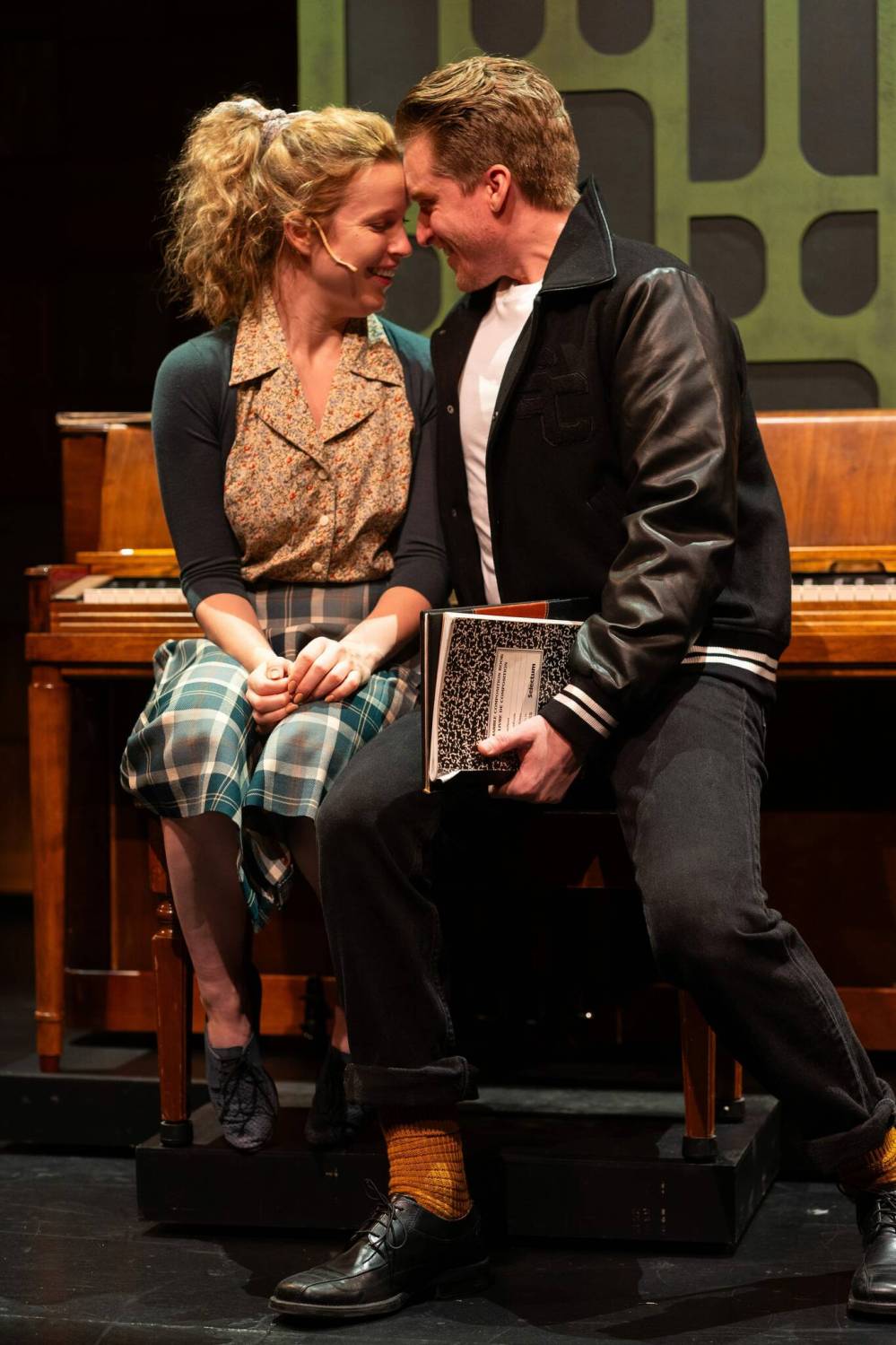
EMELIA HELLMAN PHOTO
King (Benger) and Gerry Goffin (Darren Martens) wrote numerous hits together.

(One musical nit to pick: during Benger’s first “live” performance at the Bitter End, she is backed by cast members “playing” their instruments; it would benefit the production to fine-tune the miming).
Set designer Gillian Gallow, who designed last season’s maximalist Into the Woods fantasy land, leans into the era’s textures and materials with parquet dividers in the Aldon headquarters and shimmering backdrops. Gallow’s wisest move was to find a visual harmony between the vertical configuration of the New York City skyline and the thrumming, colourful blocks that depict audio equalization levels.
The technical components of this production, including Louise Bourret’s impressive array of costumes, live up to the requirements of a big, mid-century musical that could stack up to the genre’s heyday, while also giving the King catalogue a rightful showcase.
See it before it’s too late, baby.
ben.waldman@winnipegfreepress.com
Ben Waldman is a National Newspaper Award-nominated reporter on the Arts & Life desk at the Free Press. Born and raised in Winnipeg, Ben completed three internships with the Free Press while earning his degree at Ryerson University’s (now Toronto Metropolitan University’s) School of Journalism before joining the newsroom full-time in 2019. Read more about Ben.
Every piece of reporting Ben produces is reviewed by an editing team before it is posted online or published in print — part of the Free Press‘s tradition, since 1872, of producing reliable independent journalism. Read more about Free Press’s history and mandate, and learn how our newsroom operates.
Our newsroom depends on a growing audience of readers to power our journalism. If you are not a paid reader, please consider becoming a subscriber.
Our newsroom depends on its audience of readers to power our journalism. Thank you for your support.
THEATRE REVIEW
BEAUTIFUL: THE CAROLE KING MUSICAL
● Royal Manitoba Theatre Centre Mainstage
● Runs to Feb. 3
★★★★½ out of five
Ben Waldman is a National Newspaper Award-nominated reporter on the Arts & Life desk at the Free Press. Born and raised in Winnipeg, Ben completed three internships with the Free Press while earning his degree at Ryerson University’s (now Toronto Metropolitan University’s) School of Journalism before joining the newsroom full-time in 2019. Read more about Ben.
Every piece of reporting Ben produces is reviewed by an editing team before it is posted online or published in print — part of the Free Press‘s tradition, since 1872, of producing reliable independent journalism. Read more about Free Press’s history and mandate, and learn how our newsroom operates.
Our newsroom depends on a growing audience of readers to power our journalism. If you are not a paid reader, please consider becoming a subscriber.
Our newsroom depends on its audience of readers to power our journalism. Thank you for your support.
Related Articles
Tess Benger chats about the challenges and rewards of playing Carole King in RMTC's Beautiful
Advertisement Advertise With Us
Advertisement Advertise With Us