Fit to a tea
With finger sandwiches and luscious pastries, afternoon tea is not something to be rushed

Advertisement
Read this article for free:
or
Already have an account? Log in here »
To continue reading, please subscribe:
Digital Subscription
One year of digital access for only $1.44 a week*
- Enjoy unlimited reading on winnipegfreepress.com
- Read the E-Edition, our digital replica newspaper
- Access News Break, our award-winning app
- Play interactive puzzles
*Billed as $5.77 plus GST every four weeks. After 52 weeks, price increases to the regular rate of $19.95 plus GST every four weeks. Offer available to new and qualified returning subscribers only. Cancel any time.
To continue reading, please subscribe:
Add Free Press access to your Brandon Sun subscription for only an additional
$1 for the first 4 weeks*
- Enjoy unlimited reading on winnipegfreepress.com
- Read the E-Edition, our digital replica newspaper
- Access News Break, our award-winning app
- Play interactive puzzles
*Your next Brandon Sun subscription payment will increase by $1.00 and you will be charged $17.95 plus GST for four weeks. After four weeks, your payment will increase to $24.95 plus GST every four weeks.
Read unlimited articles for free today:
or
Already have an account? Log in here »
Hey there, time traveller!
This article was published 17/01/2024 (1005 days ago), so information in it may no longer be current.
LIMERICK, Ireland — No pinkies were harmed in the taking of afternoon tea.
It’s a culinary event that’s either casual or formal, depending on venue, but either way, it’s considered rude and elitist to poke out your pinkie whilst taking a sip.
What is good form, however, is setting aside a fair amount of time. This isn’t espresso in Italy, where you buy, gulp and go. Afternoon tea is a relaxed social event that takes time, if for nothing else to sample the many delicacies served.
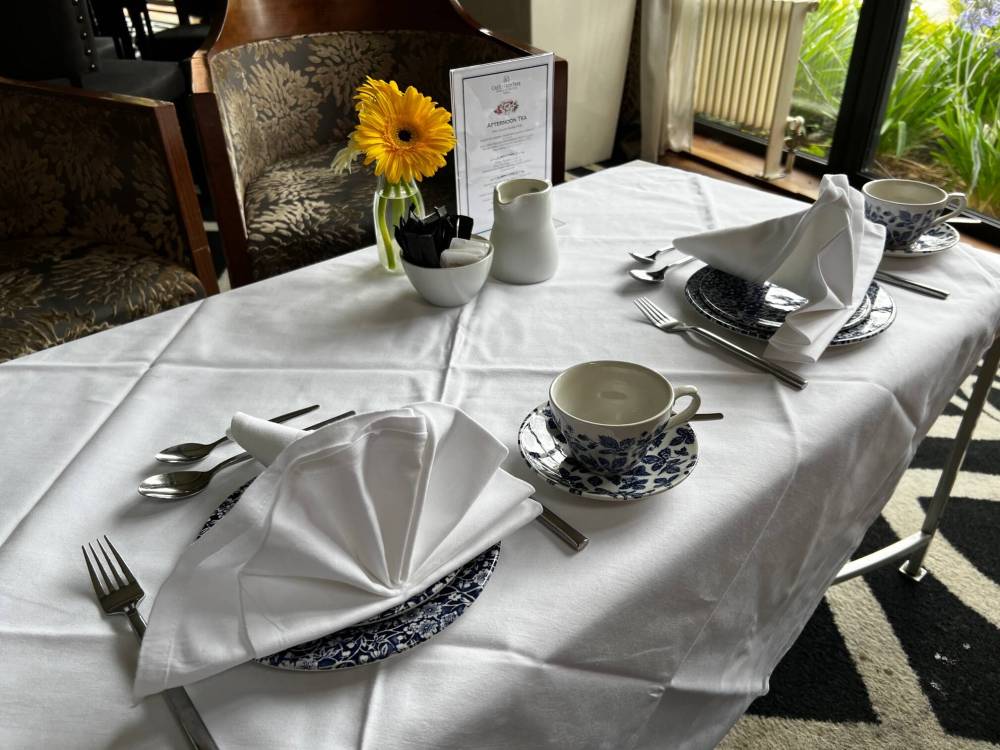
Kelly Taylor / Winnipeg Free Press
At the Castletroy Park Hotel, guests for tea are greeted by an elegant service of fine china and silverware.
Kara Huxley, waitress for the Castletroy Park Hotel on the outskirts of this western Ireland city, says it takes at least an hour, if not more, to fully enjoy the experience.
“Afternoon tea is not something to be rushed,” she says in a thick accent that barely acknowledges the ‘h’ in the ‘th’ combination.
Huxley has spent the last five years as a server specializing in afternoon tea, and the hotel made her available for an interview and provided a sampling of the day’s offerings. The tea was actually late morning, to accommodate Huxley’s expected busy time shortly after lunch.
Of course, the central ingredient to an afternoon tea is tea, and making it right requires some attention to detail. First, start with fresh, cold water. Then bring it to a hard, rolling boil before taking it off the heat and letting it cool for two minutes, Huxley says.
While it’s boiling, heat your tea pot and cups so they preserve the temperature of the tea when served.
When the boiled water has cooled slightly, she’ll pour it over the leaves or tea bag and let it steep for as much as three minutes.
The choice of tea is important: Irish afternoon tea is the blend of choice for this event.
“It’s a smoother, golden blend that goes really well with the pastries,” she says.
Kelly Taylor / Winnipeg Free Press
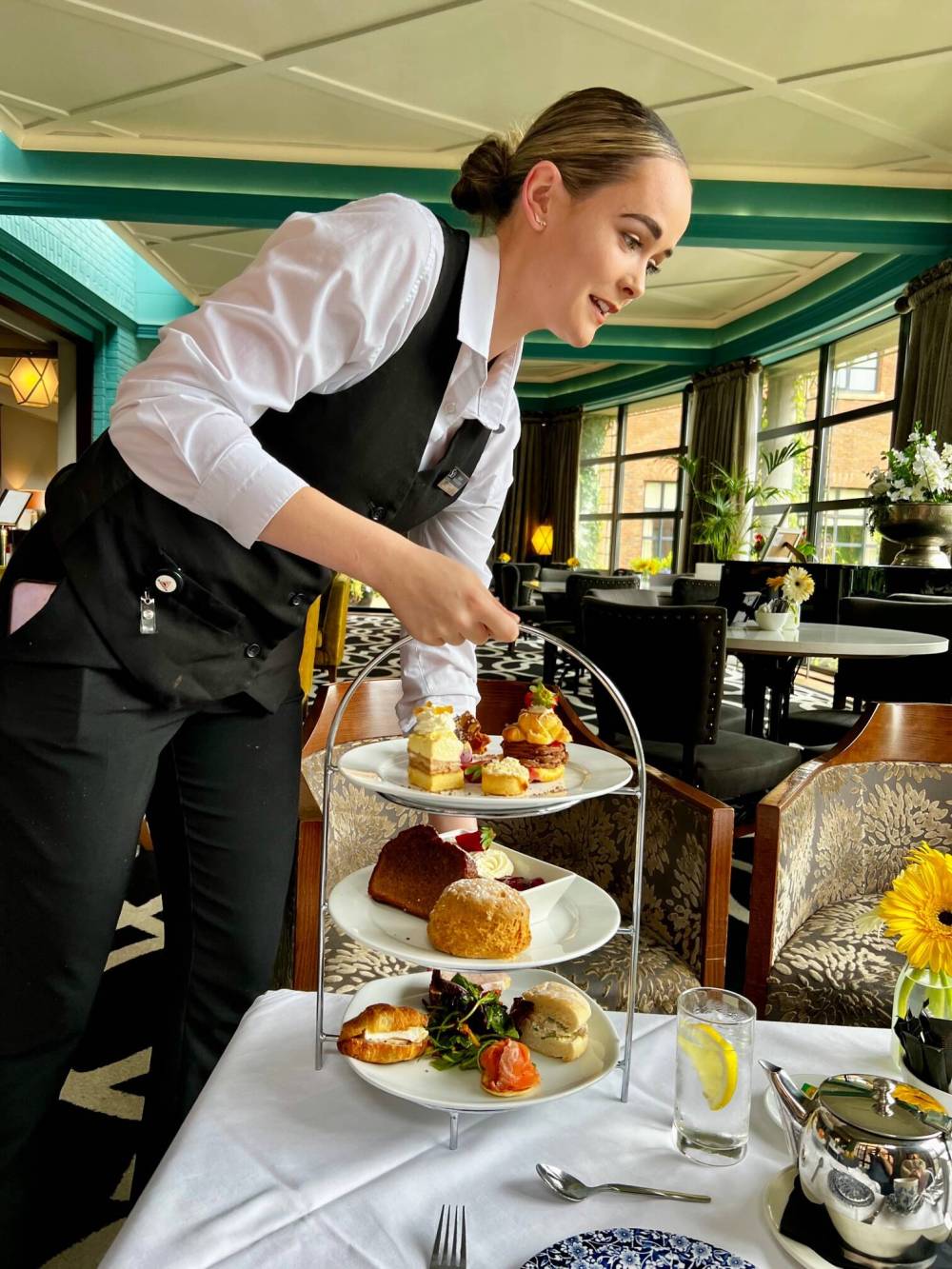
Kara Huxley, waitress at the Castletroy Park Hotel in Limerick, Ireland, brings a tower of treats to the table.
The day’s offerings are detailed on a menu placed on the table. At the Castletroy, on the day of our visit in July, afternoon tea was a fixed €29.95 (CDN$44) per person, or €36.95 (CDN$54) with a glass of prosecco.
Today, the starter is a palate cleanser of pina colada sorbet. On the top of the tiered serving arrangement (see photo) are a lemon blueberry dome with almond biscuit, earl grey mousse strawberry puff, mango and milk chocolate gateaux and a mini apple tart. On the middle tier are a fresh scone, chai tea cake and whipped cream and fruit compote. The bottom tier is savoury: smoked salmon blini with cream cheese, chicken and spring onion mayo on a mini brioche bun, honey glazed Limerick ham with red onion relish on brown soda bread and a turkey, brie and cranberry croissant.
The offerings are doubled when the tray is filled for two people.
The day’s selections are chosen in the morning when the chef and pastry chef start their preparations and rotate regularly, Huxley says.
A week later, my wife and I were in Belfast, at the Europa Hotel. This hotel, during the worst of The Troubles, became the world’s most bombed hotel, typically car bombs parked outside. It served as a media centre for journalists covering the clashes between Crown loyalists and independence fighters. Today, as then, it’s one of Belfast’s top hotels.
It also offers afternoon tea, which we ordered.

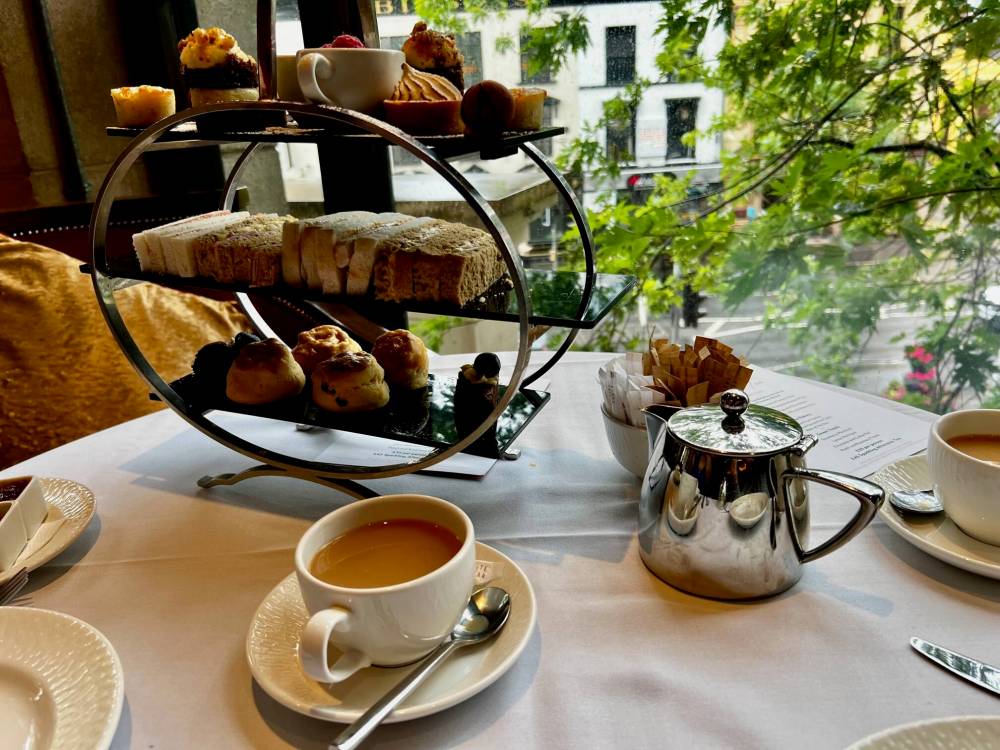
For this service, food items came similarly on a three-tiered serving: the middle tier was savoury, with finger sandwiches of egg salad, chicken and mayo, smoked salmon and cured ham and mustard. Scones and tea cake were on the bottom tier and lemon tarts, macarons and chocolate mousse on the top tier.
Kelly Taylor / Winnipeg Free Press
At Belfast’s Europa Hotel, afternoon tea is served overlooking Great Victoria Street, and similar to the Castletroy, features an assortment of pastries and finger sandwiches.
The history of afternoon tea, or tea as a meal in general, dates back centuries. Wikipedia describes afternoon tea as “a light meal typically eaten between 3:30 and 5 p.m.” Wikipedia also credits the seventh Duchess of Bedford, Anna Maria Russell, one of Queen Victoria’s ladies-in-waiting, as the inventor.
It began, largely, because the traditions at the time were to eat supper later, often as a light meal, so to tide tea-goers over until then. Luncheons were the big meal of the day, so tea would often be served at 5 p.m.
Today, tea is served typically between noon and 4 p.m.
kelly.taylor@freepress.mb.ca
Kelly Taylor
Copy Editor, Autos Reporter
Kelly Taylor is a copy editor and award-winning automotive journalist, and he writes the Free Press‘s Business Weekly newsletter. Kelly got his start in journalism in 1988 at the Winnipeg Sun, straight out of the creative communications program at RRC Polytech (then Red River Community College). A detour to the Brandon Sun for eight months led to the Winnipeg Free Press in 1989. Read more about Kelly.
Every piece of reporting Kelly produces is reviewed by an editing team before it is posted online or published in print — part of the Free Press‘s tradition, since 1872, of producing reliable independent journalism. Read more about Free Press’s history and mandate, and learn how our newsroom operates.
Our newsroom depends on a growing audience of readers to power our journalism. If you are not a paid reader, please consider becoming a subscriber.
Our newsroom depends on its audience of readers to power our journalism. Thank you for your support.
Kelly Taylor
Copy Editor, Autos Reporter
Kelly Taylor is a copy editor and award-winning automotive journalist, and he writes the Free Press‘s Business Weekly newsletter. Kelly got his start in journalism in 1988 at the Winnipeg Sun, straight out of the creative communications program at RRC Polytech (then Red River Community College). A detour to the Brandon Sun for eight months led to the Winnipeg Free Press in 1989. Read more about Kelly.
Every piece of reporting Kelly produces is reviewed by an editing team before it is posted online or published in print — part of the Free Press‘s tradition, since 1872, of producing reliable independent journalism. Read more about Free Press’s history and mandate, and learn how our newsroom operates.
Our newsroom depends on a growing audience of readers to power our journalism. If you are not a paid reader, please consider becoming a subscriber.
Our newsroom depends on its audience of readers to power our journalism. Thank you for your support.
Advertisement Advertise With Us
Advertisement Advertise With Us