You’ve got to start somewhere Actors reflect on early jobs before starring as financial tycoons
Read this article for free:
or
Already have an account? Log in here »
To continue reading, please subscribe:

Digital Subscription
One year of digital access for only $205*
- Enjoy unlimited reading on winnipegfreepress.com
- Read the E-Edition, our digital replica newspaper
- Access News Break, our award-winning app
- Play interactive puzzles
*First annual payment billed as $205.00 + GST for one year. This annual subscription will automatically renew at $233.00 + GST every 52 weeks (10% off the regular annual price of $259.35). Offer available to new and qualified returning subscribers only. Cancel any time.
To continue reading, please subscribe:
Add Free Press access to your Brandon Sun subscription for only an additional
$1 for the first 4 weeks*
- Enjoy unlimited reading on winnipegfreepress.com
- Read the E-Edition, our digital replica newspaper
- Access News Break, our award-winning app
- Play interactive puzzles
*Your next Brandon Sun subscription payment will increase by $1.00 and you will be charged $17.95 plus GST for four weeks. After four weeks, your payment will increase to $24.95 plus GST every four weeks.
Read unlimited articles for free today:
or
Already have an account? Log in here »
Hey there, time traveller!
This article was published 20/03/2024 (903 days ago), so information in it may no longer be current.
None of the stars of The Lehman Trilogy has ever worked for a global financial institution, but they each remember how and where they earned their first paycheques.
Prior to forging full-time careers in theatre and on screen, the actors were getting reviews for much less glorious performances.
Theatre Preview
The Lehman Trilogy
Royal Manitoba Theatre Centre
Starring: Alex Poch Goldin, Jordan Pettle, Ari Cohen
● Opens Thursday, runs to April 13
● Tickets $24-$110 at royalmtc.ca
Alex Poch Goldin’s earliest pocket change came from toiling at Depanneur Samson in Montreal, working as a delivery boy walking up the steep hill of Ridgewood Avenue, carrying groceries to a clientele mostly made up of “older ladies” who often chipped in with a dime tip.
“In the end, I got fired,” says Poch Goldin, 59, who now lives in Winnipeg and plays several roles, including Henry Lehman, in the Royal Manitoba Theatre Centre production, opening tonight on the John Hirsch Mainstage.
“I don’t remember why. You might have brought up some traumatic memories for me.”
Jordan Pettle, 52, a Toronto actor whose primary role is Mayer Lehman, stocked shelves at the Hasty Market around the corner from his childhood home, mopping the floors and handling the financial reserve of the shop’s cash register — a far cry from the $639 billion in assets in Lehman holdings prior to the recession of 2008.
“I worked trying to sell TVs to people in the hospital. I was having to go into people’s rooms and wake them up,” he says.
He lasted one day before his morals were too rankled to continue.
Ari Cohen, a 56-year-old Winnipeg-born and -raised actor now living in Toronto, worked at a garden centre in a Garden City parking lot, later cutting grass for the Winnipeg School Division and carrying two-fours up five flights of stairs as a delivery man for a local beer vendor.
MIKAELA MACKENZIE / FREE PRESS From left: Lehman Trilogy actors Jordan Pettle, Alex Poch Goldin and Ari Cohen at RMTC, where they star in the Broadway hit opening today.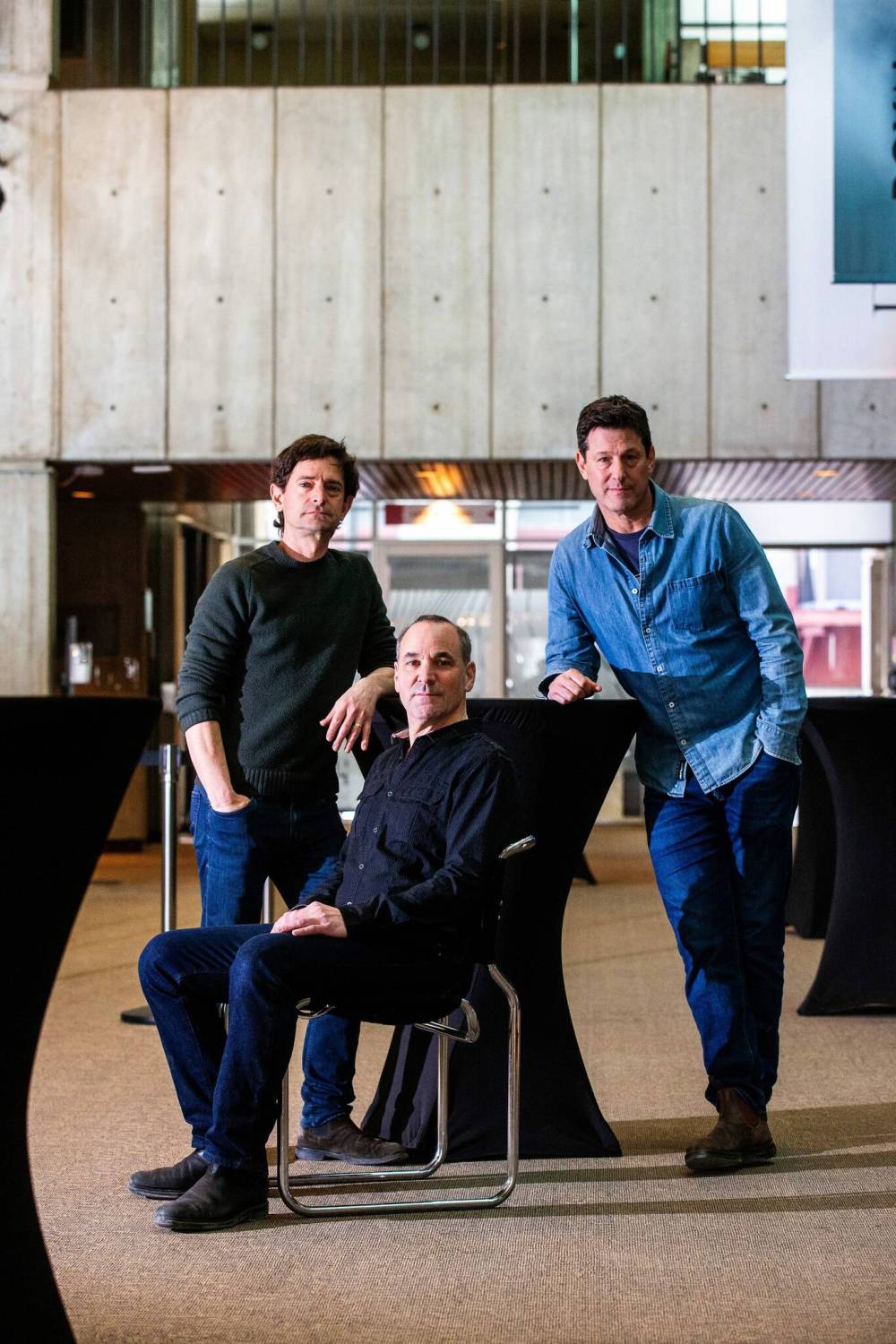
Before being welcomed into the theatre wings, those were the kinds of jobs available for the younger versions of these Jewish men who, were it not for earlier generations migrating to Canada from Eastern Europe, might have felt right at home in 1850s Bavaria, where the Lehmans’ epic story of commerce and company began.
One side of Pettle’s family came from Poland and the other from France, forced to leave their longtime homes due to rising tides of antisemitism in Europe.
“The flavour and feel of the old country, of Ashkenazi Jewish culture and language, was a big part of my family growing up,” says Pettle, a third-generation Canadian.
One grandfather, born in Canada, wanted to be a performer, but instead became a salesman.
“Inside there was an actor and a writer,” Pettle recalls of his grandfather, who sold snowsuits for Gemini and moonlighted at the CBC, working in radio drama.
His son, Pettle’s father, became a doctor, who in turn raised an actor and a television writer.
Poch Goldin’s family mostly came from Odesa.
“My grandmother came over by herself,” says the actor and playwright, who appeared in RMTC’s 2022-2023 productions of Network and Trouble in Mind.
“She was the shiksa on the boat because she didn’t speak Yiddish. She learned how on the boat.”
MIKAELA MACKENZIE / FREE PRESS Lehman Trilogy actor Alex Poch Goldin 
His grandmother became a homemaker, and his grandfather was by turns a boxer, a dance teacher and a milliner, making straw hats to keep a roof over his family’s heads. They started out keeping kosher strictly, but soon, some traditions faded.
“Eventually, they found themselves eating Chinese food on the balcony,” says Poch Goldin, whose father was an outerwear salesman for Aquascutum and whose mother was a bookkeeper.
Cohen knows his maternal grandfather comes from the region of Ukraine, Russia and Poland that switched hands more frequently than a fidget spinner.
“I’ve been curious lately to know the specifics of how and when they came over,” he says.
Like Pettle’s and Poch Goldin’s, Cohen’s grandfather got into textiles, working as a furrier, an upper echelon of Winnipeg’s booming mid-century schmatta industry, mostly staffed in those days by old-school Eastern Europeans.
His father’s father went into the printing business. One grandmother became a travel agent, the other, a homemaker.
“Doing this show, I certainly have echoes of my grandfather and that generation,” says Cohen, whose mother worked as a violin teacher and whose father worked for decades as an educator and high school administrator.
MIKAELA MACKENZIE / FREE PRESS Lehman Trilogy actor Ari Cohen 
That’s also the feeling of Cohen’s co-stars, and likely of award-winning director Richard Greenblatt, who was raised in a secular Jewish family in 1950s Montreal before embarking on a fruitful 50-year career in Canadian theatre.
To The Lehman Trilogy — written by Italian novelist Stefano Massini and adapted for the stage by Ben Power — the four men bring their own history to the grounds of Eastern Europe, the cotton fields in the Lehmans’ adopted home of Montgomery, Ala., and eventually, to the trading floors of Wall Street.
“It’s probably the most challenging thing I’ve ever worked on as an actor,” says Pettle, who played the same roles in a recent Canadian Stage production and also acted in Winnipeg Jewish Theatre’s production of Angels in America.
“It requires us to transform on a dime between characters. This kind of ensemble work takes such complicity between fellow actors. It’s massive. It’s three acts, in three hours (with intermissions). It’s an epic journey that demands everything of you as an actor and storyteller.”
(Massini is no stranger to challenging material. His next project is a rewrite of Mein Kampf, due to debut this year).
“I was blown away by the scale of it and by the challenge it presents,” says Cohen, a Black Hole Theatre alum who made his RMTC debut nearly 30 years ago in a production of Falstaff.
With Lehman, staged last month at Theatre Royal Sydney under the direction of Sam Mendes, RMTC is bringing what’s certain to be a challenging and timely production about dollars and sense to the Prairie capital.
ben.waldman@winnipegfreepress.com
One Big, Silly Question:
What would you do with $639 billion?
MIKAELA MACKENZIE / FREE PRESS Lehman Trilogy actor Jordan Pettle 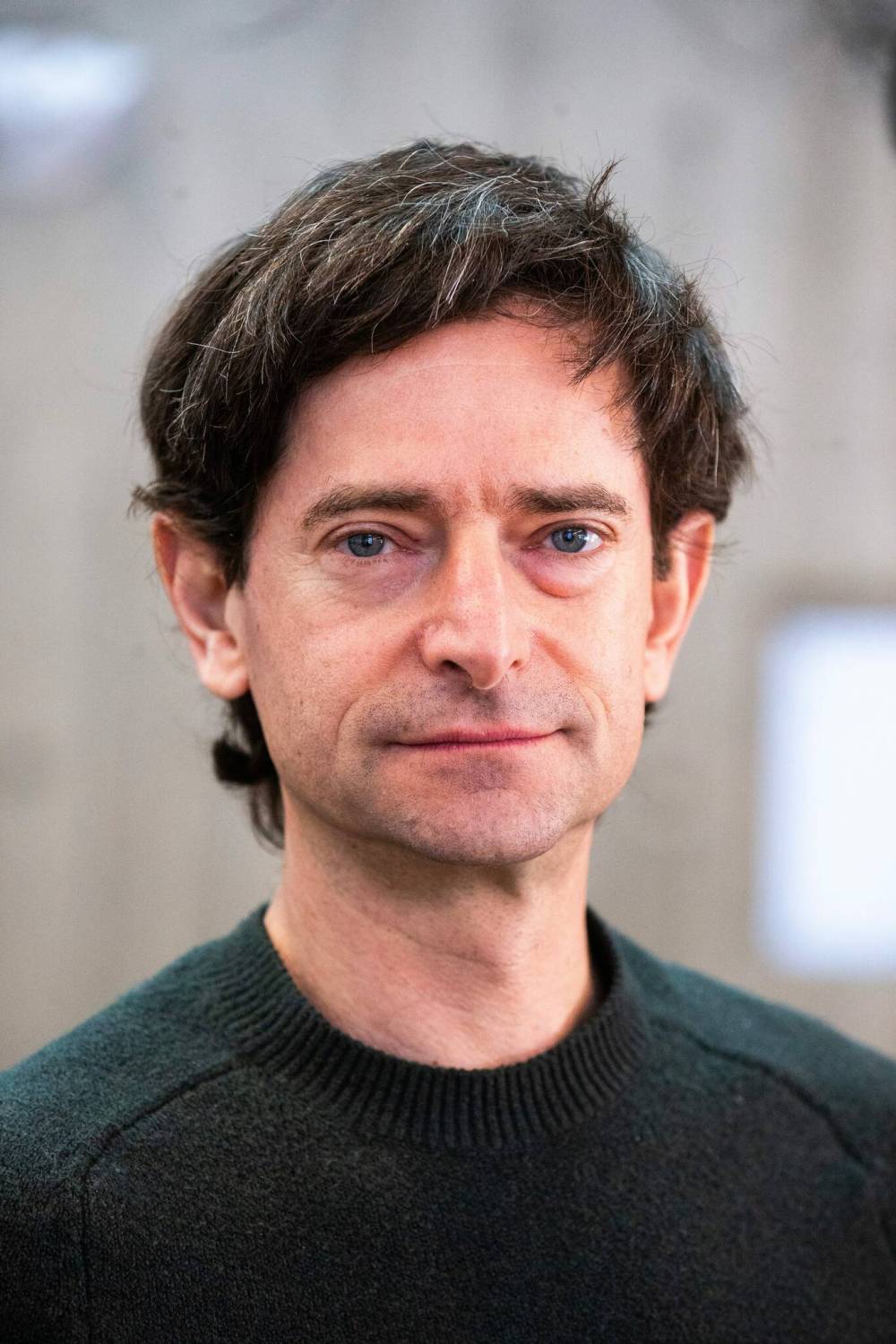
Pettle: “I have absolutely no idea what I’d do with that money. The vast gulf between the rich and the poor in our world depresses me greatly.
“I would love to have that kind of money. I would loath having that kind of money. I would want to give it all away, blow it at a casino, put it away so my kids would never have to worry about money ever.
“Money is complicated, and illusory, and not having enough of it worries me daily. I dream of a world without money.
“I feel grateful to be paid for doing the thing that I love, which in this case is a play about, among other things, money.
Cohen: “I think my top priority would definitely be environmental. We’re on a massive collision course with climate change and global warming, and of course, world hunger and poverty.
“You can sure change the world with that kind of money.”
Poch-Goldin: “I’d give millions to my friends and family. I’d build my own theatrical complex, and also create an endowment for the arts. I would stage all my plays, as well as all my favourite classical and modern writers. I would also invest in low-income housing in Manitoba.
“I would buy a Jaguar, green with seat warmers. I would go for dinner at the 529 steakhouse. I would buy my daughter front-row tickets to Noah Kahan. I would open a Montreal smoked meat restaurant with my brother, using the recipe that we invented and had a modicum of fame with in Toronto for a time.
“And lastly, I would pay Taylor Swift to visit my daughter at school and have them sing a duet together in front of the whole school.”

Ben Waldman is a National Newspaper Award-nominated reporter on the Arts & Life desk at the Free Press. Born and raised in Winnipeg, Ben completed three internships with the Free Press while earning his degree at Ryerson University’s (now Toronto Metropolitan University’s) School of Journalism before joining the newsroom full-time in 2019. Read more about Ben.
Every piece of reporting Ben produces is reviewed by an editing team before it is posted online or published in print — part of the Free Press‘s tradition, since 1872, of producing reliable independent journalism. Read more about Free Press’s history and mandate, and learn how our newsroom operates.
Our newsroom depends on a growing audience of readers to power our journalism. If you are not a paid reader, please consider becoming a subscriber.
Our newsroom depends on its audience of readers to power our journalism. Thank you for your support.