Pianist turns up the heat with electric performance
Michelle Cann elicits rapturous response from WSO audience
Advertisement
Read this article for free:
or
Already have an account? Log in here »
To continue reading, please subscribe:
Digital Subscription
One year of digital access for only $1.44 a week*
- Enjoy unlimited reading on winnipegfreepress.com
- Read the E-Edition, our digital replica newspaper
- Access News Break, our award-winning app
- Play interactive puzzles
*Billed as $5.77 plus GST every four weeks. After 52 weeks, price increases to the regular rate of $19.95 plus GST every four weeks. Offer available to new and qualified returning subscribers only. Cancel any time.
To continue reading, please subscribe:
Add Free Press access to your Brandon Sun subscription for only an additional
$1 for the first 4 weeks*
- Enjoy unlimited reading on winnipegfreepress.com
- Read the E-Edition, our digital replica newspaper
- Access News Break, our award-winning app
- Play interactive puzzles
*Your next Brandon Sun subscription payment will increase by $1.00 and you will be charged $17.95 plus GST for four weeks. After four weeks, your payment will increase to $24.95 plus GST every four weeks.
Read unlimited articles for free today:
or
Already have an account? Log in here »
Hey there, time traveller!
This article was published 24/03/2024 (943 days ago), so information in it may no longer be current.
The Winnipeg Symphony Orchestra burned up the stage Saturday night, as it presented an evening of fiery hits as its penultimate Saturday Classics concert.
The 115-minute program (including intermission) led by maestro Daniel Raiskin featured the WSO debut of American pianist Michelle Cann in a pair of crowd-pleasing concerti.
Judging by the crowd of 1,575’s enthusiastic response, including two standing ovations and even an exuberant “I love you” shouted from the house, it’s likely we’ll be seeing this dynamo grace this stage again.
Her first offering, Liszt’s Piano Concerto No. 1 in E flat major, S. 124, composed of four short movements, pushes a soloist to the max in terms of sheer technical virtuosity. It proved no match for Cann’s bravura, as she thundered up and down her keyboard with cascading octave runs during the opening Allegro maestoso, performed with conviction.
We also heard her luminous, singing tone in the subsequent Quasi adagio, her instrument bleeding into its cantabile melody after the cello and double basses’s lugubrious introduction. A highlight proved to be the Allegretto vivace — Allegro animato, with its unusual triangle motif that once earned the work the dubious moniker “the triangle concerto.” Cann once again pounced on her keyboard, punching out accents as Raiskin held taut rein over the players.
The local première of Florence Price’s Piano Concerto in One Movement leads one to imagine what other compelling works might be still lying fallow, as this one, originally composed in 1933, did for decades.
The barrier-breaking Price, hailed as the first African-American woman to be recognized as a symphonic composer, created an expansive body of more than 200 works, including symphonies, concerti, art songs, chamber pieces and instrumental solos. The Grammy-winning Cann is widely regarded one of the world’s foremost champions of the composer’s piano music; she performed the New York City première of the 18-minute concerto in the summer of 2016, followed by its later Philadelphia Orchestra debut in her hometown under the baton of Nézet-Séguin in February 2021.
Ryan Diduck photo American pianist Michelle Cann dazzles the WSO audience Saturday night at the concert hall.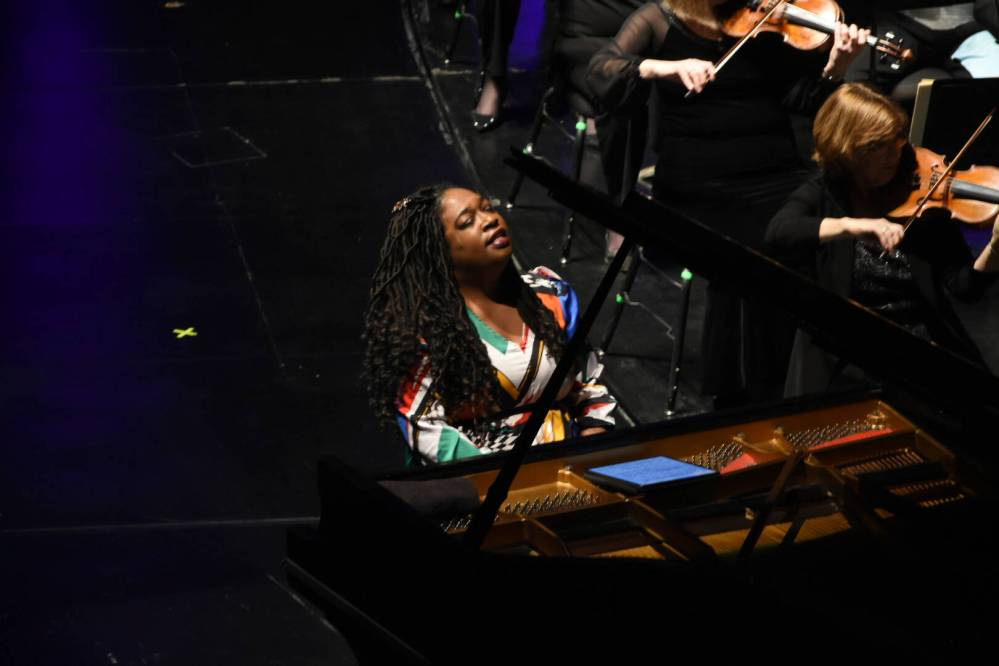
And what a revelation this was. The compact work, which maintains the bones of a traditional, three-movement structure, seamlessly melds its late-Romantic ethos — often channeling the extraverted flash of Liszt — with a melting pot of quintessentially American influences, including plaintive melodies evoking the soulful, earthier tones of spirituals and blues.
After a brief orchestral introduction, Cann launched into the Moderato section with dramatic flourish, once again digging in hard to its octave runs, underpinned by lush string harmonies.
A special nod to oboist Caitlin Broms-Jacobs for effectively weaving her sinewy obbligato lines around Cann’s exposed piano solo, coloured by blue notes, during the Adagio.
The rollicking final Allegretto — inspired by the Juba, an African dance driven by infectious, syncopated rhythms akin to ragtime — featured the entire stage full of musicians, including the ever-versatile Raiskin, bopping and throwing sparks in this high-spirited, joyful performance.
Following her second ovation, Cann treated us to quite possibly the best encore heard on this stage all season long, a no-holds-barred mash-up of classical canon and jazzy riffs that further electrified the audience.
Ryan Diduck photo Maestro Daniel Raiskin leads the WSO in a performance of Stravinsky’s The Firebird Suite Saturday night. 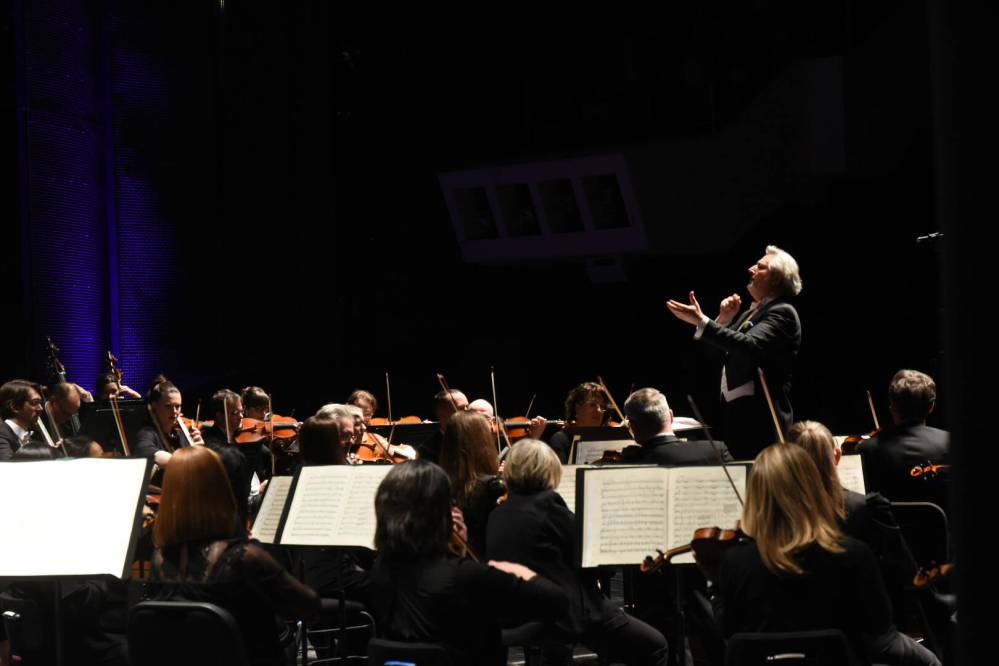
More fireworks came with Stravinsky’s The Firebird Suite, the Russian composer’s re-orchestrated version based on his prior ballet score originally created for Diaghilev’s Ballets Russes in 1910.
The work itself takes listeners through a programmatic journey of five descriptive movements; its intricate orchestration highlighting individual players, such as principal bassoonist Kathryn Brooks’s slinky solo in dialogue with the oboe and strings, during the Lullaby, and their respective sections throughout.
An oddly timid introduction was redeemed by The Firebird and its Dance and The Princesses’ Khorovod (Rondo), and Raiskin and his musicians pulled out all the stops for the expected highlight, Infernal Dance of King Kashchei, replete with bone-rattling sforzando accents by the percussion section and orchestra’s top brass. Kudos to principal horn Patricia Evans for her own noble solo that ushers listeners into the triumphant finale, sparking another standing ovation by the clearly ignited crowd.
holly.harris@shaw.ca
Holly Harris writes about music for the Free Press Arts & Life department.
Our newsroom depends on a growing audience of readers to power our journalism. If you are not a paid reader, please consider becoming a subscriber.
Our newsroom depends on its audience of readers to power our journalism. Thank you for your support.