Soldiers of misfortune
Alex Garland’s latest an unflinching look at complexities of chaotic conflict

Advertisement
Read this article for free:
or
Already have an account? Log in here »
To continue reading, please subscribe:

Digital Subscription
One year of digital access for only $205*
- Enjoy unlimited reading on winnipegfreepress.com
- Read the E-Edition, our digital replica newspaper
- Access News Break, our award-winning app
- Play interactive puzzles
*First annual payment billed as $205.00 + GST for one year. This annual subscription will automatically renew at $233.00 + GST every 52 weeks (10% off the regular annual price of $259.35). Offer available to new and qualified returning subscribers only. Cancel any time.
To continue reading, please subscribe:
Add Free Press access to your Brandon Sun subscription for only an additional
$1 for the first 4 weeks*
- Enjoy unlimited reading on winnipegfreepress.com
- Read the E-Edition, our digital replica newspaper
- Access News Break, our award-winning app
- Play interactive puzzles
*Your next Brandon Sun subscription payment will increase by $1.00 and you will be charged $17.95 plus GST for four weeks. After four weeks, your payment will increase to $24.95 plus GST every four weeks.
Read unlimited articles for free today:
or
Already have an account? Log in here »
Hey there, time traveller!
This article was published 12/04/2024 (908 days ago), so information in it may no longer be current.
As the political situation in the United States becomes increasingly fraught and divisive, the release of a movie about an American civil war set in the near future could be seen as an explosive, maybe even irresponsible act.
Civil War is angry, urgent and important, but its explosion is carefully controlled. Viewers expecting a Blue State-Red State smackdown that will fire up their tribal affinities will be disappointed.
English writer-director Alex Garland has constructed a potent warning that forces the audience to confront the horror and waste of war, while deliberately withholding information on the rights and wrongs claimed by either side.
At a key point in Civil War, a newbie photographer talks with the central character, combat-hardened photojournalist Lee (Kirsten Dunst), about how she can remain a neutral observer in the middle of some of the world’s bloodiest conflicts.
“We don’t ask,” Lee says. “We record, so other people ask.”
Garland is recording, dropping us into a chaotic battle zone with an on-the-ground, in-the-moment cinematic approach. It’s up to the audience to do the asking, and viewers will need to tackle some big, difficult questions about the fragility of democracy, the role of good journalism and the ugliest instincts of human nature.
We do find out that the American president, now in his third term, is given to authoritarian rhetoric, but we don’t learn anything about his party affiliation. (Anyone hoping that Nick Offerman, who has only two brief scenes, will do a Trump impersonation will be let down.)
The secessionists include several unstable factions, including the Western Forces, an alliance between California and Texas that’s impossible to imagine under America’s current left-right configuration.
That’s about as much background as we get when we start out in the lobby of a New York hotel with a quartet of journalists who are winding down after covering a protest that turned deadly. Level-headed Lee and her longtime professional partner Joel (Wagner Moura of Narcos), a volatile adrenaline junkie, are planning to head past the front lines and deep into the combat zone to Washington, D.C.
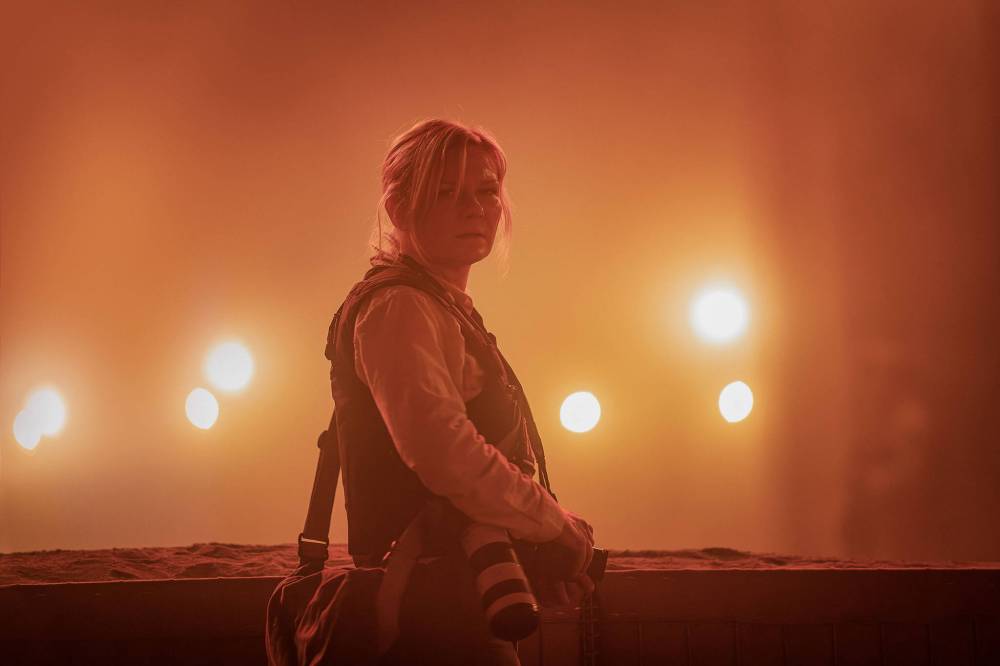
Murray Close / A24
Kirsten Dunst is a combat-hardened photojournalist in Civil War.
Weary veteran reporter Sammy (Dune’s Stephen McKinley Henderson) thinks it’s a suicide mission but can’t resist going along. Impossibly baby-faced Jessie (Priscilla’s Cailee Spaeny), for whom this is all still a big adventure, wangles the last spot in the van.
From there, the film becomes a nightmarish inversion of the all-American road trip. The word “PRESS” printed optimistically on the side of their vehicle soon feels like scant protection — and maybe even a target.
Garland, who is known for working on near-future sci-fi projects that can be both cerebral and visceral (Ex Machina, Annihilation, 28 Days Later) delivers extremely intense battle sequences and some unforgettably horrific images.
There are looters and vigilantes and armed militias and suicide bombers, highways blocked by abandoned cars and corpses hanging from overpasses. There’s a refugee camp administered by a global relief agency. There are war crimes committed on both sides.
In perhaps the clearest image of the war brought home, there’s a burned-out helicopter in the parking lot of an abandoned JCPenney store.
During a surreal shootout at a Christmas-themed amusement park, the journos run into two military snipers pinned down by an armed man in a distant house. Joel wants to know who they’re with and who they’re taking orders from.
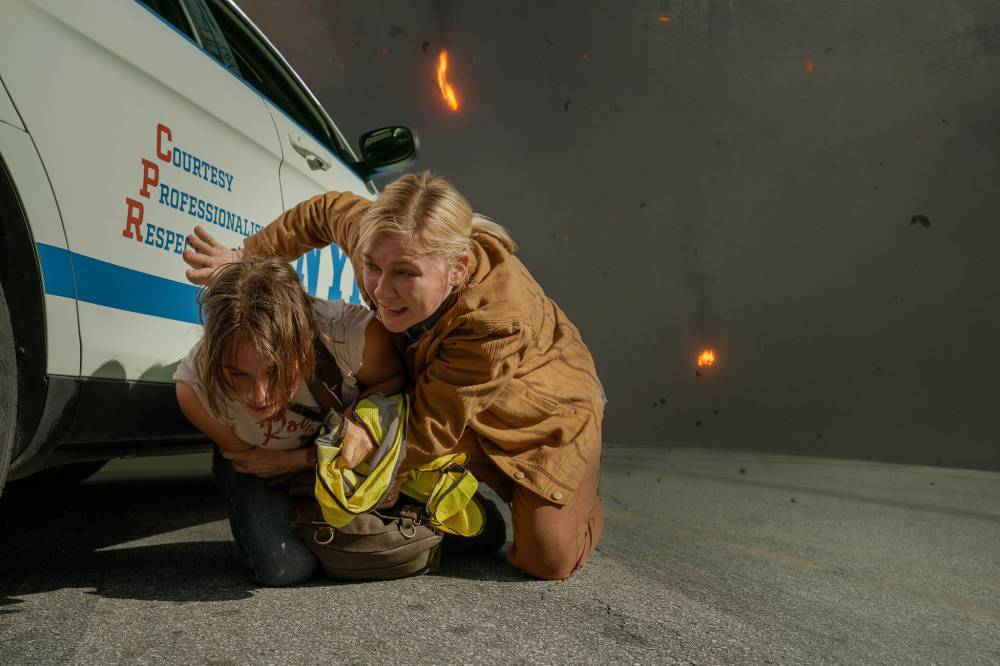
Murray Close/A24
Cailee Spaeny (left) and Kirsten Dunst are trying to document the atrocities in Alex Garland’s latest.
“He’s trying to kill us. We’re trying to kill him,” the sniper replies. That’s as much as we ever know.
The war scenes are disturbing, but it’s the quiet moments, when we get to know our four main characters better, that linger.
Garland underlines the necessity of good journalism and its commitment to truth-telling while remaining stringently unsentimental about his individual journalists.
Sammy has seen it all. Joel hasn’t seen enough. He gets jacked up by near-death experiences and manages the highs and lows of his job with his very own pharmacopoeia.

Lee, given layers of trauma and toughness by Dunst’s phenomenal work, has a thousand-yard stare that suggests she’s at some kind of mental and emotional brink. That’s why her relationship with Jessie, who resembles her younger self, is so tricky.
Garland, as he shows the embedded journalists on military missions, sometimes takes the audience out of the bloody, screaming, chaotic conflict, making the scene freeze, momentarily, into one of Jessie’s pictures — a still photo in black and white, estheticized and historicized.

Murray Close / A24
Being members of the press might not help Cailee Spaeny (left) and Wagner Moura.
He is demonstrating what photos can do — and must do — while also suggesting what they can’t.
Garland, likewise, is testing the limits of the war genre. He gives us the immediacy and awfulness of its violence, but he leaves us to navigate the narrative’s implied political and moral complexities on our own.
alison.gillmor@winnipegfreepress.com
Studying at the University of Winnipeg and later Toronto’s York University, Alison Gillmor planned to become an art historian. She ended up catching the journalism bug when she started as visual arts reviewer at the Winnipeg Free Press in 1992.
Our newsroom depends on a growing audience of readers to power our journalism. If you are not a paid reader, please consider becoming a subscriber.
Our newsroom depends on its audience of readers to power our journalism. Thank you for your support.
Movie review
Civil War
Starring Kirsten Dunst, Wagner Moura, Stephen McKinley Henderson and Cailee Spaeny
● Grant Park, McGillivray, Polo Park, St. Vital
● 109 minutes, 14A
★★★★ out of five
Other voices
It’s mourning again in America, and it’s mesmerizingly, horribly gripping.
— Manohla Dargis, New York Times
Garland’s dystopian supposition shows us that in a nation when citizens take up arms against each other, it is everyone who fails.
— Randy Myers, San Jose Mercury News
Dunst as our heroine, Lee, is terrific, post-traumatic and wearily real. She gives this often scarily glib movie something like a soul.
— Danny Leigh, Financial Times
Garland’s sharpest, most visionary rendering yet of the world gone wrong.
— David Sexton New Statesman
Studying at the University of Winnipeg and later Toronto’s York University, Alison Gillmor planned to become an art historian. She ended up catching the journalism bug when she started as visual arts reviewer at the Winnipeg Free Press in 1992.
Our newsroom depends on a growing audience of readers to power our journalism. If you are not a paid reader, please consider becoming a subscriber.
Our newsroom depends on its audience of readers to power our journalism. Thank you for your support.
Advertisement Advertise With Us
Advertisement Advertise With Us