Learning life lessons from Bluey
Children’s cartoon can teach us old dogs new tricks

Advertisement
Read this article for free:
or
Already have an account? Log in here »
To continue reading, please subscribe:

Digital Subscription
One year of digital access for only $205*
- Enjoy unlimited reading on winnipegfreepress.com
- Read the E-Edition, our digital replica newspaper
- Access News Break, our award-winning app
- Play interactive puzzles
*First annual payment billed as $205.00 + GST for one year. This annual subscription will automatically renew at $233.00 + GST every 52 weeks (10% off the regular annual price of $259.35). Offer available to new and qualified returning subscribers only. Cancel any time.
To continue reading, please subscribe:
Add Free Press access to your Brandon Sun subscription for only an additional
$1 for the first 4 weeks*
- Enjoy unlimited reading on winnipegfreepress.com
- Read the E-Edition, our digital replica newspaper
- Access News Break, our award-winning app
- Play interactive puzzles
*Your next Brandon Sun subscription payment will increase by $1.00 and you will be charged $17.95 plus GST for four weeks. After four weeks, your payment will increase to $24.95 plus GST every four weeks.
Read unlimited articles for free today:
or
Already have an account? Log in here »
Hey there, time traveller!
This article was published 25/04/2024 (835 days ago), so information in it may no longer be current.
Clearly, I have been sleeping on Bluey.
I recently stayed with friends who have young children and the hit Australian cartoon about a little Blue Heeler dog named Bluey and her family — mom Chilli, dad Bandit, sister Bingo and a colourful cast of supporting characters — was part of our days.
I was honestly knocked out by how poignant, smart and well-written it is, not to mention how winkingly funny — not just to the joys and frustrations of modern parenting, but to the canine world in which Bluey is set. (The dogs all have dog names — Calypso, Socks, Frisky, Muffin — and they wag their tails when they are happy.)
So, it’s no surprise that this show has drawn a solid adult fanbase and not just of parents — though I’ve noticed some people online direct real ire at non-parent fans of the show, forgetting, I guess, that everyone was a child once, everyone comes from a family and good storytelling with actual stakes is for everyone.
It’s also no surprise to me that The Sign, the recent 28-minute super-sized season finale that drew 10.4 million views in its first week of availability on Disney+, has the grown-ups in their feelings.
Note: spoilers follow.
Bluey’s family is moving from their home in Brisbane because Bandit got a higher-paying new job, and Bluey is upset. She doesn’t want her life to change. Chilli, her mom, is unsure about the pending move, too.
“I just want to give them the best life I can,” Bandit says.
They sell their house to two sheep dogs — or, as Bingo calls them, the Dogs With No Eyes — who, despite really wanting a pool, are settling for the Heeler family house which, as it happens, is to be the site of a family wedding between Bandit’s brother Radley and Chilli’s pal Frisky.
But the wedding is briefly called off when Frisky pulls a runaway bride after finding out Radley was planning to spring a big move of their own on her.
In the end, rather astonishingly, nobody moves. Radley and Frisky decide to stay (and the wedding goes on). The Dogs With No Eyes pull out of the sale because they’ve spotted a house with a pool, a sighting they make because of Bluey (you’ll just have to watch it). And Bandit rips out the For Sale sign out of the ground while a cinematic song plays and Chilli tackles him to the ground with joy. It’s official: the Heelers are also staying.
Of course, this ending, while emotionally affecting, is deeply unrealistic — which I realize is a rich bit of criticism for a show about cartoon dogs. For real-life kids (and parents) who might be grappling with a move to a new city or selling a childhood home, the ending of The Sign feels like a missed opportunity to teach valuable life lessons about change and resilience, especially in the face of disappointment.
Bluey could have made new friends, discovered a new school and had new adventures in a new place. Instead, her dad reverses the sale of the house they’ve already moved all their furniture out of because she doesn’t want to move? What kind of message does this send?
Watching the episode again, I came to a different conclusion. Maybe, in this stage of capitalism, when gigs are evaporating, businesses are shuttering and employees are increasingly treated as disposable, “moving for dad’s job” isn’t a compelling enough reason to uproot one’s life anymore — especially when the rest of the family really, really doesn’t want to leave.
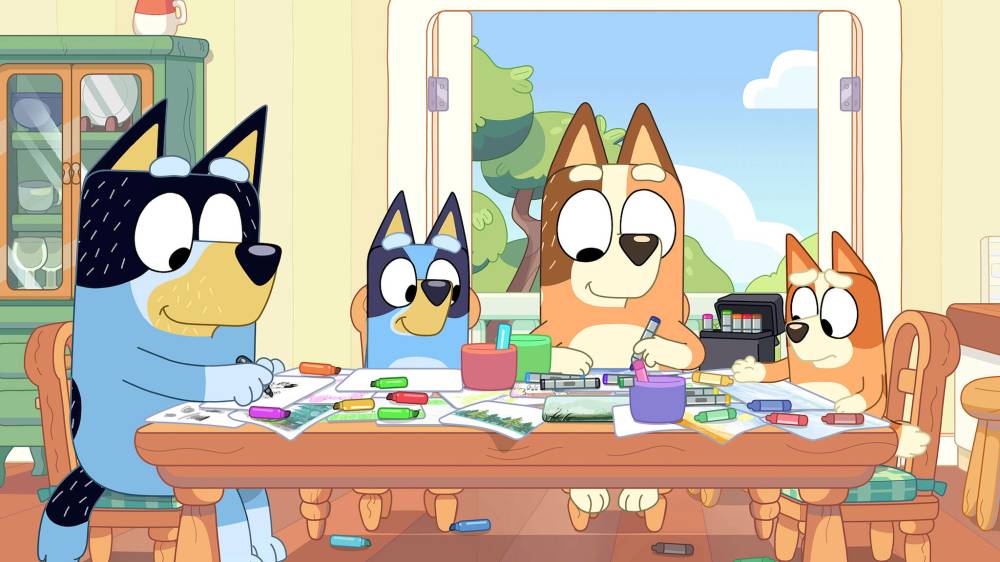
DISNEY+
Animated children’s show Bluey has earned an adult fanbase drawn to its sharp, funny writing.
Maybe, sometimes, giving them the best life you can means blooming where you’re planted, not making more money.
Perhaps the take-home of this episode is less “life is change” and more “life is a series of decisions.”

Every decision we’ll ever make comes with its own set of pros and cons, its own concessions and tradeoffs. To move or to stay. To choose this job over that one. To get married or not. To have kids or not. To take a risk or play it safe (which can sometimes be its own risk). To let go or to hold on. And for every decision made, a road goes untravelled, something we all must make peace with.
When it’s the parents tasked with making those life-changing decisions, children often feel helpless — a point underscored by the scene in which Bluey, Bingo and their cousins try in vain to remove the For Sale sign because they think that will stop the sale.
In the end, The Sign isn’t really about whether or not Bluey’s family leaves or stays. It’s about learning to live with the terrifying, exciting knowledge that you can never know how things will turn out and that we all must make a lifetime’s worth of decisions without being able to control the outcome.
Pretty timeless lesson there, if you ask me.
jen.zoratti@winnipegfreepress.com
Jen Zoratti is a columnist and feature writer working in the Arts & Life department, as well as the author of the weekly newsletter NEXT. A National Newspaper Award finalist for arts and entertainment writing, Jen is a graduate of the Creative Communications program at RRC Polytech and was a music writer before joining the Free Press in 2013. Read more about Jen.
Every piece of reporting Jen produces is reviewed by an editing team before it is posted online or published in print – part of the Free Press‘s tradition, since 1872, of producing reliable independent journalism. Read more about Free Press’s history and mandate, and learn how our newsroom operates.
Our newsroom depends on a growing audience of readers to power our journalism. If you are not a paid reader, please consider becoming a subscriber.
Our newsroom depends on its audience of readers to power our journalism. Thank you for your support.
Jen Zoratti is a columnist and feature writer working in the Arts & Life department, as well as the author of the weekly newsletter NEXT. A National Newspaper Award finalist for arts and entertainment writing, Jen is a graduate of the Creative Communications program at RRC Polytech and was a music writer before joining the Free Press in 2013. Read more about Jen.
Every piece of reporting Jen produces is reviewed by an editing team before it is posted online or published in print – part of the Free Press‘s tradition, since 1872, of producing reliable independent journalism. Read more about Free Press’s history and mandate, and learn how our newsroom operates.
Our newsroom depends on a growing audience of readers to power our journalism. If you are not a paid reader, please consider becoming a subscriber.
Our newsroom depends on its audience of readers to power our journalism. Thank you for your support.
Advertisement Advertise With Us
Advertisement Advertise With Us