Spice up your life
Season closer a stirring ode to Hawaiian tradition of sea-salt farming
Advertisement
Read this article for free:
or
Already have an account? Log in here »
To continue reading, please subscribe:

Digital Subscription
One year of digital access for only $205*
- Enjoy unlimited reading on winnipegfreepress.com
- Read the E-Edition, our digital replica newspaper
- Access News Break, our award-winning app
- Play interactive puzzles
*First annual payment billed as $205.00 + GST for one year. This annual subscription will automatically renew at $233.00 + GST every 52 weeks (10% off the regular annual price of $259.35). Offer available to new and qualified returning subscribers only. Cancel any time.
To continue reading, please subscribe:
Add Free Press access to your Brandon Sun subscription for only an additional
$1 for the first 4 weeks*
- Enjoy unlimited reading on winnipegfreepress.com
- Read the E-Edition, our digital replica newspaper
- Access News Break, our award-winning app
- Play interactive puzzles
*Your next Brandon Sun subscription payment will increase by $1.00 and you will be charged $17.95 plus GST for four weeks. After four weeks, your payment will increase to $24.95 plus GST every four weeks.
Read unlimited articles for free today:
or
Already have an account? Log in here »
Hey there, time traveller!
This article was published 30/04/2024 (868 days ago), so information in it may no longer be current.
You might never look at a saltshaker in quite the same way again.
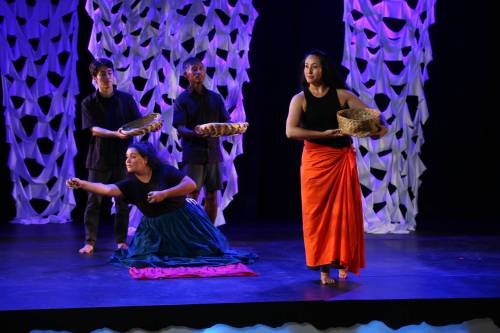
Manitoba Theatre for Young People closes its 2023/24 season with a touring production of Honolulu Theatre for Youth’s The Pa’akai We Bring, living up to its promise to “Grow Your World.”
“Pa’akai” (Hawaiian for “to solidify the sea”) refers to the precious sea salt farmed for generations on the island of Kaua‘i, long used by native Hawaiians for preserving food, as medicine, in religious ceremonies and as a treasured gift to friends.

SUPPLIED
The Honolulu Theatre for Youth lives up to its promise to grow your world.
It’s natural to feel skeptical about any play that thrusts a condiment into the spotlight, glorifying a substance normally shaken onto popcorn or added to recipes to kick things up a notch.
However, thanks to the show’s crackerjack cast — Jarren Amian, Alysia-Leila Kepa’a, Annie Lokomaika’l Lipscomb and — this play, crafted by HTY’s artistic associate Moses Goods, offers instead a heartfelt ode to ancestral tradition and the healing power of nature.
It also packs an emotional wallop with its timeless message about grace and the way the simple act of gift-giving — no matter how small or intangible — can change lives.
The 55-minute production, inspired by the real stories of the 26 Hawaiian families still tending the Hanapepe salt beds, unfolds through a series of vignettes, traditional songs, hula dances and narration.
The well-balanced ensemble fluidly morphs among characters, with effective costumes designed by Iris Kim and Emily Wrigtht, nifty set pieces suggesting salt beds and suspended, hanging panels lit by Stephen Pruitt.
We hear fascinating lore about how salt continues to be harvested on the island in the 21st century. Even more urgently, we’re told how ever-spiralling climate change threatens to engulf the salt beds through widespread flooding and, much closer to home, how younger generations are turning their backs on the hard labour of harvesting, lured away by the siren song of more modern professions.
Some sections admittedly lag and feel overly didactic with their waves of facts; there’s little of the dramatic tension one might expect in any theatrical presentation.
It also takes a while to fully enter into this evocative world; however, the script, liberally laced with Hawaiian references and phrases, helps usher us into its climes.
During one scene, Muller, dressed à la surfer dude in T-shirt, shorts and ball cap, “forces” himself to laugh uproariously, attempting to clear stress from his body so he can bring only positive “aloha” energy to the salt beds.
These glimpses into the subtleties of Hawaii’s Indigenous culture take audience members on a much deeper dive than clichéd, “tourist-happy” leis and luaus.
A luscious hula dance, led by Lokomaika’l Lipscomb with Kepa’a, could easily have gone on much longer for the Prairie crowd at Saturday’s matinee. It’s not every day one gets to see the real deal, with the women’s waving arm gestures and gently swaying hips capturing the poetic ethos of the islands. Even more unusual was the duo’s earlier seated “hula kuolo,” their voices harmonizing beautifully together in song.
Kudos in particular to Amian for his chameleonic artistry, as he brings to life Mattea Mazzella’s live, wholly organic score using both modern and traditional Hawaiian folk instruments, including ukulele, guitar, “ohe hano ihu” bamboo flute, shakers and drums.
The expected audience-participation number comes when the tots and their caregivers are coaxed into gleefully warbling along while miming the actions involved with salt farming. “Faster! Faster!” sees the crowd erupt like volcanoes into gales of giggles.
Kepa’a acting out stories using traditional string games — think cat’s cradle — evokes universal ties that bind through child’s play.

However, if there’s one reason to see this show, it’s a surprisingly tender and truly moving song about the mechanics of raking the salt beds and rinsing the “tiny gems.” It’s mesmerizing, with the actors’ reverence and respect for their cultural heritage creating a hushed lullaby that stirs the soul.
Another powerful moment comes when the performers speak about ever-rising global tensions and the balm gift-giving offers: “We fight with aloha, and our stories continue and our medicine gets stronger,” they say, opening their clenched fists to reveal palms of salt, sending shivers down the spine.
The play comes full circle when the actors share their real-life journeys to the Hanapepe farms in preparation for this production, bringing gifted packets of the grains home. When they gently shake droplets of briny water over us as a final benediction, it doesn’t get any better.
This poignant homage to time-honoured ancestral roots is well worth its salt.
holly.harris@shaw.ca
Holly Harris writes about music for the Free Press Arts & Life department.
Our newsroom depends on a growing audience of readers to power our journalism. If you are not a paid reader, please consider becoming a subscriber.
Our newsroom depends on its audience of readers to power our journalism. Thank you for your support.
Theatre Review
The Pa’akai We Bring
● Manitoba Theatre for Young People
● To Sunday
● Tickets at mtyp.ca
★★★★ out of five
Holly Harris writes about music for the Free Press Arts & Life department.
Our newsroom depends on a growing audience of readers to power our journalism. If you are not a paid reader, please consider becoming a subscriber.
Our newsroom depends on its audience of readers to power our journalism. Thank you for your support.
Related Articles
Children’s theatre piece delves into sacred importance of salt
Advertisement Advertise With Us
Advertisement Advertise With Us