Tray delicious? Hospital food served up for a taste test
Read this article for free:
or
Already have an account? Log in here »
To continue reading, please subscribe:

Digital Subscription
One year of digital access for only $205*
- Enjoy unlimited reading on winnipegfreepress.com
- Read the E-Edition, our digital replica newspaper
- Access News Break, our award-winning app
- Play interactive puzzles
*First annual payment billed as $205.00 + GST for one year. This annual subscription will automatically renew at $233.00 + GST every 52 weeks (10% off the regular annual price of $259.35). Offer available to new and qualified returning subscribers only. Cancel any time.
To continue reading, please subscribe:
Add Free Press access to your Brandon Sun subscription for only an additional
$1 for the first 4 weeks*
- Enjoy unlimited reading on winnipegfreepress.com
- Read the E-Edition, our digital replica newspaper
- Access News Break, our award-winning app
- Play interactive puzzles
*Your next Brandon Sun subscription payment will increase by $1.00 and you will be charged $17.95 plus GST for four weeks. After four weeks, your payment will increase to $24.95 plus GST every four weeks.
Read unlimited articles for free today:
or
Already have an account? Log in here »
Hey there, time traveller!
This article was published 31/05/2024 (807 days ago), so information in it may no longer be current.
Where does hospital food come from?
For most major health centres in Winnipeg, the pastel meal trays are assembled in a large regional distribution facility surrounded by commercial warehouses and industrial manufacturers on the outskirts of St. Boniface.
The Winnipeg Regional Health Authority’s nutrition and food services facility opened in 1998. It was part of a national trend away from on-site hospital kitchens and toward centralized operations, which was expected to save the provincial government about $5 million per annum.
Today, the facility prepares more than 8,000 meals daily for patients at 11 local hospitals and long-term care centres.
Mike Sudoma/Free Press A typical meal that would be served to a patient at one of 11 local hospitals and long-term care centres served by the WHRA.
Recently, the health authority invited members of the media to don hairnets, white smocks and disposable booties for an extensive tour of the facility — and a taste of its offerings.
The open house was a chance for reporters to marvel at the technical innovations within the 47,000-square-foot building and an opportunity for staff to try and dispel the long-standing stigma of subpar hospital food quality.
It’s a topic that’s been simmering since the distribution centre opened and one that appears alive and well, based on a critical review of the menus at Riverview and Deer Lodge health centres published recently in the Free Press.
Photos by Mike Sudoma / Free Press Manager of operations Charity Hanslit explains how racks of ingredients are organized in a food storage freezer inside the WRHA Food Distribution Centre.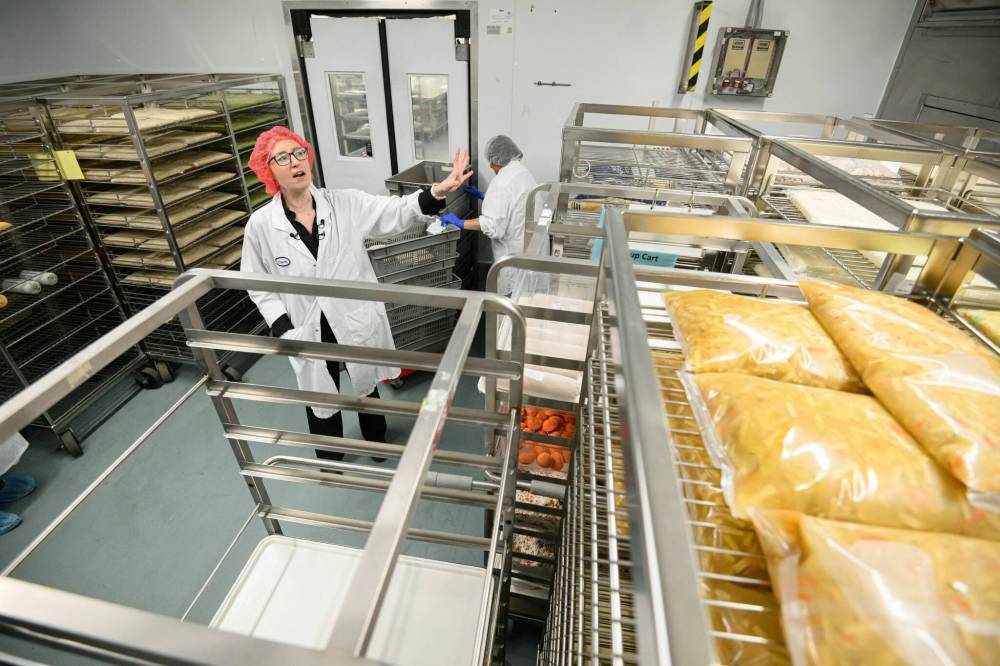
“When there’s negative comments, it’s a little bit disheartening,” says Kathleen Richardson, WRHA chief nutrition and food services officer. “I feel bad for the staff because they put their heart and souls in it … so we thought we would show everyone what we actually do.”
Although taste isn’t the centre’s top priority when coming up with new meal options — cost-effectiveness is, followed by nutrition and practicality — palatability is part of the equation.
“Just because it’s operationally, nutritionally, financially (feasible), if people aren’t going to eat it, there’s really no point in serving it,” says Charity Hanslit, manager of operations.
Hanslit starts the tour in the communication hub, where patient dietary needs, allergies and preferences from each site are plugged into a software program that spits out individualized tray tickets. The system can accommodate 98 different diet types and a huge array of modifications.
Mike Sudoma/Free Press WRHA Food Distribution Centre staff work around a conveyor belt to clean food containers, trays and cutlery.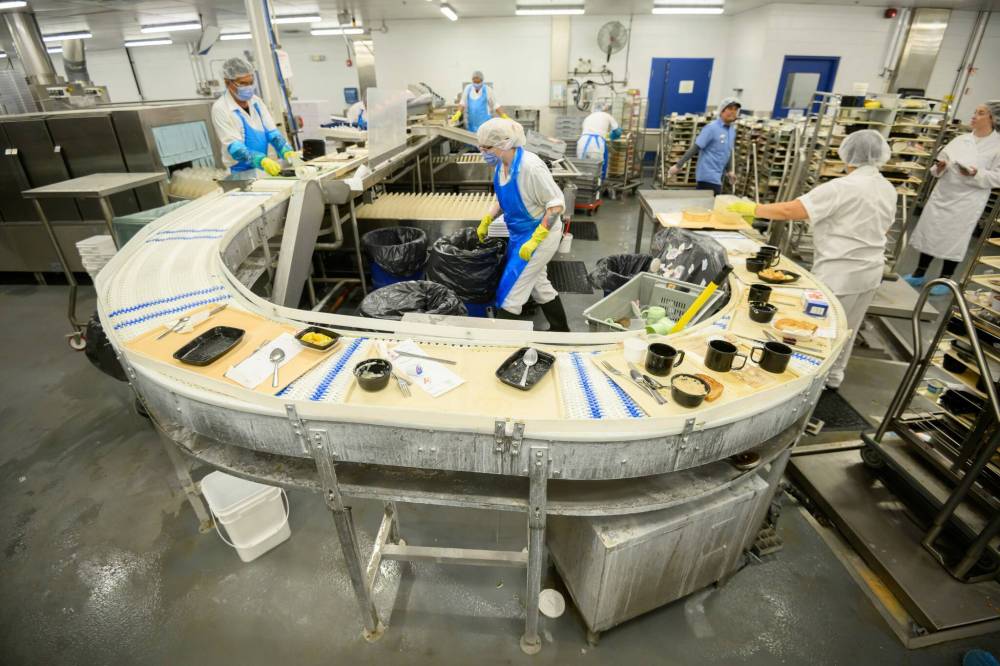
The regional distribution facility, or RDF as it’s known internally, runs on a three-week menu cycle with multiple entrée options for each lunch and dinner service.
The master weekly prep lists are five-page spreadsheets with dozens of predicted variables.
The tour continues on to the ingredient storage areas. On the way, Hanslit points out a rethermalization unit — the wheeled boxes live at the health centres and act as a portable fridge/oven to bring trays to temperature before service.
Before a new meal is added to the mix, it’s tested rigorously to ensure it can be reproduced and reheated on a mass scale.
Mike Sudoma/Free Press Workers clean trays delivered to the Food Distribution Centre to be reused in the following day's meal orders.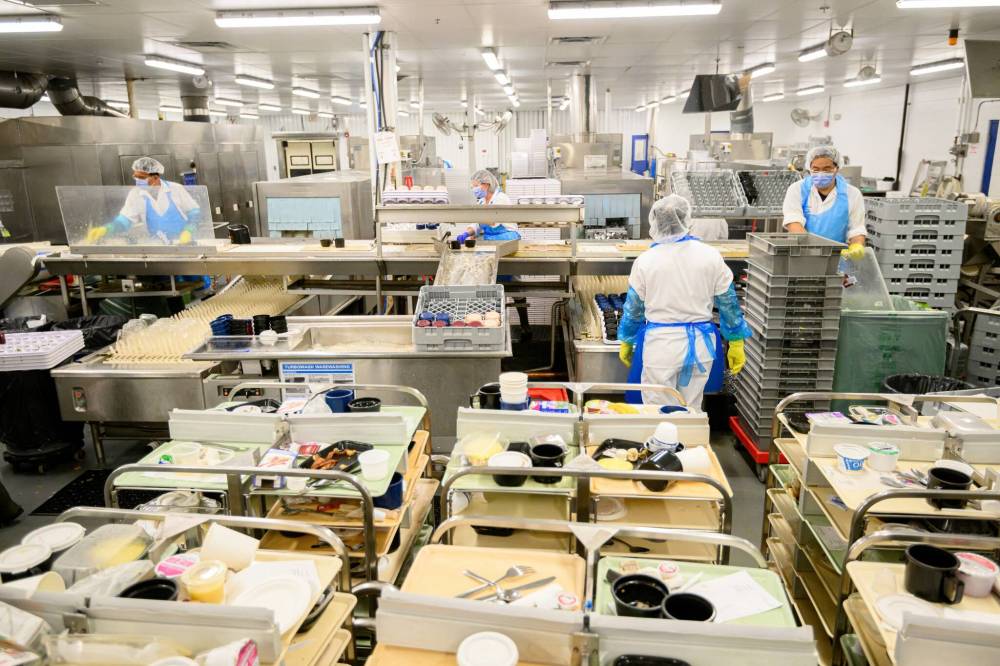
“Because the components are all cooked together, you want to make sure they work,” Hanslit says of the entrées. “You might get a vegetable that’s got a little bit of liquid to it, you’re not going to want to combine that with an item that has a breading and needs to be crispy — all those factors are considered.”
In a health-care setting, nutrition often trumps presentation. Julie Gislason — a registered dietitian and regional manager for clinical systems — is head of the team responsible for ensuring RDF food is both nutritionally balanced and enjoyable.
Mike Sudoma/Free Press WRHA food and nutrition workers Criselda (left) and Ashley (right) assemble and package egg salad sandwiches before they are delivered to patients in Winnipeg.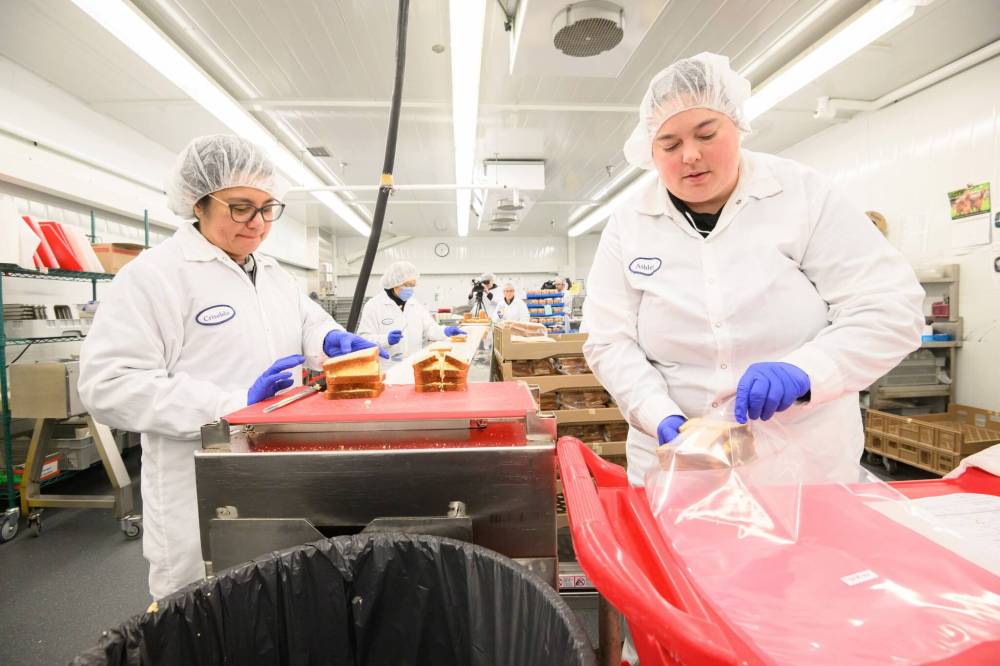
“Most food doesn’t taste (good) when you don’t feel well. It’s important that we provide very nutritious, appealing, tasty meals and that we partner with all of our health-care teams (and) family members to help promote intake because we really want to address malnutrition,” Gislason says.
Upon admission, patients are screened for malnutrition and triaged to an on-site dietitian, if needed.
Back on the tour, Hanslit stops at the walk-in freezer, a room stacked with shelves of frozen food.
Mike Sudoma/Free Press An employee hauls carts used to transport prepared meals for patients all over Winnipeg at the Food Distribution Centre.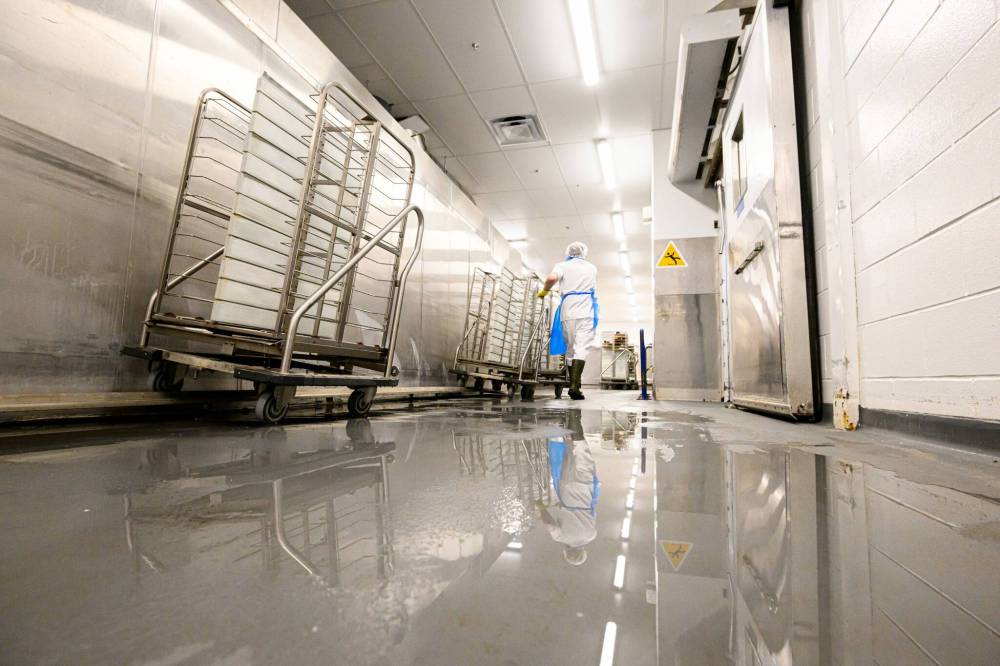
“One of the criticisms that we’ve received is that we serve frozen food, but truly, the food we serve here is really the same type of food you would buy at home,” Hanslit says.
The WRHA has endeavoured to source more products from local suppliers and has expanded its cultural food choices. Bannock, bison and samosas are now on the menu, with rice expected to be added as a breakfast option in the near future.
Down the hall, there’s a room dedicated to thawing the bags of pre-made meals, meats and mixed vegetables, but not everything comes frozen.
Mike Sudoma/Free Press WRHA employee Criselda slices an egg salad sandwich before it's packaged and shipped.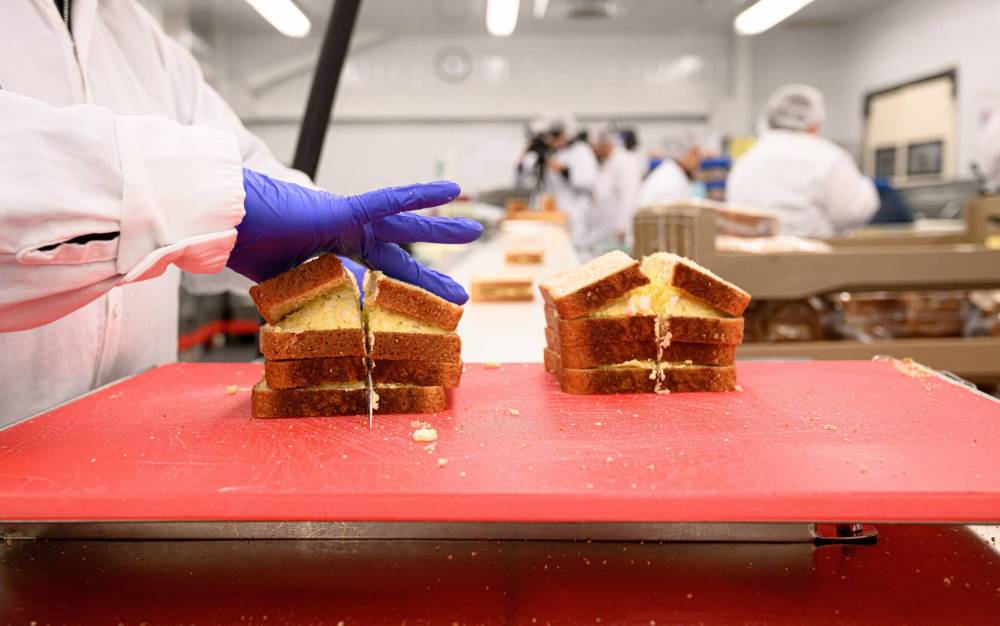
In a nearby room, several of the facility’s 250 staff members are busy portioning out fresh apple slices and salads. In another, workers on an assembly line are building and bagging 544 egg salad sandwiches on white and whole wheat bread. Computerization and granular planning keeps food waste to a bare minimum.
Posted on a bulletin board is a memo with kudos from patients about the quality of the food. The WRHA claims a meal satisfaction rate of nearly 86 per cent, based on regular patient surveys.
Mike Sudoma/Free Press Perogies are on the menu in WRHA health-care facilities.
The aforementioned meal tickets are sent to the tray line, where the components of each order are compiled and verified before being stacked and prepared for delivery.
The team can pump out eight trays per minute and the workspace is full of mechanized lifts, timed conveyor belts and ergonomic optimization to avoid repetitive use injuries.
Delivery trucks pick up and return the carts of food three times per day. During the tour, dinner trays were being prepped and spent breakfast trays were being returned for cleaning.
The massive dish pit is a thing to behold. The room is filled with trays of coffee cups, packaging debris, mini cereal boxes and half-eaten waffles — the RDF also audits its waste to assess which meals aren’t being finished regularly.
Occasionally the trays arrive with dentures, wallets and other personal effects, which are easy to return thanks to the ticket system.
@winnipegnews 🍽️ Hospital food served up for a taste test. #greenscreen #winnipeg #winnipegnews #food #healthcare #nutrition ♬ original sound – Winnipeg Free Press
Staff clad in rubber gloves and aprons rinse and organize the incoming trays before sending the reusable cutlery and dinnerware through industrial dishwashers and back onto the production line.
The tour ends in the boardroom, where a tray cart is wheeled in and the assembled reporters are invited to sit down for lunch.
The locally produced potato and cheddar perogies — a “beloved” menu item according to Hanslit — are served three to an order with a generous scoop of mealy corn and a log of surprisingly salty garlic sausage.
The fruit salad was fine, the coleslaw overdressed and the minestrone soup a tad watery.
It’s no five-star dining experience, but the platter is palatable, especially considering the sheer scale of the kitchen whence it came.
eva.wasney@winnipegfreepress.com
X: @evawasney

Eva Wasney has been a reporter with the Free Press Arts & Life department since 2019. Read more about Eva.
Every piece of reporting Eva produces is reviewed by an editing team before it is posted online or published in print — part of the Free Press‘s tradition, since 1872, of producing reliable independent journalism. Read more about Free Press’s history and mandate, and learn how our newsroom operates.
Our newsroom depends on a growing audience of readers to power our journalism. If you are not a paid reader, please consider becoming a subscriber.
Our newsroom depends on its audience of readers to power our journalism. Thank you for your support.