Watching surreality television
Fandom, pop culture and transformation collide in atmospheric psychodrama

Advertisement
Read this article for free:
or
Already have an account? Log in here »
To continue reading, please subscribe:
Digital Subscription
One year of digital access for only $1.44 a week*
- Enjoy unlimited reading on winnipegfreepress.com
- Read the E-Edition, our digital replica newspaper
- Access News Break, our award-winning app
- Play interactive puzzles
*Billed as $5.77 plus GST every four weeks. After 52 weeks, price increases to the regular rate of $19.95 plus GST every four weeks. Offer available to new and qualified returning subscribers only. Cancel any time.
To continue reading, please subscribe:
Add Free Press access to your Brandon Sun subscription for only an additional
$1 for the first 4 weeks*
- Enjoy unlimited reading on winnipegfreepress.com
- Read the E-Edition, our digital replica newspaper
- Access News Break, our award-winning app
- Play interactive puzzles
*Your next Brandon Sun subscription payment will increase by $1.00 and you will be charged $17.95 plus GST for four weeks. After four weeks, your payment will increase to $24.95 plus GST every four weeks.
Read unlimited articles for free today:
or
Already have an account? Log in here »
Hey there, time traveller!
This article was published 07/06/2024 (759 days ago), so information in it may no longer be current.
This dark little drama is from A24, the film company known for arthouse horror flicks such as Hereditary, Midsommar and X.
Don’t expect blood, gore or jump scares, though. This intense and atmospheric psychodrama focuses on the steady, low-grade emotional horror of isolated and unhappy adolescence.
When we first see Owen (played initially by Ian Foreman and then as he gets older by Justice Smith of Jurassic World: Fallen Kingdom), he’s sitting on the floor, seemingly hypnotized by the light that plays over his face.
The particular quality of that light will be familiar to anyone who remembers the 1990s: Owen is illuminated by the flickering images emitted by a cathode-ray tube TV in a dim basement rec room.
Filmmaker Jane Schoenbrun, whose debut feature, We’re All Going to the World’s Fair, was another unsettling tale of teens and screens, uses light as an esthetic tool and thematic signifier in this slow and moody work.
Characters are bathed in the lurid purple or green or red glow of artificial light, irradiated by traffic signals and car headlights, club strobes and blinking neon, supermarket fluorescents and stadium floodlights.
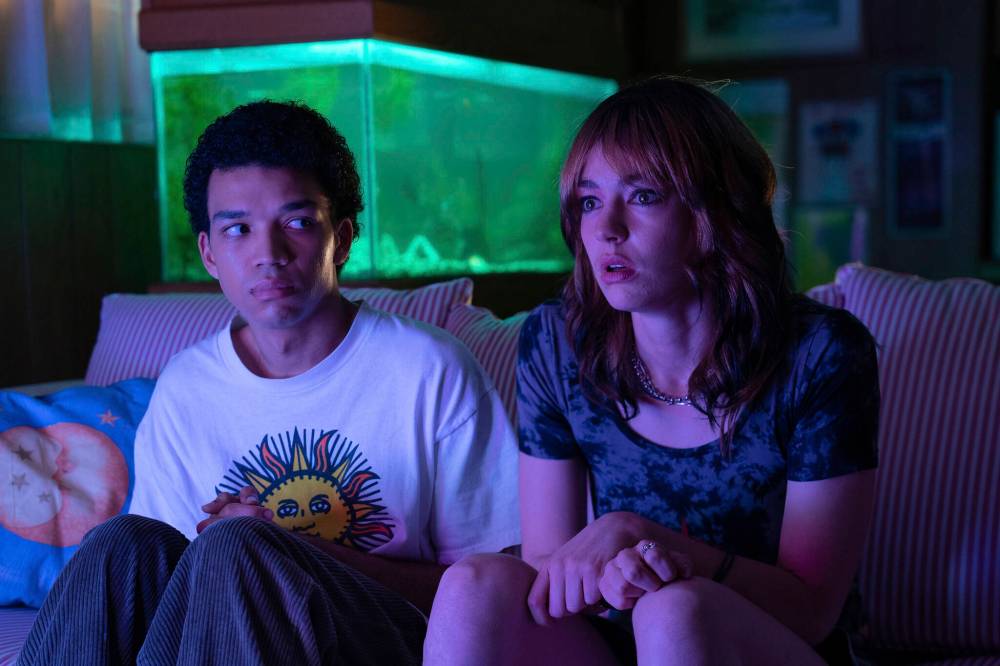
Asked whether he likes boys or girls, the quiet, anxious Owen can only say, “I like to watch TV.” He bonds with Maddy (Atypical’s Brigette Lundy-Painer), an older queer kid, over a culty cable television show called The Pink Opaque.
Forbidden to watch by his strict, cold father (“Isn’t that a girls’ show?”), Owen receives contraband VHS tapes from his friend.
The show — its quintessentially ‘90s features expertly replicated in brief clips — features Isabel and Tara (Helena Howard and Lindsey Jordan), teen girls who connect on the psychic plane to battle the monster of the week. These supernatural threats are sent by Mr. Melancholy, the series’ Big Bad, who plots to trap the girls forever in a place called the Midnight Realm.
Schoenbrun’s cinematic influences go right back to 1902 and Georges Méliès’s A Trip to the Moon and include the movies of David Lynch and David Cronenberg. The filmmaker also riffs on TV shows such as The X-Files, Lynch’s Twin Peaks and, especially, Buffy the Vampire Slayer.
A24
Owen (Justice Smith, left) and Maddy (Brigette Lundy-Paine) are fans of the TV show The Pink Opaque.
Twin Peaks is repped in Owen and Maddy’s world by a dive bar with a suspiciously good house band (in this case Sloppy Jane, featuring Phoebe Bridgers). The Buffyverse gets a shout-out in The Pink Opaque’s titles (such as Episode #307, Homecoming to Get You), as well as a cameo from Buffy alum Amber Benson, who is now playing someone’s mom. (Maddy talks several times about time passing in an unnaturally rapid way, and this pretty much confirms it.)
For Maddy, The Pink Opaque “feels more real than real life, you know?” Maddy finds in the show’s gay-coded characters and relationships an affirmation she can’t find in her family or town, with its empty streets and tidy suburban split-levels.
She and Owen attend the pointedly named Void High School (“Go Vultures!”), which also happens to be abbreviated as VHS.
Then Owen is left alone and seemingly frozen after his mother dies, Maddy disappears, and The Pink Opaque is cancelled, ending in what seems like a hopeless and unresolved way.
As the story jumps forward in time, Owen has a strange final encounter with Maddy, who only wants to talk about The Pink Opaque.
“Do you remember it as just a TV show?” Maddy asks Owen in a scene that makes it clear that the lines between TV and life have completely broken down.

Schoenbrun is looking at fan culture and pop culture nostalgia, suggesting they can be both sanctuary and trap. But the 37-year-old trans filmmaker, who began hormone therapy when they started this project, uses I Saw the TV Glow as a specific metaphor for the experience of growing up transgender. This can be seen as a framework for Maddy and Owen’s sense of being alienated and alone, their sense that “this isn’t how life is supposed to feel.”
A24
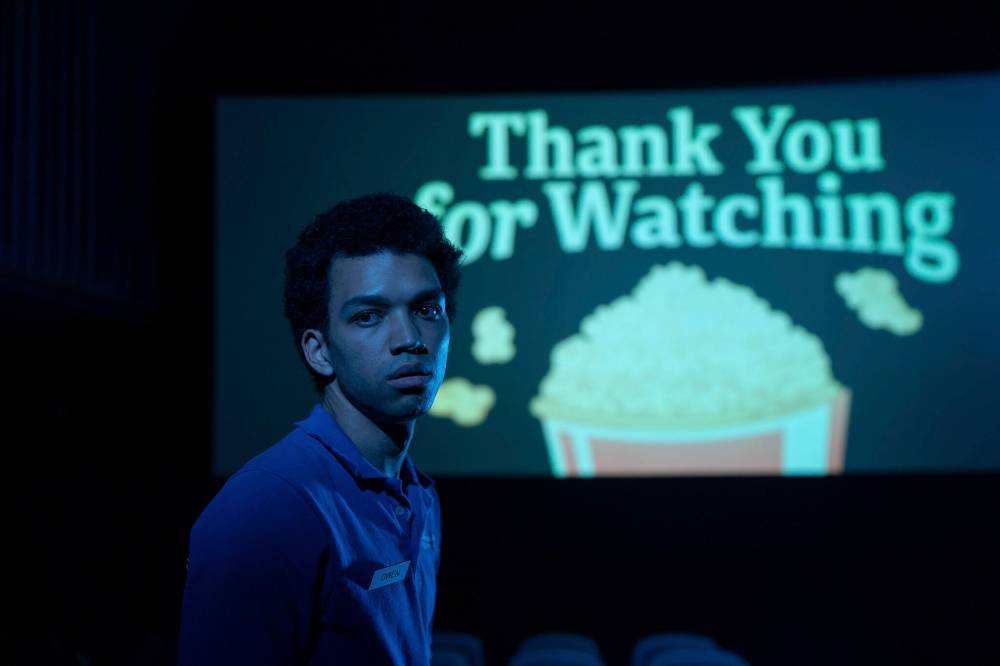
Owen (Justice Smith) is a quiet, anxious teen who finds solace in television.
The question that looms over the very odd ending is whether Owen will remain trapped in the half-light of another kind of Midnight Realm. Though there’s an intentional flatness in the performances, a numbness that can be exasperating, these final sequences are quietly electrifying and deeply sad.
At one point Owen looks back to childhood: “I remember playing in the snow, driving to baseball games with my dad, cooking with my mom.”
Perhaps the scariest thing about this film is that these ordinary memories seem far less palpable than the ever-present glow of the TV screen.
alison.gillmor@winnipegfreepress.com
Studying at the University of Winnipeg and later Toronto’s York University, Alison Gillmor planned to become an art historian. She ended up catching the journalism bug when she started as visual arts reviewer at the Winnipeg Free Press in 1992.
Our newsroom depends on a growing audience of readers to power our journalism. If you are not a paid reader, please consider becoming a subscriber.
Our newsroom depends on its audience of readers to power our journalism. Thank you for your support.
Movie review
I Saw the TV Glow
Starring Justice Smith and Brigette Lundy-Paine
● Dave Barber Cinematheque, until June 20
● PG, 100 minutes
★★★★ out of five
Other voices
Glow blends the real and the surreal in a neon-drenched nightmare that leaves a trail of thematic breadcrumbs for its audience.
— Brian Truitt, USA Today
Director Jane Schoenbrun blurs the lines between reality and fantasy with an intoxicating, Lynchian flair.
— Jen Yamato, Washington Post
At times I’m not sure I fully understood it. But I’m sure that I won’t forget it.
— Bill Goodykoontz, Arizona Republic
Studying at the University of Winnipeg and later Toronto’s York University, Alison Gillmor planned to become an art historian. She ended up catching the journalism bug when she started as visual arts reviewer at the Winnipeg Free Press in 1992.
Our newsroom depends on a growing audience of readers to power our journalism. If you are not a paid reader, please consider becoming a subscriber.
Our newsroom depends on its audience of readers to power our journalism. Thank you for your support.
Advertisement Advertise With Us
Advertisement Advertise With Us