Striving for relevancy; caught in ’90s time warp

Advertisement
Read this article for free:
or
Already have an account? Log in here »
To continue reading, please subscribe:

Digital Subscription
One year of digital access for only $205*
- Enjoy unlimited reading on winnipegfreepress.com
- Read the E-Edition, our digital replica newspaper
- Access News Break, our award-winning app
- Play interactive puzzles
*First annual payment billed as $205.00 + GST for one year. This annual subscription will automatically renew at $233.00 + GST every 52 weeks (10% off the regular annual price of $259.35). Offer available to new and qualified returning subscribers only. Cancel any time.
To continue reading, please subscribe:
Add Free Press access to your Brandon Sun subscription for only an additional
$1 for the first 4 weeks*
- Enjoy unlimited reading on winnipegfreepress.com
- Read the E-Edition, our digital replica newspaper
- Access News Break, our award-winning app
- Play interactive puzzles
*Your next Brandon Sun subscription payment will increase by $1.00 and you will be charged $17.95 plus GST for four weeks. After four weeks, your payment will increase to $24.95 plus GST every four weeks.
Read unlimited articles for free today:
or
Already have an account? Log in here »
Hey there, time traveller!
This article was published 06/07/2024 (750 days ago), so information in it may no longer be current.
Presumed Innocent (a limited series now streaming on Apple TV+) centres on Rusty Sabich (Jake Gyllenhaal), a high-flying prosecutor who makes lofty courtroom speeches about truth and justice. When his colleague Carolyn Polhemus (Renate Reinsve) is viciously murdered, Rusty is on the case — at least until it’s revealed that Rusty, who is married with two children, was in an obsessive sexual relationship with the victim.
When Rusty himself is charged with the crime, his career and family — and maybe even those speeches about truth and justice — will be turned inside-out.
Presumed Innocent started out in 1987 as a bestselling Scott Turow novel.
It was later turned into a 1990 film. Directed by Alan Pakula and starring a buzzcut Harrison Ford, that movie was a quintessential sexed-up ’90s legal thriller, which means big shoulder pads, a big twist ending and lots of weirdo gender dynamics.
In a period when workplaces were changing, Hollywood responded with a spate of “masculine paranoia” flicks, including movies like Fatal Attraction and Disclosure. In this genre, professional women are often portrayed as man-eating demons in power suits, sleeping their way to the corner office, wrecking solid suburban marriages.
In the 1990 film, Greta Scacchi’s Carolyn is ruthlessly ambitious and sexually voracious. After news breaks of her murder, one of her colleagues remarks that her death is a waste. “A sexy broad like that,” he says, adding, almost as an afterthought: “And a hell of a lawyer.”
David E. Kelley, the man behind the current eight-episode reboot, has been clear he’s intent on updating the source material. Reportedly, Turow was told outright the new adaptation would veer from the novel.
Accordingly, the Chicago-set story gets a more diverse cast. There are more female characters — not just a silently enduring wife and a cutthroat single career woman — and they get more to do and say. Nobody uses the word “broad.”
The new series is properly dressed up as intelligent, adult, complicated and contemporary. Like all Kelley productions, it’s handsomely put together and features an A-list cast, including Gyllenhaal and Ruth Negga as Barbara Sabich. But the ’90s clichés seem to be lurking underneath the 2024 surfaces, and the result is a series that feels fatally divided.
Kelley’s own heyday was in the ’90s. He was a king of TV in that decade, creating zeitgeisty appointment shows like Ally McBeal. He was a showrunner when no one talked about showrunners. (Remember, this was pre-Sopranos, pre-prestige TV, pre-streaming wars.) A former lawyer, he worked on network legal series like L.A. Law and Boston Legal.
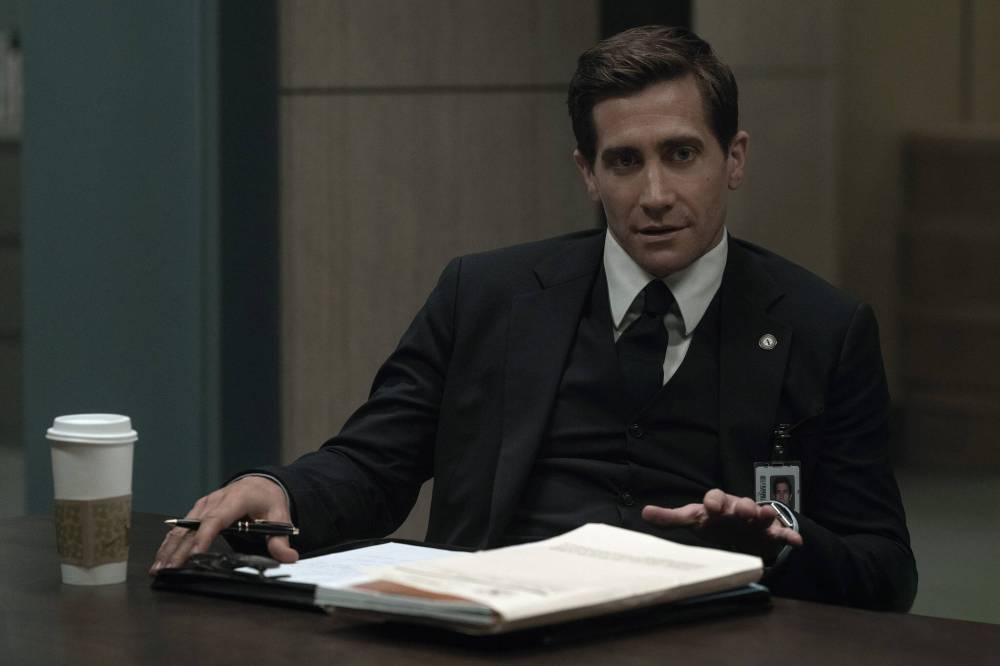
Apple TV+ / TNS
Jake Gyllenhaal stars in "Presumed Innocent."
Adapting to the streaming era, he has specialized in stories of very wealthy, very unhappy women, often with a murder case thrown in (Big Little Lies, The Undoing, Anatomy of a Scandal).
But lately he seems to be in a nostalgic mode. Another recent Kelley project, the Netflix drama A Man in Full, is based on a Tom Wolfe novel, a source with a totally ’90s vibe that never makes the jump to the 21st century.
Presumed Innocent also ends up being pulled between two eras. The updated characters talk a lot more about their feelings, for example. But does the audience really learn anything new?
In 1990, Harrison Ford delivered a typically laconic and emotionally contained performance as Rusty. Gyllenhaal brings more to the surface, and his take on the character is sometimes sympathetic and sometimes sweaty and shouty and angry and arrogant and awash in self-pity.
Rusty’s boss, Raymond Horgan (Bill Camp), who later becomes his defence lawyer, suggests that while Rusty might chalk up his behaviour to “complexity” — the familiar defence of TV’s “difficult men” — some people might just say he’s a “pig.”
It’s an issue Kelley seems to acknowledge, in good 2024 fashion, but is not quite prepared to deal with.

Likewise, the women get more visibility, but do their characters become more rounded? Barbara announces to Rusty — and to us — that she’s not “tragically dependent.” But despite Negga’s strong work, Barbara can’t quite shake the original association with the tropes of “the long-suffering wife.”
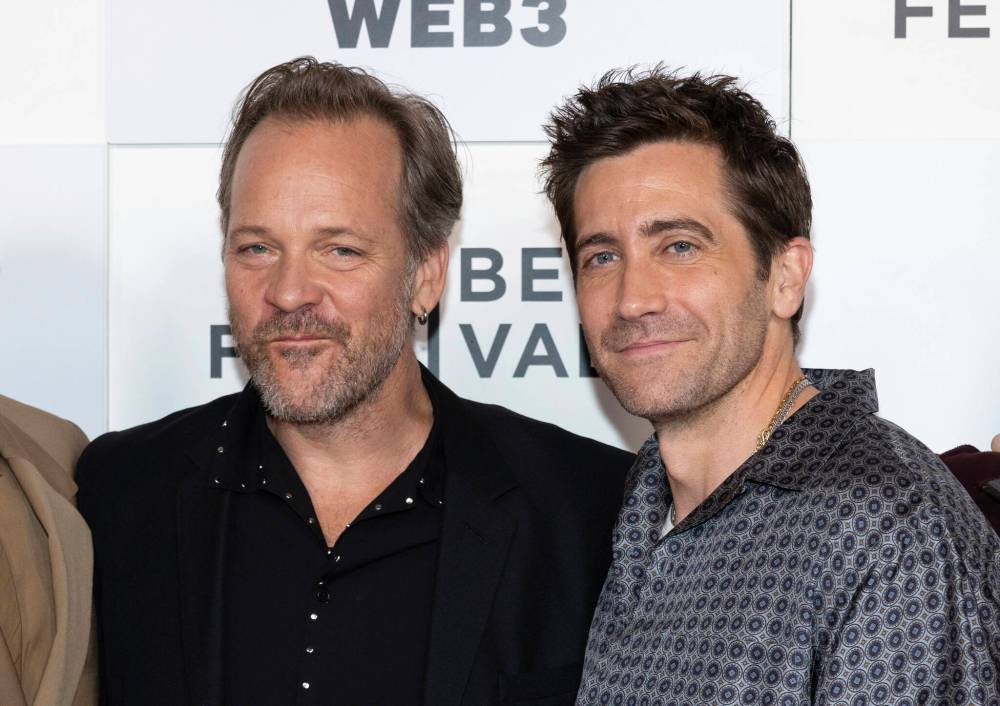
The Associated Press Files
Peter Sarsgaard (left) and Jake Gyllenhaal attend the “Presumed Innocent” premiere during the Tribeca Festival in New York on Sunday.
Carolyn, only seen in other characters’ flashbacks and in increasingly gratuitous crime scene photos of her bloodied, brutalized and bound body, has perhaps even less presence than her 1990 predecessor. This seems like a particularly glaring gap, especially considering the new series’ expanded running time.
“I understand your thirst for relevance,” a character says at one point, using the line as a nasty taunt. Kelley displays his own thirst for relevance, trying to get gritty, real and current with the treatment of gender politics, workplace dynamics and HR nightmares.
But he can’t quite escape the storyline’s ’90s structure. As we head toward the ending, which was famously shocking in the original movie, it will be interesting to see how Kelley handles what has become an improbable and tonally conflicted tangle of regressive and progressive impulses.
alison.gillmor@freepress.mb.ca
Studying at the University of Winnipeg and later Toronto’s York University, Alison Gillmor planned to become an art historian. She ended up catching the journalism bug when she started as visual arts reviewer at the Winnipeg Free Press in 1992.
Our newsroom depends on a growing audience of readers to power our journalism. If you are not a paid reader, please consider becoming a subscriber.
Our newsroom depends on its audience of readers to power our journalism. Thank you for your support.
Studying at the University of Winnipeg and later Toronto’s York University, Alison Gillmor planned to become an art historian. She ended up catching the journalism bug when she started as visual arts reviewer at the Winnipeg Free Press in 1992.
Our newsroom depends on a growing audience of readers to power our journalism. If you are not a paid reader, please consider becoming a subscriber.
Our newsroom depends on its audience of readers to power our journalism. Thank you for your support.
Advertisement Advertise With Us
Advertisement Advertise With Us