Canada’s role in Afghanistan explored in new doc

Advertisement

Advertise with us

After the Sept. 11, 2001, terrorist attacks on the United States, Canadian Armed Forces joined international efforts to secure and rebuild Afghanistan.

Read this article for free:


or

Already have an account? Log in here »

To continue reading, please subscribe:

Subscribe and receive a limited-edition Free Press branded hat or tote.

Digital Subscription

One year of digital access for only $205*

  • Enjoy unlimited reading on winnipegfreepress.com
  • Read the E-Edition, our digital replica newspaper
  • Access News Break, our award-winning app
  • Play interactive puzzles

*First annual payment billed as $205.00 + GST for one year. This annual subscription will automatically renew at $233.00 + GST every 52 weeks (10% off the regular annual price of $259.35). Offer available to new and qualified returning subscribers only. Cancel any time.

To continue reading, please subscribe:

Add Free Press access to your Brandon Sun subscription for only an additional

$1 for the first 4 weeks*

  • Enjoy unlimited reading on winnipegfreepress.com
  • Read the E-Edition, our digital replica newspaper
  • Access News Break, our award-winning app
  • Play interactive puzzles
Start now

*Your next Brandon Sun subscription payment will increase by $1.00 and you will be charged $17.95 plus GST for four weeks. After four weeks, your payment will increase to $24.95 plus GST every four weeks.

Hey there, time traveller!
This article was published 17/09/2024 (690 days ago), so information in it may no longer be current.

After the Sept. 11, 2001, terrorist attacks on the United States, Canadian Armed Forces joined international efforts to secure and rebuild Afghanistan.

Fallen Heroes is a compelling and poignant 90-minute documentary about that experience.

Directed by Robert Curtin and produced by Karen Storwick, both of whom live in Calgary, an earlier 30-minute version of the film came out a couple of years ago and was shown at the ANAVETS hall on Portage Avenue.

“The film highlights the war’s impact on Canadians and is a tribute to the courage and bravery of our men and women in uniform,” says Storwick, who is principal and partner of Combined Forces Production Collaborative, as well as a historian, promoter and producer.

More than 40,000 Canadian Armed Forces members served in Afghanistan over the 14-year campaign.

“Very few Canadians understand why we were in Afghanistan and why it was important, yet it was Canada’s longest war,” Storwick says via email.

Fallen Heroes is the template for a 10-part documentary series on the war in Afghanistan preserving this little-known history for future generations.”

Combined Forces Production Collaborative was the most significant operation for the Canadian Armed Forces in two generations, she says.

“Along with our NATO partners, we were commanding combat operations in Kandahar, ships in the Persian Gulf, and, unprecedented for Canada, we had generals in command of all NATO forces. It was an unusual time in Canadian history where both governing and opposition parties were working in concert in support of the war. All political obstacles and red tape were lifted to equip our soldiers in the field as effectively as possible.”

For an extended period of five years, Canada alone was responsible for security in the most volatile region of the country where we were punching far above our weight, she says.

“We had an important seat at the table and gained an immeasurable amount of respect from other NATO nations. Our efforts were second to none,” Storwick says.

“Canada was the only country with tanks in the field, our pilots were the most daring, our snipers the best in the world, our infantry incredibly courageous and kinetic.”

Our soldiers brought their values into the field, which is uniquely Canadian, she adds.

“In many cases, our soldiers would read the Qur’an ahead of their deployment in order to better understand the people they were going over to help.”
Justin Tang / The Canadian Press files
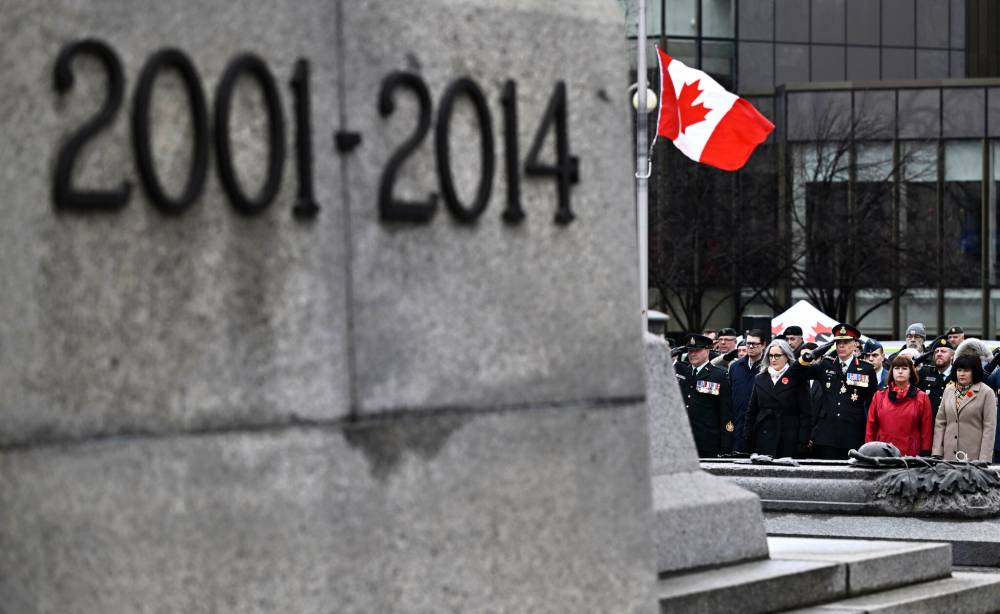
                                The National War Memorial in Ottawa includes a monument dedicated to Canada’s mission in Afghanistan.

Justin Tang / The Canadian Press files

The National War Memorial in Ottawa includes a monument dedicated to Canada’s mission in Afghanistan.

Storwick also points to the tragic cost: Canada lost 159 soldiers and four civilians in Afghanistan. Three times that number came home with physical wounds and countless more with moral and stress injuries.

More than 200 Canadian soldiers have died by suicide since returning home from the war.

“Ramp ceremonies to send our fallen home to their families became an all-too-common reminder of the service and sacrifice of those in uniform. Remembering those that we lost, through projects like Fallen Heroes, is crucial,” says Col. Ryan Stimpson, Chief of Staff, 1 Canadian Air Division.

The trouble in Afghanistan has continued, despite past international efforts.

On Aug. 15, 2021, the Taliban marched into Kabul after a 3 1/2-month offensive, creating chaos, destruction, fear and heartache for the people of Afghanistan following a hasty and poorly planned withdrawal of American forces, Storwick says.

“On the same day, president (Ashraf) Ghani fled the country and the government of Canada closed its embassy. In a shocking twist, the fate of the Afghan people was cruelly rewritten. A generation of Afghans who had grown up in a relatively stable, fledgling democracy had their future wiped out in an instant,” she says.

Fallen Heroes will have its Winnipeg première on Wednesday at the Landmark Cinemas Grant Park at 7 p.m., for one night only. A longer screening run is being planned later this year at another venue.

arts@freepress.mb.ca

Report Error Submit a Tip

More Stories

Canada’s role in Afghanistan explored in new doc

Martin Zeilig 4 minute read Preview

Canada’s role in Afghanistan explored in new doc

Martin Zeilig 4 minute read Tuesday, Sep. 17, 2024

After the Sept. 11, 2001, terrorist attacks on the United States, Canadian Armed Forces joined international efforts to secure and rebuild Afghanistan. Fallen Heroes is a compelling and poignant 90-minute documentary about that experience.

Read
Tuesday, Sep. 17, 2024

Poilievre’s lips moving, but Canadians aren’t interested in what he’s saying

Tom Brodbeck 5 minute read Preview

Poilievre’s lips moving, but Canadians aren’t interested in what he’s saying

Tom Brodbeck 5 minute read Thursday, Aug. 6, 2026

Pierre Poilievre’s biggest political challenge right now isn’t Prime Minister Mark Carney’s popularity.

It’s the fact that he still seems to be campaigning against a political landscape that no longer exists.

More than a year after the 2025 federal election, the Conservative leader is still relying on the same message, the same themes and the same attacks that defined his party’s campaign before voters went to the polls.

And Canadians appear to be tuning it out.

Read
Thursday, Aug. 6, 2026

Puzzles Palace

1 minute read Monday, Jul. 27, 2026

To solve our puzzles, please subscribe with this special offer: |

Survival guide offers a frightening perspective on life in U.S. prisons

Reviewed by Bill Rambo 4 minute read Preview

Survival guide offers a frightening perspective on life in U.S. prisons

Reviewed by Bill Rambo 4 minute read 2:01 AM CDT

Canadian criminal sentencing guidelines identify “three traditional utilitarian goals — deterrence … incapacitation and rehabilitation.”

In spite of lofty intentions, fiction and film have identified North American incarceration in general as largely negative, incapacitating most inmates only while they are actually behind bars. Prison often leads to more crime, teaching criminal behaviour.

Tom Nelson spent more than 17 years in medium and maximum security facilities in the U.S. for such pasttimes as auto theft, armed robbery and drug dealing. Then he turned that life of crime around and became a successful physical trainer and gym owner in Los Angeles.

Nelson met and formed a friendship with Taylor Sheridan, creator and writer of such series as Yellowstone, Landman and the prequels 1883 and 1923. When COVID devastated the gym business and Nelson’s health was failing, Sheridan suggested turning Nelson’s attempt at a screenplay about prison life into a book.

Read
2:01 AM CDT

Local medical scrubs retailer feeling abandoned by U of M, RRC Polytech nursing programs

Maggie Macintosh 4 minute read Preview

Local medical scrubs retailer feeling abandoned by U of M, RRC Polytech nursing programs

Maggie Macintosh 4 minute read Thursday, Aug. 6, 2026

A Winnipeg uniform store is appealing to medical students to shop locally for scrubs this back-to-school season as it grapples with growing competition online and an apparent shutout by local campuses.

Unimor Healthwear has long ordered uniforms in bulk in navy blue, burgundy and pewter, as nurses-in-training are required to wear those colours based on where they’re enrolled in the province.

“It’s not like it used to be,” Evan Schwartz said about customer traffic to his store at 98 Sherbrook St.

The company’s director estimated he spent about $15,000 to stock up on scrubs in pewter in preparation for the launch of Red River College Polytechnic’s upcoming nursing intake.

Read
Thursday, Aug. 6, 2026

Watching while we work

Tory McNally 7 minute read Preview

Watching while we work

Tory McNally 7 minute read 2:01 AM CDT

For many employees, the idea that their employer might be tracking how long they spend at their keyboard, how often they move their mouse, or whether they are actively working throughout the day feels unsettling. For many employers, however, workplace surveillance is increasingly viewed as another management tool, particularly as hybrid and remote work become more common. The recent news that TD plans to monitor certain employees’ activity during the workday has reignited a conversation that has been quietly growing for several years: where is the line between legitimate oversight and excessive monitoring?

The reality is that workplace surveillance is nothing new. Employers have long monitored attendance, reviewed security camera footage, tracked company vehicles using GPS, audited expense reports, and reviewed internet usage on company-owned devices. What has changed is the sophistication of the technology. Today’s software can record login times, monitor application usage, track keystrokes, capture screenshots, analyze email activity, and even generate reports ranking employees based on their perceived productivity.

This naturally raises an important question. Does increased surveillance actually make people work harder?

The answer is not nearly as straightforward as many organizations hope.

Read
2:01 AM CDT