Moving images, mirrored reflections

Advertisement
Read this article for free:
or
Already have an account? Log in here »
To continue reading, please subscribe:
Digital Subscription
One year of digital access for only $1.44 a week*
- Enjoy unlimited reading on winnipegfreepress.com
- Read the E-Edition, our digital replica newspaper
- Access News Break, our award-winning app
- Play interactive puzzles
*Billed as $5.77 plus GST every four weeks. After 52 weeks, price increases to the regular rate of $19.95 plus GST every four weeks. Offer available to new and qualified returning subscribers only. Cancel any time.
To continue reading, please subscribe:
Add Free Press access to your Brandon Sun subscription for only an additional
$1 for the first 4 weeks*
- Enjoy unlimited reading on winnipegfreepress.com
- Read the E-Edition, our digital replica newspaper
- Access News Break, our award-winning app
- Play interactive puzzles
*Your next Brandon Sun subscription payment will increase by $1.00 and you will be charged $17.95 plus GST for four weeks. After four weeks, your payment will increase to $24.95 plus GST every four weeks.
Read unlimited articles for free today:
or
Already have an account? Log in here »
Hey there, time traveller!
This article was published 05/10/2024 (742 days ago), so information in it may no longer be current.
‘I grew up in a household where my parents had a lot of mirrors,” says Anto(n) Astudillo, whose first name includes a parenthetical as a practical and playful reminder of different stages of their life.
As a kid in Santiago, Chile, Astudillo wasn’t the type to shy away from self-assessment. “There was a lot of imagining what I looked like,” says the artist, who uses they/he pronouns. He would play with his hair or wear his father’s ties, noticing what he now understands as the transportative, ethereal possibilities offered by a reflective surface.
“To me, the mirror was a dream space,” says Astudillo, who now lives in Brooklyn and who shares insights into their trans experience using a hybrid of film and live theatre.
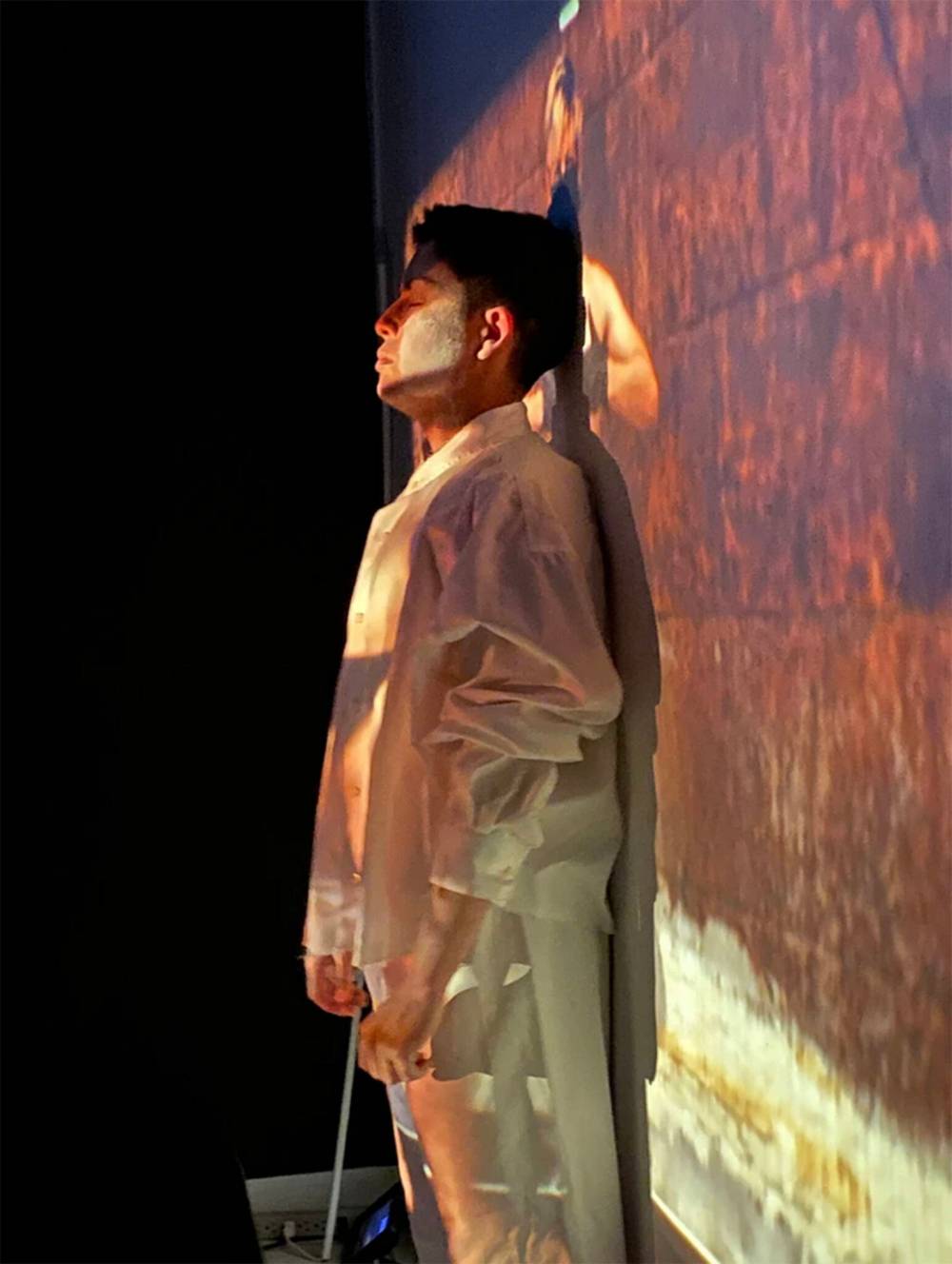
MIKA PHOTO
Artist Anto(n) Astudillo in a performance titled A Body Surrenders
It’s an idea that Astudillo explored Friday night at the Winnipeg Film Group’s Black Lodge Studio as a visiting artist for the 19th edition of the WNDX Festival of Moving Image — the annual five-day experimental film fest that runs to Sunday — in a new lyrical performance dubbed Trans the Mirror, followed by a 30-minute AR, VR and mixed-reality performance by Winnipeg’s Freya Björg Olafson.
This afternoon at 2 p.m., Astudillo and Olafson will participate in a free artist talk at Dave Barber Cinematheque, discussing their processes, their visions and their understandings of their work, both in the context of solo performance and in the presence of an engaged audience. Donations are accepted at the door.
With a film of their own showing in the background, the performance began with Astudillo sitting in a chair with a 16-millimetre projector illuminating his bare legs. “I think a lot of my work is about what I can make you feel in that intimate moment, embracing that you can feel really good about certain parts of your body that feel closer to, in my case, feeling masculine and more comfortable with my body.”
The performance was inspired, Astudillo says, by the effort and time it takes to make peace with your body and its own visibility. “I was thinking of my personal experience being trans and what it means to transition, whether medically or hormonally, so I was thinking about mirrors, a little bit inspired by (the Alice in Wonderland sequel) Through the Looking Glass.
“How Alice goes through the mirror into this other world where the rules don’t work the same way, where gravity doesn’t work the same way, where time doesn’t work the same way, and I was thinking about how as individuals we offer a new perspective of life and a new way to see.
“We’ve proposed to change our binary mentality, so I was thinking of this idea of transgressing the mirror and breaking through,” they add. “A lot of us trans people grew up imagining who we really are and what our reflection really looks like. From a very young age, (we are aware) of the idea of a mirror being a space that could take you to a portal of transition.”
The performance naturally leads the audience to consider its own gaze and perception, and to questions about distortion and the fallability of visual information. Are we sure that what we see is what’s being shown?
Aside from the narrative innovations of Lewis Carroll, the ideas behind Astudillo’s work are inspired by the commentary criticism of scholars like Judith Butler, Simone de Beauvoir and in particular Jack Halberstam. In terms of performance, they say a major influence has been Juan-Carlos Montagna, who taught Astudillo about an approach to performance called psycho-physical theatre.
“As the name says, it has a lot to do with your physical presence and choreography, the idea of it being connected to your psyche, with your body and mind being one thing, not divided into intellectual or physical or text theatre,” Astudillo says. “It looks like dance, but with a text.”
The work can be physically draining and often emotionally open, Astudillo adds, especially when considering the intersecting identities existing for artists from marginalized groups.
“At first you have to be visible, and in this visibility, there’s a lot of vulnerability,” the artist adds. “You never know what the reaction will be.”
ben.waldman@freepress.mb.ca
Ben Waldman is a National Newspaper Award-nominated reporter on the Arts & Life desk at the Free Press. Born and raised in Winnipeg, Ben completed three internships with the Free Press while earning his degree at Ryerson University’s (now Toronto Metropolitan University’s) School of Journalism before joining the newsroom full-time in 2019. Read more about Ben.
Every piece of reporting Ben produces is reviewed by an editing team before it is posted online or published in print — part of the Free Press‘s tradition, since 1872, of producing reliable independent journalism. Read more about Free Press’s history and mandate, and learn how our newsroom operates.
Our newsroom depends on a growing audience of readers to power our journalism. If you are not a paid reader, please consider becoming a subscriber.
Our newsroom depends on its audience of readers to power our journalism. Thank you for your support.
WNDX Festival events
All events at Dave Barber Cinematheque (100 Arthur St.) unless otherwise indicated
Saturday
2 p.m. – Anto(n) Astudillo + Freya Björg Olafson artist talk
4 p.m. – Trans-temporal imaginations: Experimental Film from South Asia
7 p.m. – Feature Documentary: Feet in Water, Head on Fire by Terra Long
9 p.m. – Open Call 4: Horror Landscape
Sunday
2 p.m. – Open Call 5: wnderland
4 p.m. – Open Call 6: Ceremonial/Valley of Light
7 p.m. – One Take Super-8 film showcase at Manitoba Museum Auditorium (190 Rupert Ave.)
For more information, visit wndx.org
Ben Waldman is a National Newspaper Award-nominated reporter on the Arts & Life desk at the Free Press. Born and raised in Winnipeg, Ben completed three internships with the Free Press while earning his degree at Ryerson University’s (now Toronto Metropolitan University’s) School of Journalism before joining the newsroom full-time in 2019. Read more about Ben.
Every piece of reporting Ben produces is reviewed by an editing team before it is posted online or published in print — part of the Free Press‘s tradition, since 1872, of producing reliable independent journalism. Read more about Free Press’s history and mandate, and learn how our newsroom operates.
Our newsroom depends on a growing audience of readers to power our journalism. If you are not a paid reader, please consider becoming a subscriber.
Our newsroom depends on its audience of readers to power our journalism. Thank you for your support.
Advertisement Advertise With Us
Advertisement Advertise With Us