Beauty and the beast
Undercurrent of climate dread flows through haunting landscape

Advertisement
Read this article for free:
or
Already have an account? Log in here »
To continue reading, please subscribe:

Digital Subscription
One year of digital access for only $205*
- Enjoy unlimited reading on winnipegfreepress.com
- Read the E-Edition, our digital replica newspaper
- Access News Break, our award-winning app
- Play interactive puzzles
*First annual payment billed as $205.00 + GST for one year. This annual subscription will automatically renew at $233.00 + GST every 52 weeks (10% off the regular annual price of $259.35). Offer available to new and qualified returning subscribers only. Cancel any time.
To continue reading, please subscribe:
Add Free Press access to your Brandon Sun subscription for only an additional
$1 for the first 4 weeks*
- Enjoy unlimited reading on winnipegfreepress.com
- Read the E-Edition, our digital replica newspaper
- Access News Break, our award-winning app
- Play interactive puzzles
*Your next Brandon Sun subscription payment will increase by $1.00 and you will be charged $17.95 plus GST for four weeks. After four weeks, your payment will increase to $24.95 plus GST every four weeks.
Read unlimited articles for free today:
or
Already have an account? Log in here »
Hey there, time traveller!
This article was published 30/11/2024 (673 days ago), so information in it may no longer be current.
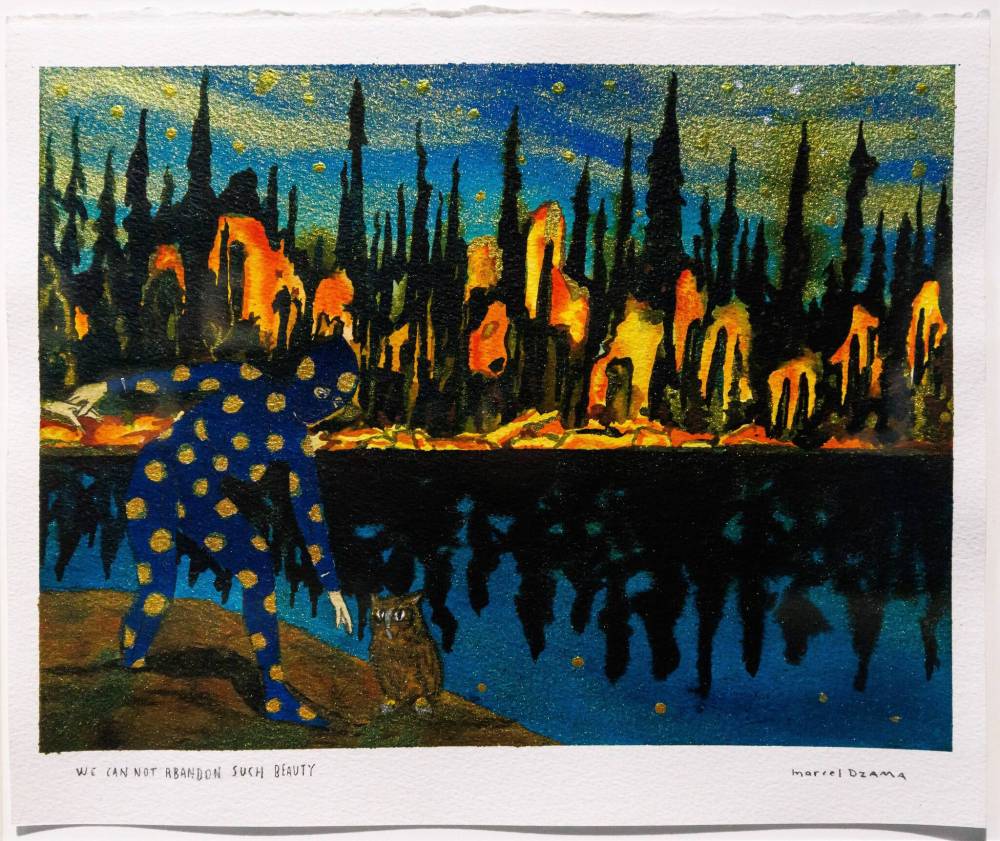
WHAT IT IS: We can not abandon such beauty is a 2023 work by Marcel Dzama, a Canadian artist raised in Winnipeg and now living in New York. This mixed media-on-paper landscape — modest in its dimensions but outsized in its chromatic intensity and apocalyptic beauty — is part of his new solo show at Plug In ICA.
WHAT IT’S ABOUT: Ghosts of Canoe Lake: New Works by Marcel Dzama was initially organized by the McMichael Canadian Art Collection, the Kleinburg, Ont., museum that is a repository of works by Tom Thomson and the Group of Seven. Dzama’s work can be seen as both a sincere homage and a subversive challenge to that artistic legacy.
There are Group of Seven riffs in the style of We can not abandon such beauty, in the intense colours and the textured, painterly marks. And there are clear historical references in the subject matter, those spindly pines reflected in deep water calling up the raw, rough renderings of the Canadian wilderness we see in the paintings of Thomson and the Group. The text next to the work suggests there could be connections to the early work of Lawren Harris, or perhaps Arthur Lismer.
Winnipeg-born artist Marcel Dzama’s solo exhibition Ghosts of Canoe Lake is currently on show at the Plug In ICA gallery until March 8.
But there’s a sudden outbreak of oddity in the foreground — on our side of the lake, so to speak. A masked and bodysuited female figure — a bit whimsical, a little sinister — reaches out with an ambiguous gesture to an owl. The woman seems fated to remain in mime-like silence. The miffed little bird, on the other hand, as with so many of Dzama’s creatures, looks like it could say a few things.
Going back to his early Winnipeg days, when he was a student at the University of Manitoba’s School of Art and a founding member of the influential art collective the Royal Art Lodge, Dzama has always been on the lookout for beauty and weirdness, gathering up creative influences with avid hunger.
This show channels not just those early 20th-century Canadian artists, but also William Blake and James Ensor, Vincent van Gogh and Gustav Klimt, Francis Picabia and Marcel Duchamp, Spanish poet Federico Garcia Lorca and French filmmaker Georges Méliès.
Then there are the callbacks to old-timey cartoons, scary fairy tales and Maurice Sendak’s wild rumpuses, to the characters of the carnivale and the harlequinade.
What’s miraculous about this show is that it never becomes an all-over-the-place artistic free-for-all. All those disparate sources are funnelled through Dzama’s obsessive, idiosyncratic imagination, transmuted into his own highly distinctive style and attitude. Even with all the hat-tips to other artists and other works, there’s an unusual visual and tonal unity to Ghosts of Canoe Lake.

We can not… speaks to the exhibition’s other pieces with its hues — the deep, dark blues of the northern lake and starry night, the molten yellows and oranges of the woods — and in the density and energy of its composition.
It also channels the show’s overall mood, which can feel whimsical but also undercut with menace. Here the lights in the woods suggest threats of wildfire and environmental devastation.
WHY IT MATTERS: Dzama’s show engages with the Group of Seven’s achievements but also supplies a crucial contemporary update to their vision of the Canadian landscape as pure, pristine and unpeopled.
The natural world, as Dzama makes clear, is not untouched. Human activity is shifting it, maybe even tipping it irrevocably toward destruction. For all the strange beauty of this image, there is a thin, insistent line of climate dread running underneath.
alison.gillmor@freepress.mb.ca
Studying at the University of Winnipeg and later Toronto’s York University, Alison Gillmor planned to become an art historian. She ended up catching the journalism bug when she started as visual arts reviewer at the Winnipeg Free Press in 1992.
Our newsroom depends on a growing audience of readers to power our journalism. If you are not a paid reader, please consider becoming a subscriber.
Our newsroom depends on its audience of readers to power our journalism. Thank you for your support.
Studying at the University of Winnipeg and later Toronto’s York University, Alison Gillmor planned to become an art historian. She ended up catching the journalism bug when she started as visual arts reviewer at the Winnipeg Free Press in 1992.
Our newsroom depends on a growing audience of readers to power our journalism. If you are not a paid reader, please consider becoming a subscriber.
Our newsroom depends on its audience of readers to power our journalism. Thank you for your support.
Advertisement Advertise With Us
Advertisement Advertise With Us