Rare Woodland encounter Thanks to avid collector, trove of Indigenous artist Kakegamic’s works now on display
Read this article for free:
or
Already have an account? Log in here »
To continue reading, please subscribe:

Digital Subscription
One year of digital access for only $205*
- Enjoy unlimited reading on winnipegfreepress.com
- Read the E-Edition, our digital replica newspaper
- Access News Break, our award-winning app
- Play interactive puzzles
*First annual payment billed as $205.00 + GST for one year. This annual subscription will automatically renew at $233.00 + GST every 52 weeks (10% off the regular annual price of $259.35). Offer available to new and qualified returning subscribers only. Cancel any time.
To continue reading, please subscribe:
Add Free Press access to your Brandon Sun subscription for only an additional
$1 for the first 4 weeks*
- Enjoy unlimited reading on winnipegfreepress.com
- Read the E-Edition, our digital replica newspaper
- Access News Break, our award-winning app
- Play interactive puzzles
*Your next Brandon Sun subscription payment will increase by $1.00 and you will be charged $17.95 plus GST for four weeks. After four weeks, your payment will increase to $24.95 plus GST every four weeks.
Read unlimited articles for free today:
or
Already have an account? Log in here »
Hey there, time traveller!
This article was published 07/12/2024 (660 days ago), so information in it may no longer be current.
Winnipeggers have the rare chance to immerse themselves in the work of the late Joshim (Josh) Kakegamic, a key artist in the historic Woodland School.
Man Into Thunderbird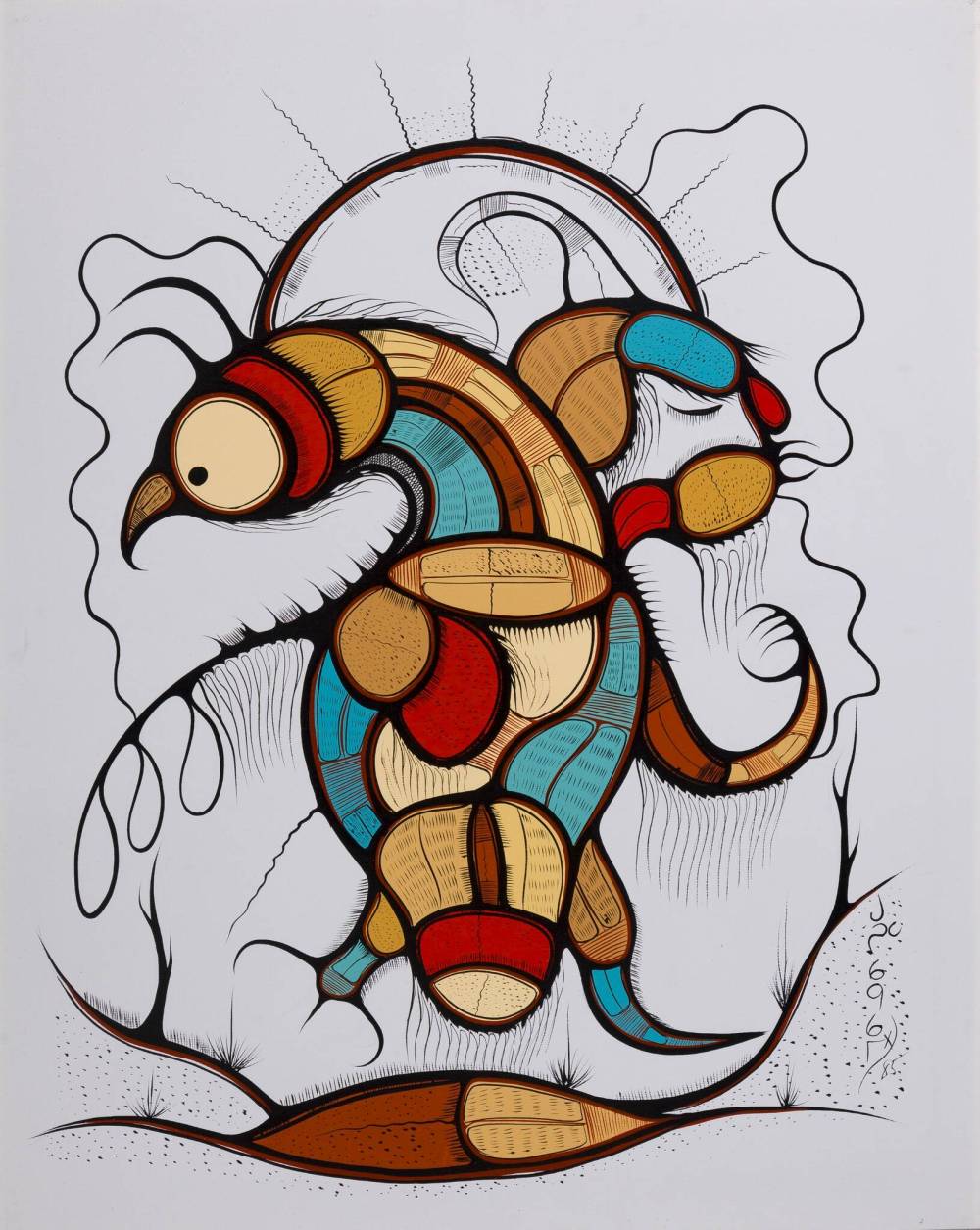
Joshim Kakegamic: The Litman Collection features 53 works for sale by the late Kakegamic, a close peer of the late Norval Morrisseau, who founded the Woodland School of Art. It’s an impressive selection from Jerry Litman’s collection of Woodland painters.
“My father was the town dentist in Kenora, so the profile was such that the office became a spot where people would stop off and say, ‘Here’s some artwork for you,’” says Shelley Litman, daughter of the Winnipeg-born Jerry, who died in 2020.
Much of this work was in the Woodland School, known for blending traditional First Nations legends and myths with modern mediums.
You’ll have seen the iconic style, with its X-ray view of animals, people and spiritual beings; northern Ontario and southwestern Manitoba are among its key sources. The majority of the Woodland artists are Anishinaabeg.
MIKE DEAL / FREE PRESS Mayberry Fine Art founder Bill Mayberry (left) and Shelley Litman, daughter of dentist and Woodland School art collector Jerry Litman, stand amid works of artist Joshim Kakegamic, on sale now at the Exchange District gallery.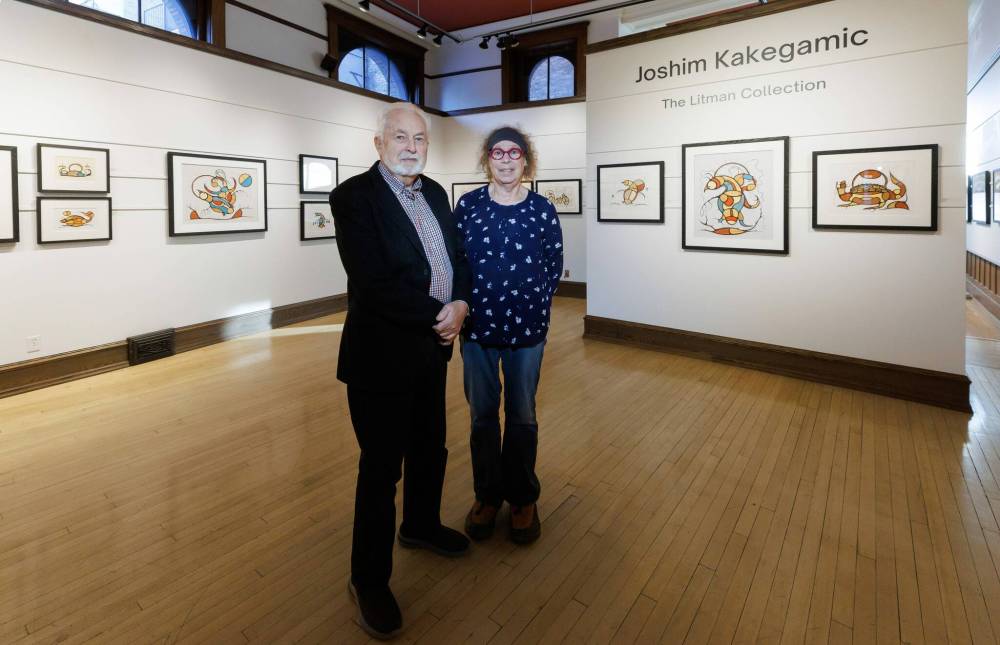
“Norval Morrisseau’s studio was two buildings over from my dad, so he would take me there as a little kid, because they were friends,” Shelley Litman goes on.
The family was living amid a vital art movement, whose leader, Morrisseau, was called the “Picasso of the North.”
Born in 1952, Kakegamic, from Sandy Lake First Nation and Morrisseau’s younger brother-in-law, began painting as a teenager in the late ’60s. He was a remarkably fast learner.
“By 1970 he had already honed his skills,” says Mayberry Fine Art gallery founder Bill Mayberry. “You see the confidence within the drawing patterns of the (early) work.”
Medicine Man, by Josh Kakegamic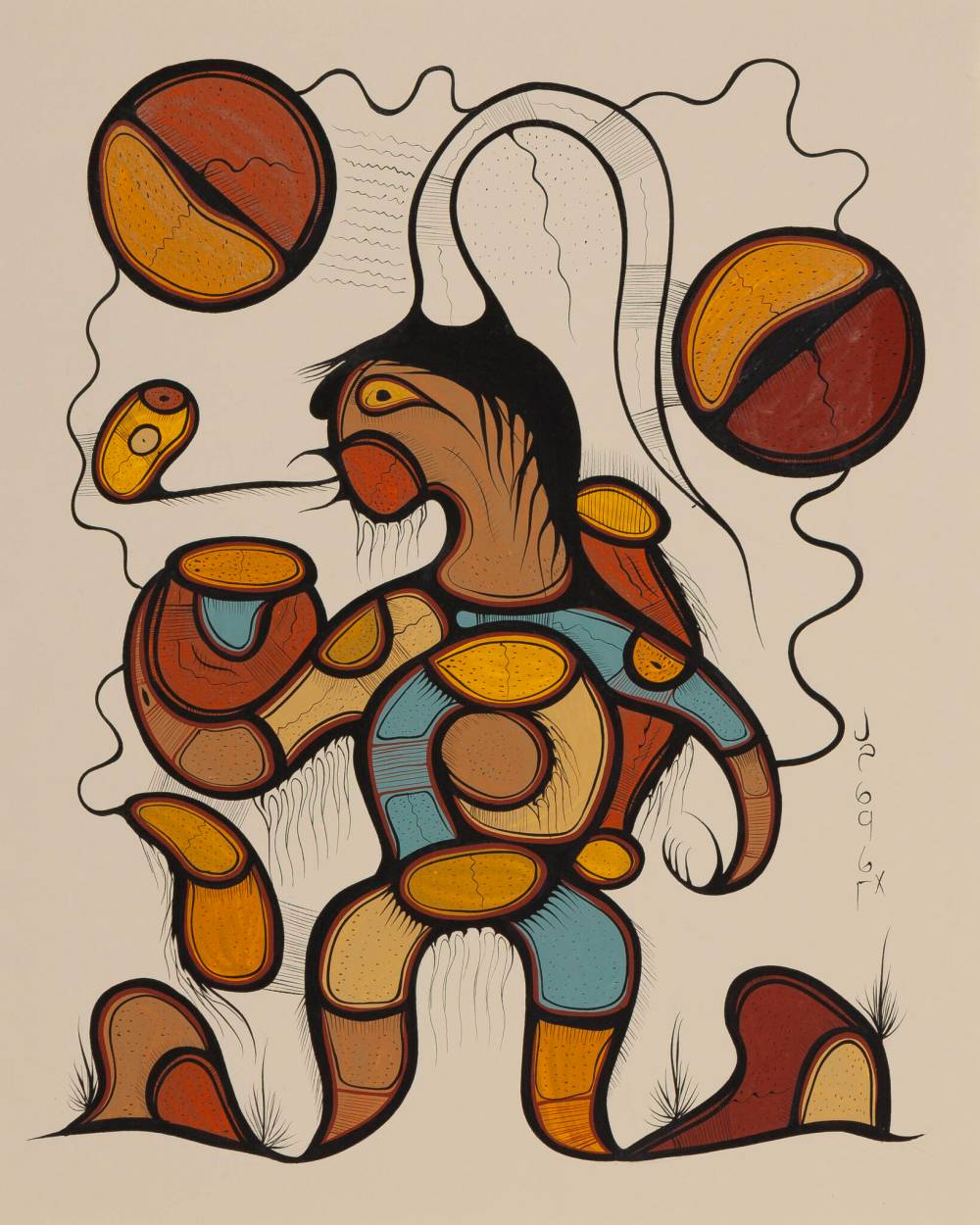
Kakegamic took lessons from Morrisseau and fellow Indigenous Group of Seven member Carl Ray, who had been delivering workshops for local First Nations. A workshop at Fanshawe College in London, Ont., introduced him to screen printing, and then he was off to Toronto, spending time at the Open Studio during one of the city’s more exciting periods in its visual art scene.
With his works’ bold but meticulous use of colour and line, Kakegamic developed a style of his own. But for someone who drew inspiration from his Woodland peers and the landscape, it was natural he’d soon find himself closer to home.
In 1973, at only 21 years of age, Kakegamic and his brothers co-founded the screen-printing business Triple K Co-operative in Red Lake, Ont. The first Indigenous-owned and operated printing company in Canada, Triple K also contributed considerably to Woodland School’s legacy, producing limited editions of many of its artists’ work.
Sacred Loon by Josh Kakegamic; the Cree artist’s bold lines and colours are distinctive.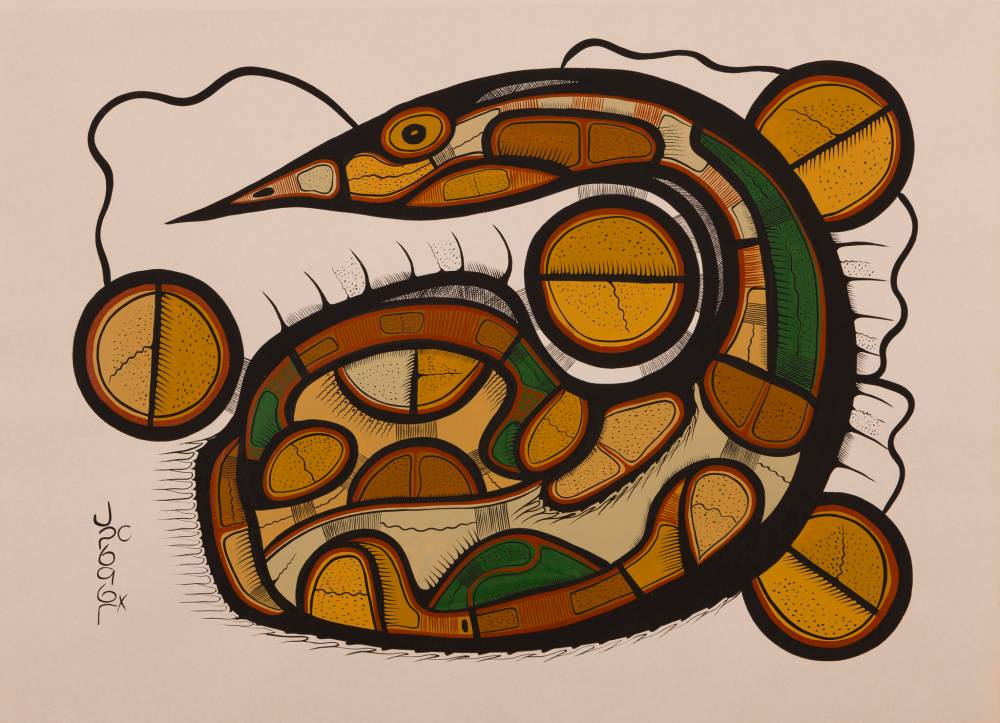
The Royal Ontario Museum in Toronto mounted Silkscreens of Famous Native Artists from Northern Ontario in 1977 to showcase work from Triple K Co-operative.
“They were pretty amazing print-makers,” says Thunder Bay’s Ahnisnabae Art Gallery owner and operator Louise Thomas, whose gallery carries some of Kakegamic’s work.
“It was quite an accomplishment for Indigenous artists, especially back then. Red Lake is a drivable town, but even for that community, it was amazing… Starting from scratch, before computers, and working together.”
Throughout the 1970s and ’80s, Kakegamic exhibited in Canada, England and Germany. In the process, he established himself as a powerful voice in a historic artistic movement — but, in the words of Mayberry, remains “a little bit ignored because of the dominance of the few other artists.”
Tragically, Kakegamic died in 1993 while attempting to rescue someone on a Northern Ontario lake, after he’d bravely responded to a call to retrieve some young snowmobilers stranded on the ice.
Kakegamic’s work was spread in many directions, one of them being the Litman family, who moved back to Winnipeg from Kenora in 1979.
Noah’s Ark by Josh Kakegamic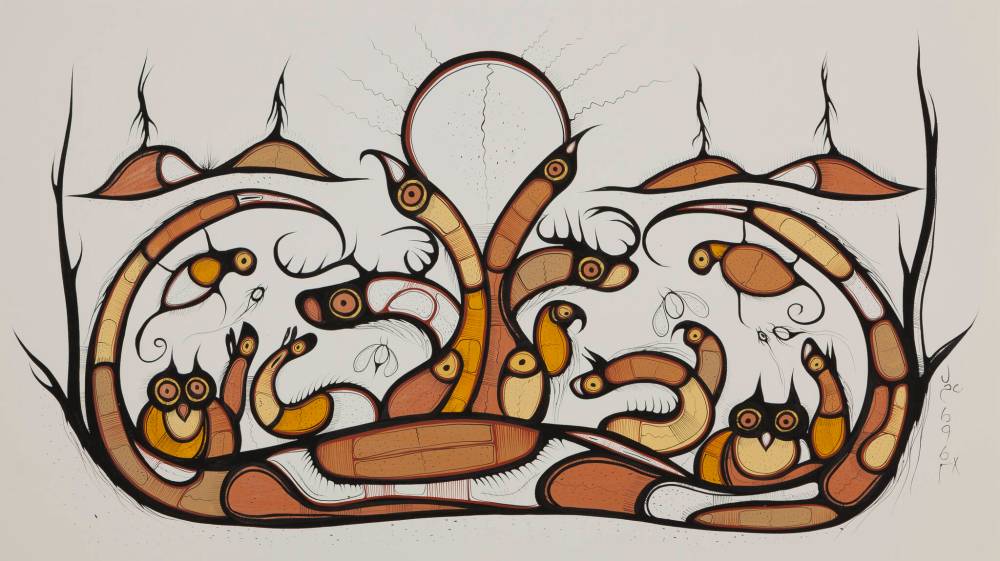
“I just never realized how much (my father) was accumulating, and then he had to get it into the house past my mother,” says Litman. “It was unframed. It was hidden. It was in closets. It was in drawers. It was in garment bags.”
It was also originally at her father’s place of work. Litman describes him often stepping out and coming back with a bag, its art object inside concealed, and a wry look on his face.
This seems to be a special case of “dentist office art” being much, much more than that.
Deciding what to do with the work in her father’s estate has been, she says, a bittersweet process. From the 350-odd works in his Woodland collection, about 170 are now with the University of Manitoba, 100 with Mayberry, and the rest with the Muse art centre in Kenora.
Of the Kakegamics, there are four Litman said she couldn’t bear to part with.
The artworks in the Mayberry exhibition are priced in the $700 to $5,000 range and can be viewed online at wfp.to/kakegamic. The sale runs to Dec. 21.
conrad.sweatman@freepress.mb.ca

Conrad Sweatman is an arts reporter and feature writer. Before joining the Free Press full-time in 2024, he worked in the U.K. and Canadian cultural sectors and freelanced for outlets including The Walrus, VICE and Prairie Fire. Read more about Conrad.
Our newsroom depends on a growing audience of readers to power our journalism. If you are not a paid reader, please consider becoming a subscriber.
Our newsroom depends on its audience of readers to power our journalism. Thank you for your support.
History
Updated on Wednesday, December 11, 2024 1:39 PM CST: Adds quotes