The motion in emotion
‘We try to use all the movements I can do on the bike to try to understand, what can the bike say? Where can the bicycle take us?’

Advertisement
Read this article for free:
or
Already have an account? Log in here »
To continue reading, please subscribe:

Digital Subscription
One year of digital access for only $205*
- Enjoy unlimited reading on winnipegfreepress.com
- Read the E-Edition, our digital replica newspaper
- Access News Break, our award-winning app
- Play interactive puzzles
*First annual payment billed as $205.00 + GST for one year. This annual subscription will automatically renew at $233.00 + GST every 52 weeks (10% off the regular annual price of $259.35). Offer available to new and qualified returning subscribers only. Cancel any time.
To continue reading, please subscribe:
Add Free Press access to your Brandon Sun subscription for only an additional
$1 for the first 4 weeks*
- Enjoy unlimited reading on winnipegfreepress.com
- Read the E-Edition, our digital replica newspaper
- Access News Break, our award-winning app
- Play interactive puzzles
*Your next Brandon Sun subscription payment will increase by $1.00 and you will be charged $17.95 plus GST for four weeks. After four weeks, your payment will increase to $24.95 plus GST every four weeks.
Read unlimited articles for free today:
or
Already have an account? Log in here »
Hey there, time traveller!
This article was published 17/01/2025 (584 days ago), so information in it may no longer be current.
Guillaume Doin rides two bicycles every day, but only one of them is street-safe.
On his daily commute through Montreal, he straddles his trusty two-wheeler before arriving at the theatre.
There, he climbs onto his work bike: a special, yellow vélo without brakes that he whips around the stage at freeway speeds before balancing his body weight on the curled handlebars and leather seat as if it were the most natural way to get around town.
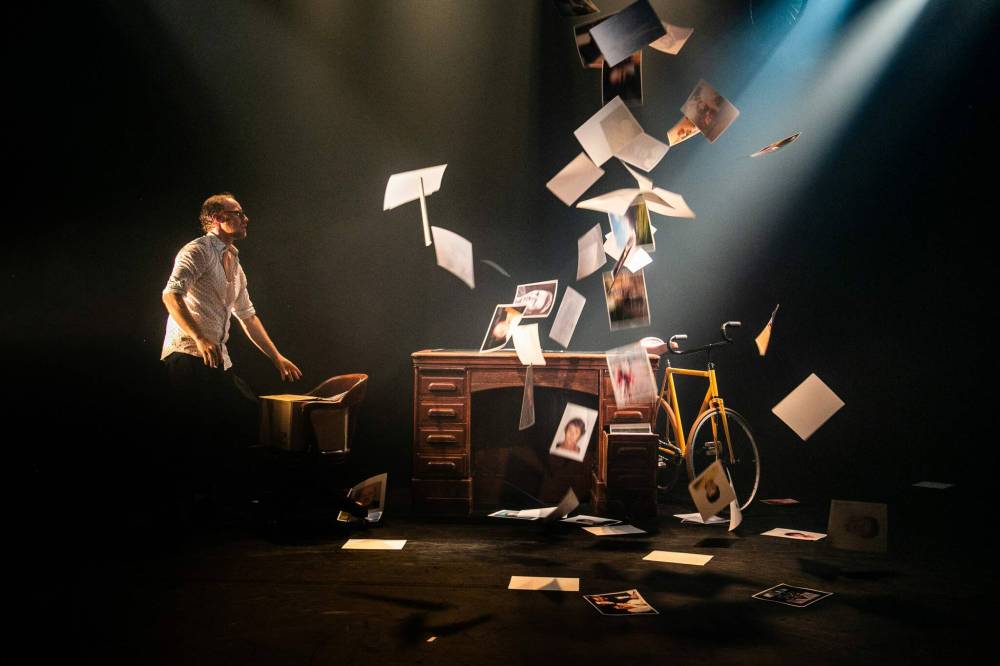
Robert Etcheverry / MTYP
In Life-Cycle, Guillaume Doin rides his bike to dazzling effect during the wordless, hour-long performance, recommended for audiences eight years and up.
Doin makes it look easy, but he wasn’t always so graceful.
“At first, I fell off a lot,” laughs Doin, the creator and gymnastic performer of Life-Cycle, opening Jan. 17 at Manitoba Theatre for Young People (MTYP). “Then I trained and now I fall less.”
A story of perseverance and self-discovery, with Doin’s character returning to his past to better comprehend his present, Life-Cycle was created for Montreal’s Complètement Cirque festival by Doin and director Yves Simard.
Simard and Doin knew the bicycle could help carry the type of story theatre company DynamO likes to share — a blend of motion and emotion that transcends linguistic barriers.
At first, Simard didn’t grasp how challenging it was to master the bike, the kind used in the niche sport of artistic bicycling — a style of riding more akin to figure skating than it is to BMX.

“I was always asking Guillaume, ‘Can you do this? Can you try that?’ And then he made me try his bike, and I understood why it took so long to do his tricks,” says Simard, the co-artistic director of DynamO Théâtre, the company that, alongside Doin, created the show in 2019.
Founded in 1981, DynamO creates shows that emphasize movement and crossover between different types of stage entertainment, including acrobatics, illusions, puppetry and clowning. The company has performed in over 30 countries, braking eight times at MTYP with various shows.
Life-Cycle uses the bicycle as a literal vehicle for storytelling, with Doin manipulating the bike’s fixed architecture to dazzling effect during the wordless, hourlong performance, recommended for audiences eight years and up.
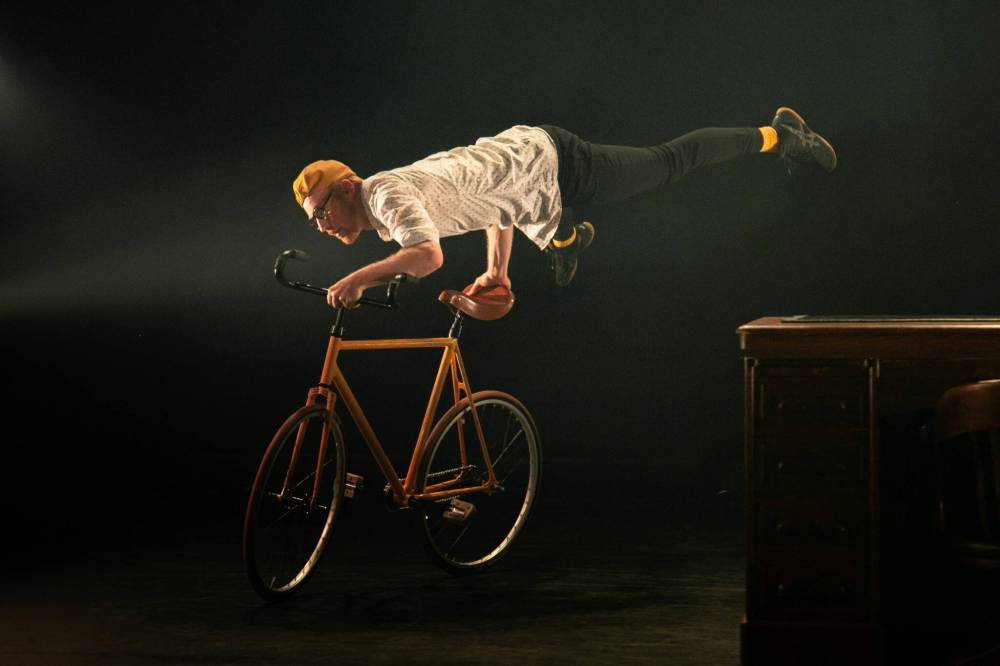
Robert Etcheverry / MTYP
Guillaume Doin’s performance in Life-Cycle owes more to the niche sport of artistic bicycling than to street cycling.
“There are elements of magic and illusion, too,” says Simard, who leaves the stunt-riding up to Doin.
“We try to use all the movements I can do on the bike to try to understand, what can the bike say? Where can the bicycle take us?” says Doin, whose training as a circus performer prepared him for the daring movements in the show.
So far, the bicycle has taken the performer all around the world, from Seoul to Madrid to Bogotá to Guelph.
“We’ve performed it now over 100 times,” says Simard, who especially enjoys putting on shows for young audiences, which, like riding a bike, is a restorative experience.
“It’s quite good for the soul of the artist.”
ben.waldman@winnipegfreepress.com
If you value coverage of Manitoba’s arts scene, help us do more.
Your contribution of $10, $25 or more will allow the Free Press to deepen our reporting on theatre, dance, music and galleries while also ensuring the broadest possible audience can access our arts journalism.
BECOME AN ARTS JOURNALISM SUPPORTER
Click here to learn more about the project.
Ben Waldman is a National Newspaper Award-nominated reporter on the Arts & Life desk at the Free Press. Born and raised in Winnipeg, Ben completed three internships with the Free Press while earning his degree at Ryerson University’s (now Toronto Metropolitan University’s) School of Journalism before joining the newsroom full-time in 2019. Read more about Ben.
Every piece of reporting Ben produces is reviewed by an editing team before it is posted online or published in print — part of the Free Press‘s tradition, since 1872, of producing reliable independent journalism. Read more about Free Press’s history and mandate, and learn how our newsroom operates.
Our newsroom depends on a growing audience of readers to power our journalism. If you are not a paid reader, please consider becoming a subscriber.
Our newsroom depends on its audience of readers to power our journalism. Thank you for your support.
Theatre Preview
Life-Cycle
● Manitoba Theatre For Young People, 2 Forks Market Rd.
● Tonight, Jan. 17 to Jan. 26
● Tickets $24 to $27 at mtyp.ca
If you value coverage of Manitoba’s arts scene, help us do more.
Your contribution of $10, $25 or more will allow the Free Press to deepen our reporting on theatre, dance, music and galleries while also ensuring the broadest possible audience can access our arts journalism.
BECOME AN ARTS JOURNALISM SUPPORTER
Click here to learn more about the project.
Ben Waldman is a National Newspaper Award-nominated reporter on the Arts & Life desk at the Free Press. Born and raised in Winnipeg, Ben completed three internships with the Free Press while earning his degree at Ryerson University’s (now Toronto Metropolitan University’s) School of Journalism before joining the newsroom full-time in 2019. Read more about Ben.
Every piece of reporting Ben produces is reviewed by an editing team before it is posted online or published in print — part of the Free Press‘s tradition, since 1872, of producing reliable independent journalism. Read more about Free Press’s history and mandate, and learn how our newsroom operates.
Our newsroom depends on a growing audience of readers to power our journalism. If you are not a paid reader, please consider becoming a subscriber.
Our newsroom depends on its audience of readers to power our journalism. Thank you for your support.
Advertisement Advertise With Us
Advertisement Advertise With Us