Severed from COVID context, office-set satire still cuts it

Advertisement
Read this article for free:
or
Already have an account? Log in here »
To continue reading, please subscribe:

Digital Subscription
One year of digital access for only $205*
- Enjoy unlimited reading on winnipegfreepress.com
- Read the E-Edition, our digital replica newspaper
- Access News Break, our award-winning app
- Play interactive puzzles
*First annual payment billed as $205.00 + GST for one year. This annual subscription will automatically renew at $233.00 + GST every 52 weeks (10% off the regular annual price of $259.35). Offer available to new and qualified returning subscribers only. Cancel any time.
To continue reading, please subscribe:
Add Free Press access to your Brandon Sun subscription for only an additional
$1 for the first 4 weeks*
- Enjoy unlimited reading on winnipegfreepress.com
- Read the E-Edition, our digital replica newspaper
- Access News Break, our award-winning app
- Play interactive puzzles
*Your next Brandon Sun subscription payment will increase by $1.00 and you will be charged $17.95 plus GST for four weeks. After four weeks, your payment will increase to $24.95 plus GST every four weeks.
Read unlimited articles for free today:
or
Already have an account? Log in here »
Hey there, time traveller!
This article was published 18/01/2025 (584 days ago), so information in it may no longer be current.
The first season of Severance streamed in the spring of 2022. It was dense with ideas, thick with mysterious menace. The second season just kicked off on Apple TV+, with new episodes dropping on Fridays.
In that almost three-year gap between seasons, my unsevered, overburdened brain hasn’t retained much of the show’s complicated plot. I recall a provocative premise, cool chairs, something about baby goats.
After a comprehensive online recap and a dip into the fevered fan theorizing that proliferated during the series’ hiatus, I picked up my keycard and returned to Lumon Industries headquarters. Thank Keir, Severance’s sophomore season does not slump.
The off-kilter comic satire is as sharp as ever, the ethical questions are even trickier, the unexpected emotional tenderness has deepened.
Plus, there’s more about the goats.
From creator Dan Erickson and executive producer and director Ben Stiller, Severance is basically The Office by way of Franz Kafka. The series starts off with a disquieting speculative concept: Employees at the Lumon corporation, a global leader in biotechnology, can undergo a chip-implanting process known as “severance,” in which their memories are bifurcated into a job mode and a home mode.
It’s a grotesquely literal version of our culture’s obsession with “work-life balance.” Now the “outies” can head home unburdened by work worries (and, not incidentally, also unable to recall any inconvenient whistle-blowing facts about what this very sinister, secretive company might be up to).
The “innies,” meanwhile, possess general memory but have never fretted about household budgets or day-care arrangements. Neither have they seen the sun nor read their kids a bedtime story. Sequestered on the “severed” floor, they experience life as an endless, windowless round of work, their productivity unimpeded by thoughts of the larger world.
Season 1’s cliffhanger ending saw the four intrepid innies of the MDR (Macro Data Refining) section — Mark S. (Adam Scott), Helly R. (Britt Lower), Irv B. (John Turturro) and Dylan G. (Zach Cherry) — experiencing a brief awakening in the outside world.
This season sees the gang getting back together to do some stealth investigations of their corporate overlords, with the show returning to some of the rabbit holes over which Reddit commentators have been obsessing for almost three years.
The series’ look continues to be highly stylized and slightly uncanny, an out-of-place, out-of-time mix of mid-20th-century corporate modernism, impossibly wide pre-1980 cars, and tech that calls back to the days of AV carts, clunky computers and dot-matrix printers.
There are some new additions. If you feel the interns are getting younger every year, you’ll be disturbed to find Lumon’s latest is an actual child, the scarily impervious Miss Huang (Sarah Bock).
Expanding an already complex genre combo of paranoid psychological thriller, dystopian sci-fi, workplace drama and absurdist comedy, this season offers an intriguing foray into folk horror, as well as the very niche genre of “the bad dinner party.”
We get more of Lumon founder Keir Eagan’s loony mythology, with its weird 19th-century argot (“Stray not from Keir’s path, lest you roil nature’s wrath,”) and fears of “Woe, Frolic, Malice and Dread.” We get more parodies of modern motivational talks and Orwellian corporate double-speak.
We’ve already learned that terms like “Break Room” and “Overtime Contingency” hold unsettling possibilities and that “Office Waffle Parties” are not at all what you’d expect. This season, we have a “Team-Building Occurrence” that is frankly terrifying.

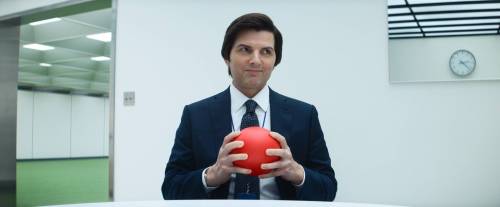
Adam Scott in “Severance” on Apple TV+. (Supplied)
We also see more of the yawning abyss between Lumon’s PR statements and its real-world actions, the company’s promise of “bounteous reforms” for the working conditions of innies amounting to “four-ply washroom tissue” and new fruit-leather snacks in the office vending machines.
The coolness of the show’s often deadpan dialogue persists (“Marshmallows are for team players,” chides Mr. Milchick, played by Tramell Tillman). But it’s warmed by incredibly committed and tight ensemble performances. The outside world might debate the status of innies. Activists see them as exploited indentured labourers. Others scorn them as freaks, only half-alive. Evidently the Lutherans have declared they have distinct souls.
For the audience, their full humanity is never in doubt. This season further explores — and complicates — the relationships between Mark and Helly, between Irv and Burt (Christopher Walken), as well as revealing more about Dylan’s family life.
As Severance expands its cast of characters and narrative, our world has also changed. Season 1 of Severance found an unexpected resonance when it was released during the COVID crisis, when so many people were re-evaluating their work and home lives.

In 2025, many white-collar employees have not returned to a physical office, at least not full-time, and the show’s endless white corridors, echoing empty rooms and dead company parking lots might not seem so hyper-stylized anymore.
People who’ve come to appreciate the work-from-home shift might find themselves nodding in agreement with the show’s contention that enforced office celebrations, compulsory trust exercises and customized balloons aren’t that good for morale after all.
And a lot of viewers will be finding anxious parallels with current events, as tech broligarchs encroach on the democratic process and corporate bottom-lining infringes on the rights of workers and citizens. In 2025, Lumon Industries, a massive multinational organization that requires cult-like fealty to its founder, might be looking distressingly familiar.
Still, if Season 2 of Severance is about as dystopian as it gets, the show continues to suggest ways to resist, with its small, funny, unpredictable surges of solidarity and humanist optimism. Forget the marshmallows. How about a work revolution?
alison.gillmor@freepress.mb.ca
Studying at the University of Winnipeg and later Toronto’s York University, Alison Gillmor planned to become an art historian. She ended up catching the journalism bug when she started as visual arts reviewer at the Winnipeg Free Press in 1992.
Our newsroom depends on a growing audience of readers to power our journalism. If you are not a paid reader, please consider becoming a subscriber.
Our newsroom depends on its audience of readers to power our journalism. Thank you for your support.
Studying at the University of Winnipeg and later Toronto’s York University, Alison Gillmor planned to become an art historian. She ended up catching the journalism bug when she started as visual arts reviewer at the Winnipeg Free Press in 1992.
Our newsroom depends on a growing audience of readers to power our journalism. If you are not a paid reader, please consider becoming a subscriber.
Our newsroom depends on its audience of readers to power our journalism. Thank you for your support.
Advertisement Advertise With Us
Advertisement Advertise With Us