People twice removed
Black and Indigenous artists in conversation at WAG-Qaumajuq

Advertisement
Read this article for free:
or
Already have an account? Log in here »
To continue reading, please subscribe:

Digital Subscription
One year of digital access for only $205*
- Enjoy unlimited reading on winnipegfreepress.com
- Read the E-Edition, our digital replica newspaper
- Access News Break, our award-winning app
- Play interactive puzzles
*First annual payment billed as $205.00 + GST for one year. This annual subscription will automatically renew at $233.00 + GST every 52 weeks (10% off the regular annual price of $259.35). Offer available to new and qualified returning subscribers only. Cancel any time.
To continue reading, please subscribe:
Add Free Press access to your Brandon Sun subscription for only an additional
$1 for the first 4 weeks*
- Enjoy unlimited reading on winnipegfreepress.com
- Read the E-Edition, our digital replica newspaper
- Access News Break, our award-winning app
- Play interactive puzzles
*Your next Brandon Sun subscription payment will increase by $1.00 and you will be charged $17.95 plus GST for four weeks. After four weeks, your payment will increase to $24.95 plus GST every four weeks.
Read unlimited articles for free today:
or
Already have an account? Log in here »
Hey there, time traveller!
This article was published 06/02/2025 (563 days ago), so information in it may no longer be current.
In Shaman Never Die, a striking, large-scale 1989 mixed-media work by Cree painter and printmaker Jane Ash Poitras, language is rendered in many different ways. In syllabics. In English. In newsprint. In drawings. All layered atop one another, all jockeying for space.
At the top of the canvas, written in blood-red paint, are the words “preserve our language and culture.”
“It’s a representation of how our existence on this territory is also very layered,” says Nestor Wynrush (a.k.a. Elliott Walsh), the Winnipeg-based MC, writer, organizer, workshop facilitator and now, co-curator of Threads of Kin and Belonging: A Trinnipeg Live Mixtape Project, a new exhibition opening at WAG-Qaumajuq Saturday, with a free public celebration Friday.
RUTH BONNEVILLE / FREE PRESS
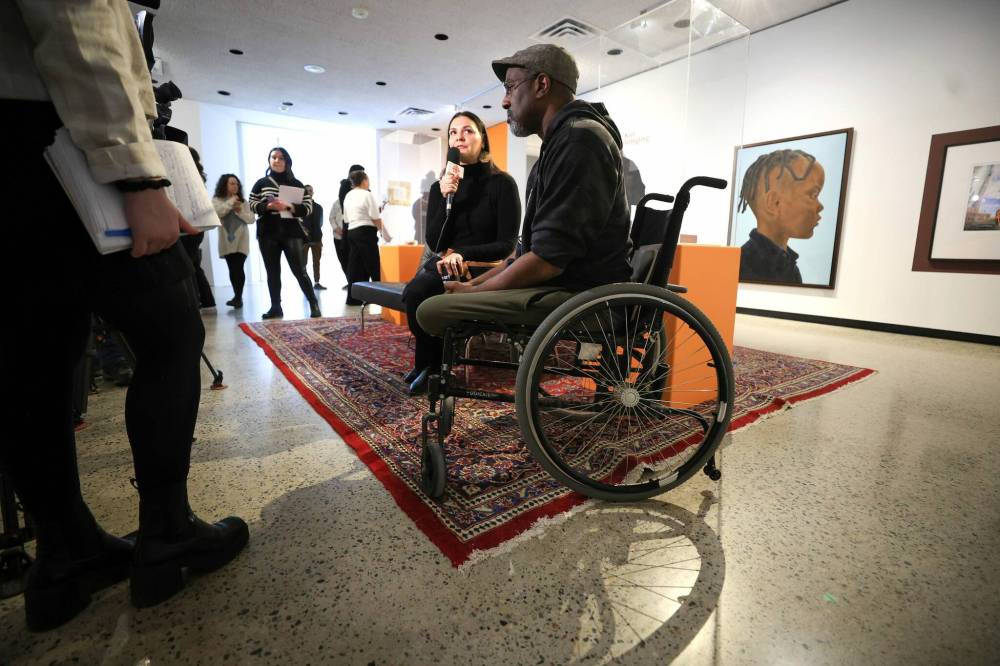
Threads of Kin and Belonging co-curators Nestor Wynrush (right) and Julia Lafreniere are showing care for the communities represented in their exhibition.
“I speak as a person from the Black African Caribbean diaspora that has been greatly affected by these triangles of colonialism that have brought us here. The idea of people twice removed, threads of kin and belonging. What land do we belong to? Who do we belong to? Who claims us? How do we move in collective strength? How do we take up space?”
Those are the big questions at the heart of Threads of Kin and Belonging. Curated by Wynrush and Julia Lafreniere, head of Indigenous Ways & Learning at WAG-Qaumajuq, and co-produced with Synonym Art Consultation, the exhibition is described as a conversation and an intervention between Indigenous and Black communities on Treaty One Territory.
It features works by Black and Indigenous artists — including Shaman Never Die — in conversation with each other.
The exhibition is the fourth iteration of Wynrush’s ongoing Trinnipeg Live Mixtape — a multidisciplinary collaboration, mentorship and workshop project.
Wynrush says he was initially hesitant about co-curating a visual art exhibition.
“I’m hesitant about everything,” he says with a laugh.
His reluctance stemmed from the pressures of balancing voices and perspectives, the individual works themselves and the viewer’s experience.
SUPPLIED
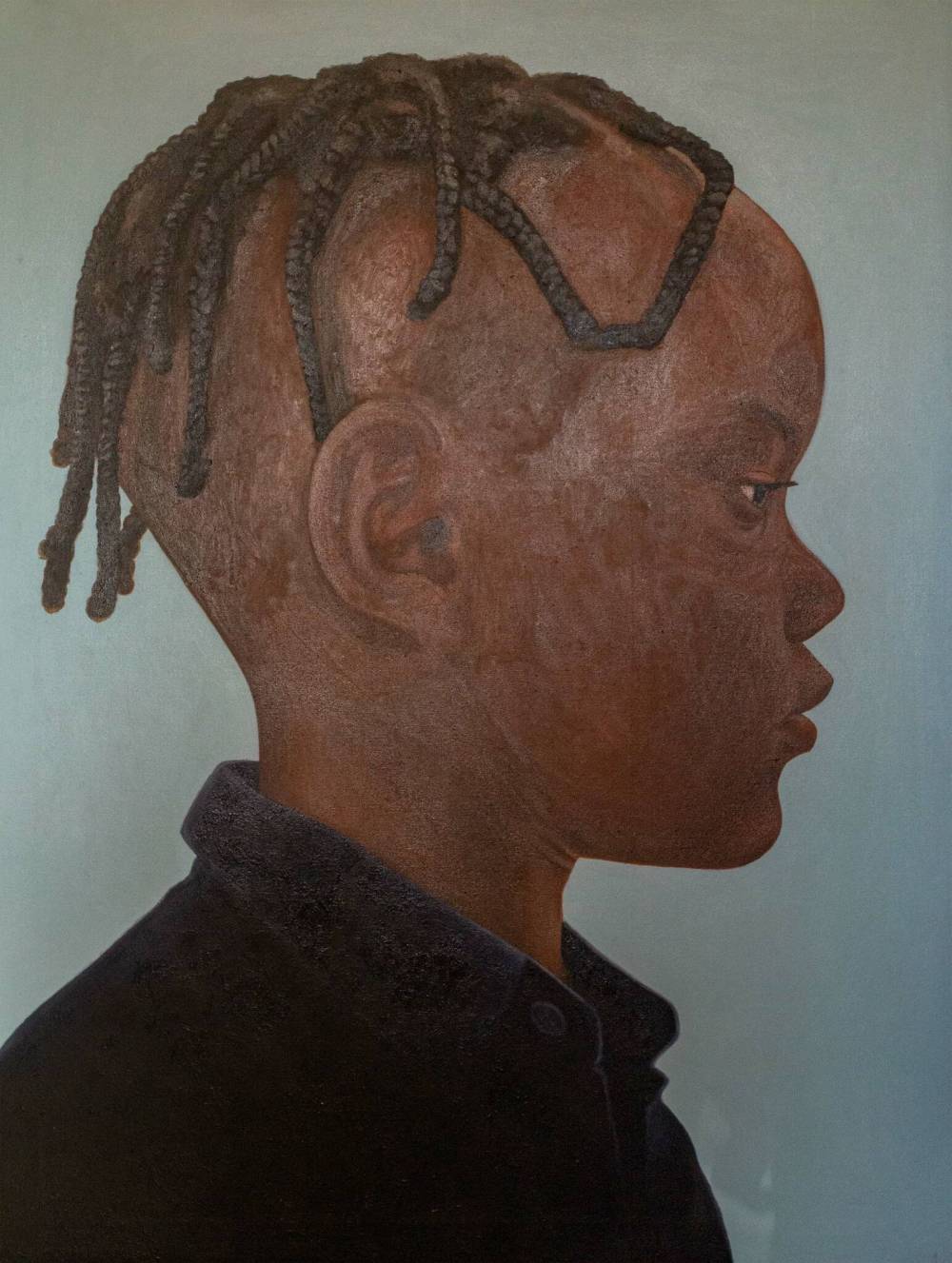
Kimani Beckford’s Young Boy in Contemplation, 2024
“Really, this room becomes a canvas for a greater idea — and also, it’s left to interpretation. When somebody comes through the room, they come in with whatever experiences they carry in, right? So it’s wanting to do the artist justice, but also leaving the audience with something. It’s loyalty to our communities first. It’s about their lens. Are they seeing themselves?” Wynrush says.
“Are they cared for?” adds Lafreniere, who is Michif and Anishinaabe and is claimed by and belongs to Minegoziibe Anishinabe First Nation on Treaty 4 Territory.
“It’s a different way to curate because we’re accountable to them first, before the institution.”
That care can be seen throughout Threads of Kin and Belonging.
Care is reflected in how the exhibition sounds; Lagos-born, Toronto-based artist Chukwudubem Ukaigwe’s ceramic vessels, Untitled (Locution 1) and Untitled (Locution 2), double as sound installations, allowing visitors to be enveloped by the warm cacophony of a Nigerian market, the sound of which cannot be confined to a single gallery but instead spills out into neighbouring ones — a welcome interruption “letting it known that we’re here,” Wynrush says.
Care is also reflected in the exhibition’s accessibility features. The artworks are installed a bit lower so that people who use wheelchairs — like Wynrush — can view them at eye level.
RUTH BONNEVILLE / FREE PRESS
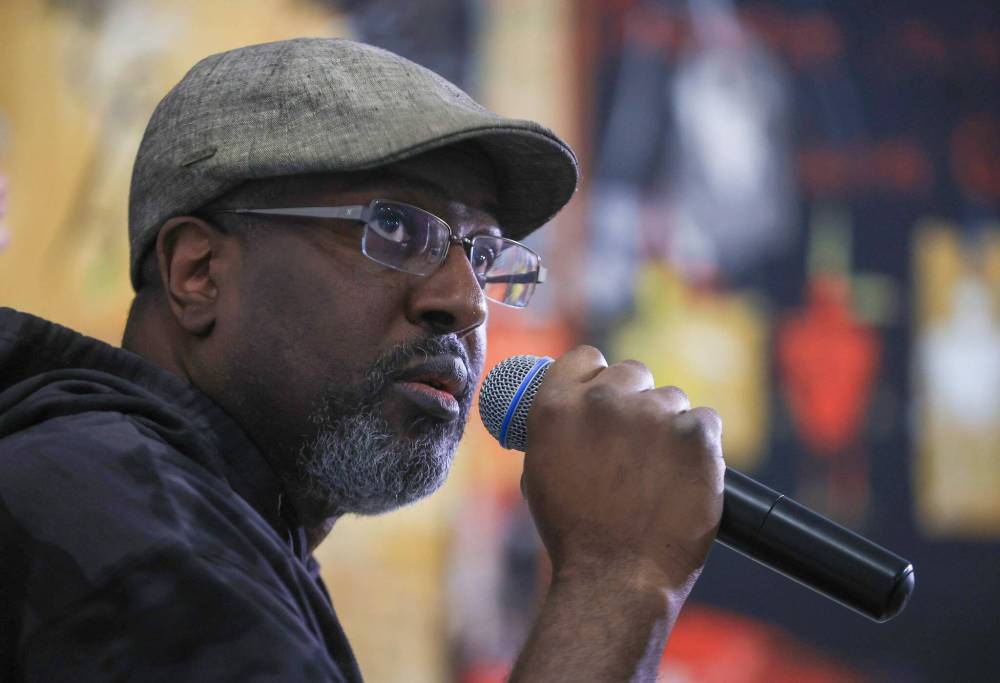
Co-curator Nestor Wynrush
There is seating with backs for people who might have mobility issues or can’t stand for long periods of time. QR codes will allow those with visual impairment to hear image descriptions.
Stephen Borys, director and CEO of WAG-Qaumajuq, says this exhibition is another step towards the organization’s goal of “decolonizing the gallery and decentring traditional settler perspectives and experiences.”
Other steps have included building acquisition endowments so that WAG-Qaumajuq can expand its collections of works by First Nations, Métis and racialized artists, as well as the establishment of a curatorial fellowship for an emerging racialized curator.
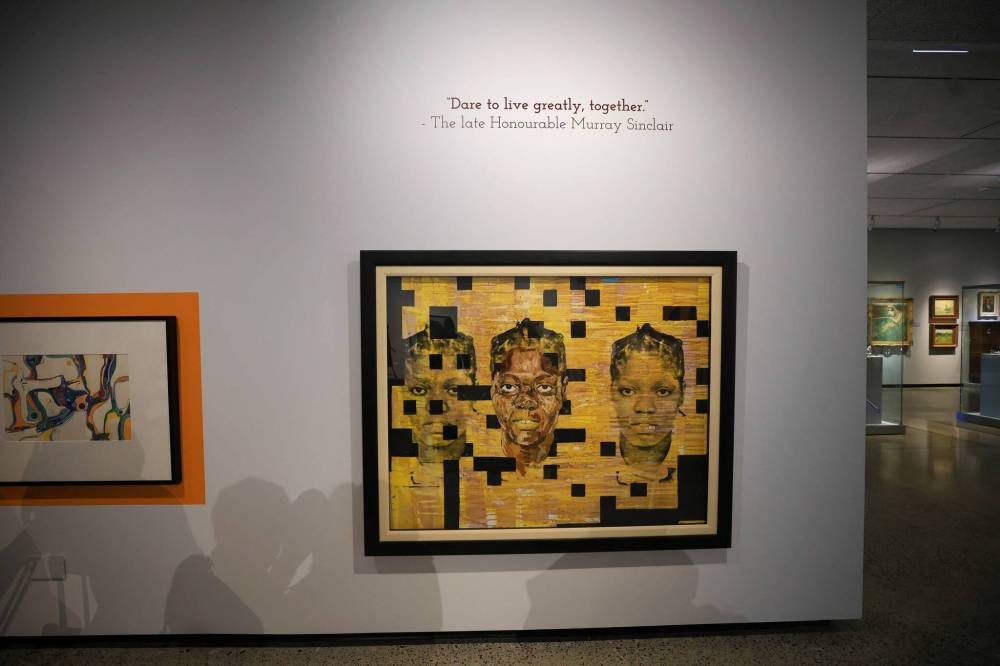
The words of the late Hon. Murray Sinclair, placed high on the wall so that they are visible throughout the building, serve as a guiding principle for Threads of Kin and Belonging: “Dare to live greatly, together.”
“This exhibition is about remaining true to ourselves as Indigenous, Black and racialized nations and our ancestors. It is a reminder to lead with love, care and compassion. It is about centring our words, our beliefs and our inherent sacred knowledge. We are stronger together, and if we embody this belief, our future ancestors will benefit,” Lafreniere says.
A host of other programming will be offered during the exhibition’s run, including storytelling, workshops and a live music event on Indigenous People’s Day, June 21.
The exhibition is a thread in a bigger tapestry; its curators want its impact to be felt beyond the gallery’s walls.
RUTH BONNEVILLE / FREE PRESS
A quote by the late Murray Sinclair adorns the wall at WAG-Qaumajuq.
“It’s a small space with a big vision,” Wynrush says.
Threads of Kin and Belonging: A Trinnipeg Live Mixtape Project is on view until Sept. 30.
jen.zoratti@winnipegfreepress.com
Jen Zoratti is a columnist and feature writer working in the Arts & Life department, as well as the author of the weekly newsletter NEXT. A National Newspaper Award finalist for arts and entertainment writing, Jen is a graduate of the Creative Communications program at RRC Polytech and was a music writer before joining the Free Press in 2013. Read more about Jen.
Every piece of reporting Jen produces is reviewed by an editing team before it is posted online or published in print – part of the Free Press‘s tradition, since 1872, of producing reliable independent journalism. Read more about Free Press’s history and mandate, and learn how our newsroom operates.
Our newsroom depends on a growing audience of readers to power our journalism. If you are not a paid reader, please consider becoming a subscriber.
Our newsroom depends on its audience of readers to power our journalism. Thank you for your support.
Visual art preview
Threads of Kin and Belonging: A Trinnipeg Live Mixtape Project
● WAG-Qaumajuq, 300 Memorial Blvd.
● Opening celebration Friday, 7 p.m.
● Free
Jen Zoratti is a columnist and feature writer working in the Arts & Life department, as well as the author of the weekly newsletter NEXT. A National Newspaper Award finalist for arts and entertainment writing, Jen is a graduate of the Creative Communications program at RRC Polytech and was a music writer before joining the Free Press in 2013. Read more about Jen.
Every piece of reporting Jen produces is reviewed by an editing team before it is posted online or published in print – part of the Free Press‘s tradition, since 1872, of producing reliable independent journalism. Read more about Free Press’s history and mandate, and learn how our newsroom operates.
Our newsroom depends on a growing audience of readers to power our journalism. If you are not a paid reader, please consider becoming a subscriber.
Our newsroom depends on its audience of readers to power our journalism. Thank you for your support.
Advertisement Advertise With Us
Advertisement Advertise With Us