Timely tale
Play within a play Indecent tells a cyclical story of intolerance
Advertisement
Read this article for free:
or
Already have an account? Log in here »
To continue reading, please subscribe:

Digital Subscription
One year of digital access for only $205*
- Enjoy unlimited reading on winnipegfreepress.com
- Read the E-Edition, our digital replica newspaper
- Access News Break, our award-winning app
- Play interactive puzzles
*First annual payment billed as $205.00 + GST for one year. This annual subscription will automatically renew at $233.00 + GST every 52 weeks (10% off the regular annual price of $259.35). Offer available to new and qualified returning subscribers only. Cancel any time.
To continue reading, please subscribe:
Add Free Press access to your Brandon Sun subscription for only an additional
$1 for the first 4 weeks*
- Enjoy unlimited reading on winnipegfreepress.com
- Read the E-Edition, our digital replica newspaper
- Access News Break, our award-winning app
- Play interactive puzzles
*Your next Brandon Sun subscription payment will increase by $1.00 and you will be charged $17.95 plus GST for four weeks. After four weeks, your payment will increase to $24.95 plus GST every four weeks.
Read unlimited articles for free today:
or
Already have an account? Log in here »
Hey there, time traveller!
This article was published 14/02/2025 (594 days ago), so information in it may no longer be current.
The prescience of Paula Vogel’s 2015 play-about-a play, chronicling the evolution of 20th-century Polish-American playwright Sholem Asch’s God of Vengeance, is shocking.
Indecent, which opened at the Royal Manitoba Theatre Centre Thursday, also speaks to the power of theatre to shine a light into the longer shadows of the human condition, including forbidden love, censorship, religious hypocrisy, antisemitism and the perennial fear of “the other.”
Sharply directed by RMTC artistic director Kelly Thornton, the deliciously theatrical, 105-minute (no intermission) show — steeped in Yiddishkeit and soaked in Old World sensibility — features a ghostly, 10-member “dead troupe” of actors and musicians, shape-shifting through a kaleidoscope of archetypal characters as the brisk narrative leapfrogs from 1907 Warsaw to 1953 Connecticut.
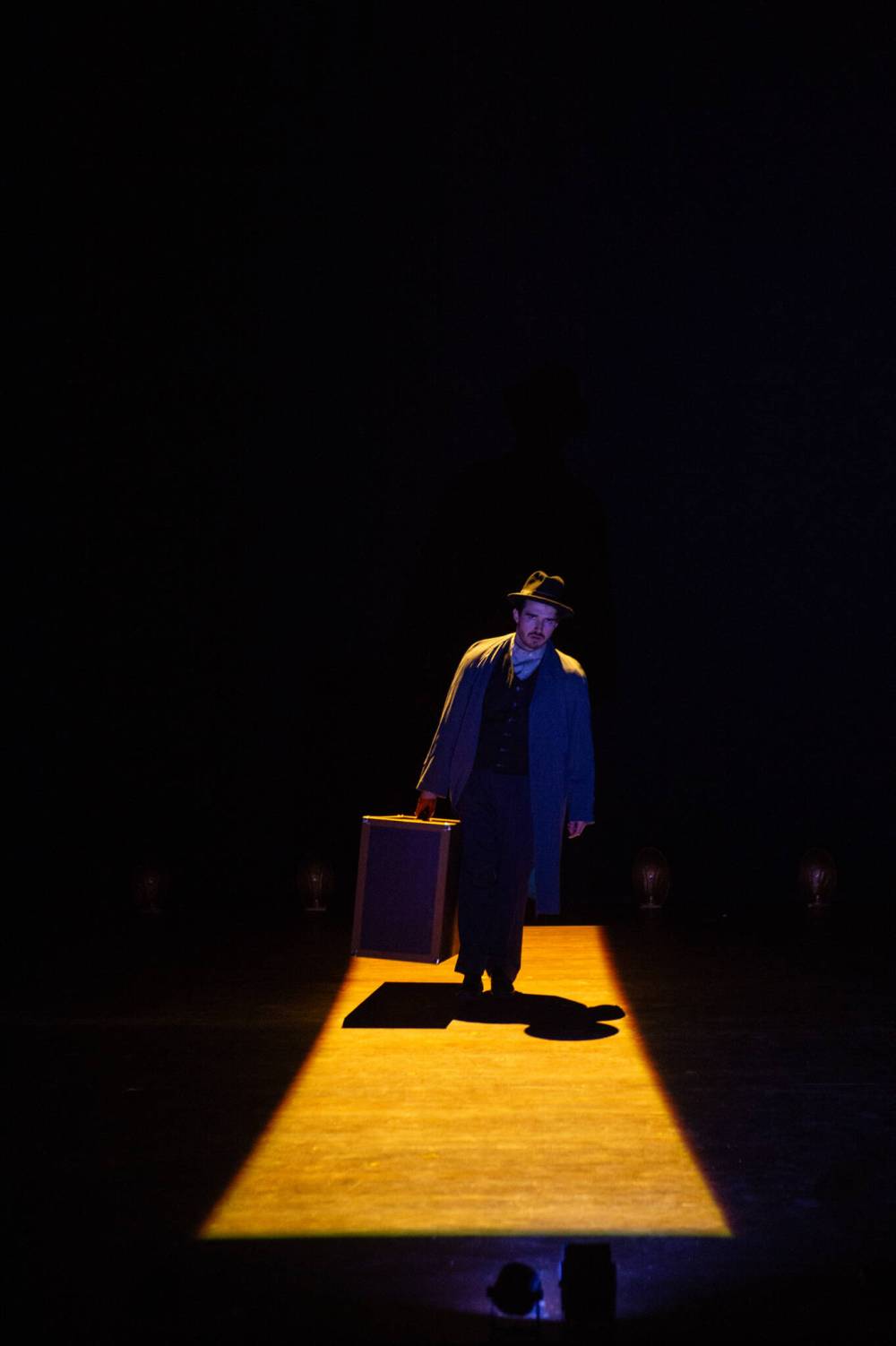
Like the rest of the cast, Josh Bellan plays several roles in the production.
Asch’s play, which was met with great success in Europe following its 1907 Russian première, famously included the first onstage kiss between two women on an American stage after crossing the Atlantic to New York City.
It tells the tale of Jewish brothel owner Yekel (a marvellous Dov Mickelson, who booms and growls throughout the show) and his long-suffering wife Sarah (Mariam Bernstein, walking an emotional tightrope between supportive and beleaguered spouse with her own potent backstory) raising their daughter Rifkele (Katherine Matlashewski), who falls head over heels with a female sex worker (Amy Lee).
The entire cast and crew were arrested on obscenity charges after the show’s Broadway première in February 1923, despite its script having been sanitized and censored — including a passionate rain scene between the two lovers, teased throughout the show — for skittish stakeholders.
The Pulitzer Prize-winning Vogel (How I Learned to Drive) first discovered Asch’s play as a 23-year-old graduate student; seduced into collaborating on her gripping play laced with plenty of both comedic flourishes with fellow student Rebecca Taichman, then writing her thesis about GOV’s obscenity trial.
A compelling Alex Poch-Goldin as the Stage Manager Lemml propels the story forward after first telling the opening-night audience, “This play changed my life.”
Josh Bellan portrays the initially optimistic Asch (and later, a cameo of playwright Eugene O’Neill) as bursting with the courage of his own idealistic convictions. His faith in the creative process erodes into ultimate bitterness — an all-too-familiar emotion for many artists, especially now during these increasingly “anti-woke” times.
Matlashewski displays chameleonic versatility as she effortlessly morphs between Asch’s supportive wife Madje, Rifkele, newly discovering her love for another woman, and perky American ingénue Virginia (still with me?) who replaces fired actor Dorothee (portraying Manke) for the show’s Broadway debut; one can hardly believe it’s the same actor.
What a pleasure to see the Winnipeg-born Lee onstage again, belting out Yiddish tunes for all she’s worth while bringing convincing flesh-and-blood vulnerability to her principal role of Manke. Her love scenes with Rifkele feel raw and real, as she entices her with eloquently poetic prose that might still be pushed further; the climactic rain scene in particular needs more heart-stopping passion.
Andrew Cecon provides solid backbone and cohesion with his coterie of roles, including producer for the Broadway show.
There are several scenes that elicit open guffaws, including the depiction of the final moments of Asch’s play, shown being performed in a series of European theatres, with Mickelson and Bernstein’s increasingly over-the-top theatricality as they reject their daughter’s lesbianism — a sly wink to the requisite repetition of stagecraft.
Other moments chill to the bone, including scenes that speak to the death grip of the Holocaust, as God of Vengeance eventually returns to Poland’s Lodz Ghetto with its cast now dwindling.
One can’t imagine this production with its enthralling trio of onstage klezmer musicians — violinist Shiloh Hiebert, clarinettist Myron Schultz and accordionist Orit Shimoni — seemingly transported right out of an Eastern European shtetl and infusing the evening with colour and life.
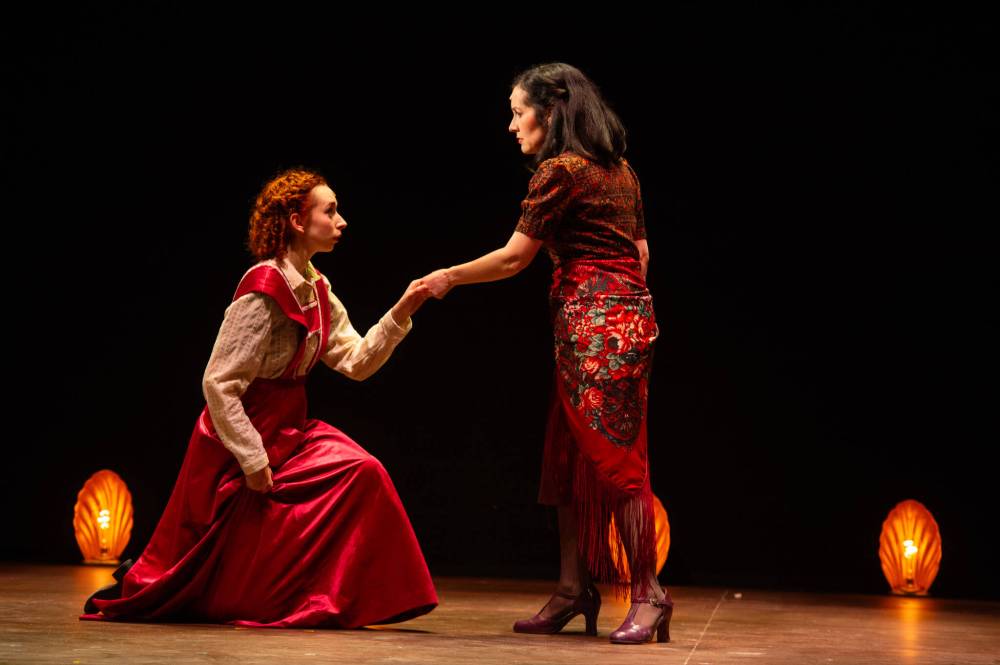
DYLAN HEWLETT PHOTO
The passion between characters played by Katherine Matlashewski (left) and Amy Lee feels real.
Rachel Cooper’s spot-on choreography blends traditional Jewish horas with fluid stylized movement sequences during set changes, performed with joyful abandon by the ensemble. The production also includes effective costumes by Joseph Abetria and vocal direction by Grace Hrabi, with lighting designer Hugh Conacher working magic with his shadows and light.
Scott Penner creates meta-layered trompe-l’oeil effects with his imaginative set design, in which the real-life audience is given a front-row seat to the theatre’s backstage, including industrial lighting banks and a circular staircase.
Visual projections are cast on an upstage “safety curtain” that helps ground the narrative while providing an overall framework.

It’s admittedly tricky at times to keep up with who is playing whom — and when — with the program cryptically describing most actors as “Ingénues,” “Middles” and “Elders.” One is well advised to simply allow the characterizations to flow like a river of images.
In her opening remarks, Thornton introduced her ghostly production as “the true story of a little Jewish play” as well as “an early valentine to theatre.”
It is all that, and more.
However, Vogel’s play is also a plea for empathy and understanding in our own increasingly fractured world. It’s no small coincidence that the playwright’s choice to feature 10 cast members — ostensibly a minyan, the quorum necessary for Jewish public worship — becomes a prayer for the healing balm of love, regardless of time or place, or the person whom our own whispering hearts most greatly desire.
holly.harris@shaw.ca
Holly Harris writes about music for the Free Press Arts & Life department.
Our newsroom depends on a growing audience of readers to power our journalism. If you are not a paid reader, please consider becoming a subscriber.
Our newsroom depends on its audience of readers to power our journalism. Thank you for your support.
Theatre review
Indecent
● Royal Manitoba Theatre Centre’s John Hirsch Mainstage
● To March 8
★★★★½ out of five
Holly Harris writes about music for the Free Press Arts & Life department.
Our newsroom depends on a growing audience of readers to power our journalism. If you are not a paid reader, please consider becoming a subscriber.
Our newsroom depends on its audience of readers to power our journalism. Thank you for your support.
Related Articles
Timely revisiting of notorious 1907 play as ‘a love story and a question of how art can fight hate’
Advertisement Advertise With Us
Advertisement Advertise With Us