From them to we
Photo of great-great-grandmother at age 105 moved ceramicist to explore her Indo-Caribbean heritage

Advertisement
Read this article for free:
or
Already have an account? Log in here »
To continue reading, please subscribe:

Digital Subscription
One year of digital access for only $205*
- Enjoy unlimited reading on winnipegfreepress.com
- Read the E-Edition, our digital replica newspaper
- Access News Break, our award-winning app
- Play interactive puzzles
*First annual payment billed as $205.00 + GST for one year. This annual subscription will automatically renew at $233.00 + GST every 52 weeks (10% off the regular annual price of $259.35). Offer available to new and qualified returning subscribers only. Cancel any time.
To continue reading, please subscribe:
Add Free Press access to your Brandon Sun subscription for only an additional
$1 for the first 4 weeks*
- Enjoy unlimited reading on winnipegfreepress.com
- Read the E-Edition, our digital replica newspaper
- Access News Break, our award-winning app
- Play interactive puzzles
*Your next Brandon Sun subscription payment will increase by $1.00 and you will be charged $17.95 plus GST for four weeks. After four weeks, your payment will increase to $24.95 plus GST every four weeks.
Read unlimited articles for free today:
or
Already have an account? Log in here »
Hey there, time traveller!
This article was published 27/02/2025 (549 days ago), so information in it may no longer be current.
When Heidi McKenzie first saw the photo of her great-great-grandmother Roonia, it unlocked something in her imagination.
“When you look at her, wow,” says the Toronto-based ceramic and installation artist. “You see the weathered skin and the deep creases and the set-in face and then on the back of the photograph, it says that she was 105 when the photograph was taken.”
From 1838 to 1917, 1.6 million Indians were exported to British colonies (including British Guiana, Trinidad, Jamaica, Suriname, Mauritius and Fiji) to work sugar, cocoa and coffee plantations in indentured servitude as part of the Indian indenture system, a replacement for slavery, which had been abolished by the British just years prior.

MIKE DEAL / FREE PRESS
Toronto artist Heidi McKenzie at Gallery 1C03 with her exhibition, Reclaimed: Indo-Caribbean HerStories.
MIKE DEAL / FREE PRESS
Heidi McKenzie and artist from Toronto at Gallery 1C03 for her exhibition, Reclaimed: Indo-Caribbean HerStories. It will be running from February 27 to April 25. On the left is, Coinage, which is an abstract depiction of a set of coins strung on a women’s necklace, while on the right is, Crescent Moon, a symbol of islamic culture used in Indo-indentured jewerly. Reporter: Jen Zoratti 250226 - Wednesday, February 26, 2025.
Roonia was one of them.
McKenzie’s great-great-grandmother is one of many inspirations behind her solo exhibition Reclaimed: Indo-Caribbean HerStories, opening at Gallery 1C03 at the University of Winnipeg today. McKenzie’s work explores the little-known histories of indentured Indo-Caribbean women in the mid-19th and early 20th centuries, using photographic portraiture on ceramics.
McKenzie pulled a variety of threads to make the works in Reclaimed. Reading Gaiutra Bahadur’s book Coolie Woman: The Odyssey of Indenture was particularly foundational; Bahadur’s great-great-grandmother’s story was very similar to McKenzie’s.
“Reading that was really transformative for me in terms of getting an appreciation and starting to understand that people often assume that women who are migrating are coming to make families and make babies, but really, these women were not coming to do that. They were coming to work the sugar-cane fields and do hard, back-breaking labour, and so then (I really started) imagining my grandmother doing this,” McKenzie says.
McKenzie kept going, following paths of inquiry and curiosity, meeting people and hearing their stories.
“Research is a really big component of what I do. I tend to be very much in my head and very conceptual, and I struggle, sometimes, to get it into my hands,” she says.
Supplied
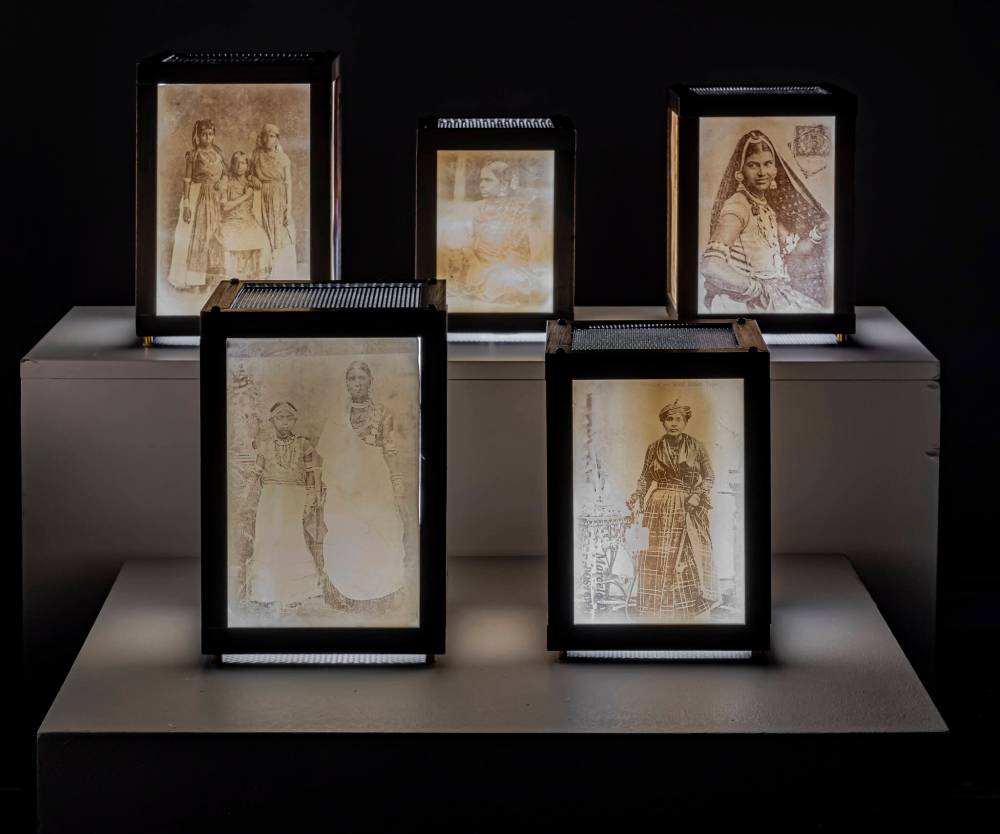
Reclaimed explores the little-known histories of indentured Indo-Caribbean women, using photographic portraiture on ceramics.
It was Sequoia Miller, curator at the Gardiner Museum in Toronto, who asked McKenzie what she really wanted to say with Reclaimed, which was first mounted at the Gardiner in 2023.
That question set her focus.
“I wanted to talk about these women. I wanted to talk about not only these women, but, gosh, us women. We women.”
Reclaimed is composed of three main installations: Coinage, Bangle and Crescent Moon; Looking Back; and Holding Ancestry.
Coinage, Bangle, and Crescent Moon are three abstract sculptures inspired by Indo-indentureship silver jewelry.

MIKE DEAL / FREE PRESS
Crescent Moon, a symbol of islamic culture used in Indo-indentured jewerly.
Indentured women had no access to banks, so they had their earnings — one, three or five British silver shillings a day — fashioned by fellow Indo-indentured workers into jewelry.
“They wore their banks on their bodies, heavy bangles, necklaces, nose rings, earrings, arm bands and foot bracelets,” McKenzie writes in an essay.
Looking Back features two hanging window frames featuring a collage of “Coolie Belles” photographs and ephemera on porcelain, inspired by early 20th-century postcards.
In 2019, McKenzie had befriended York University Prof. Amar Wahab, who had lent her a treasure trove: a four-inch ring binder filled with period postcards from the Caribbean.
“I think when I first received the photographs, I didn’t understand the whole situation, so I didn’t have this, ‘Oh my God’ thing. I was like, ‘Oh these are really pretty’ — I didn’t understand it,” she says with a laugh.
“I started reading the back of the postcards. I was really interested in who was sending these postcards. Where were they going? Who sent them and why?”
Supplied
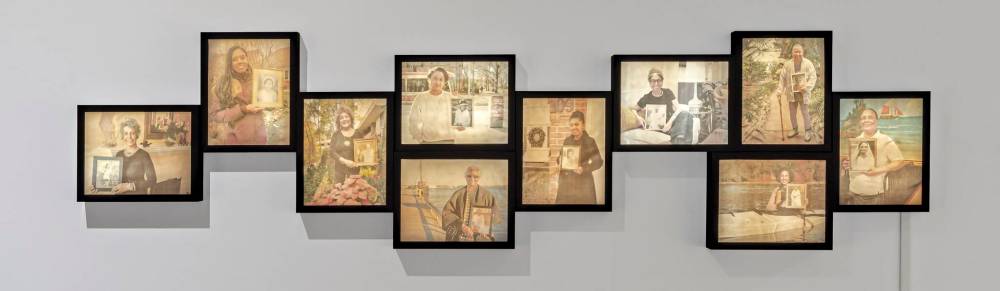
Holding Ancestry (above) features porcelain-mounted portraits of contemporary Indo-Caribbean women holding a photo of their chosen matrilineal ancestor. The Coolie Belles were indentured women featured on postcards (left) traded by wealthy Western tourists.
The Coolie Belles were indentured women featured on postcards that were traded by wealthy Western tourists. These women were dressed in traditional dress and jewelry and photographed on sets, exoticized by their male colonial photographers.
These photos, McKenzie points out, erase the hardship of their lives on the plantations.

“It was really only after I really understood the full context of those photographs that I started to think, ‘Oh, wow, I have to shed some light, literally, on these women.’ That’s what I had to do.”
Holding Ancestry is composed of porcelain-mounted portraits of contemporary Indo-Caribbean women — representing a wide cross-section of class, gender, age and diasporas — holding a photo of their chosen matrilineal ancestor.
The portraits are lit from behind and are accompanied by short videos so viewers can actually hear the subject’s voices. McKenzie’s subjects also had agency over how they appeared in the images — in other words, the opposite experience of the Coolie Belles.

MIKE DEAL / FREE PRESS
Coinage, which is an abstract depiction of a set of coins strung on a women’s necklace.
And McKenzie is in one of them, holding the photo of Roonia.
jen.zoratti@winnipegfreepress.com
Jen Zoratti is a columnist and feature writer working in the Arts & Life department, as well as the author of the weekly newsletter NEXT. A National Newspaper Award finalist for arts and entertainment writing, Jen is a graduate of the Creative Communications program at RRC Polytech and was a music writer before joining the Free Press in 2013. Read more about Jen.
Every piece of reporting Jen produces is reviewed by an editing team before it is posted online or published in print – part of the Free Press‘s tradition, since 1872, of producing reliable independent journalism. Read more about Free Press’s history and mandate, and learn how our newsroom operates.
Our newsroom depends on a growing audience of readers to power our journalism. If you are not a paid reader, please consider becoming a subscriber.
Our newsroom depends on its audience of readers to power our journalism. Thank you for your support.
Visual art preview
Heidi McKenzie: Reclaimed: Indo-Caribbean HerStories
● Gallery 1C03, University of Winnipeg
● Opening reception today, 4-6 p.m., through April 25
Jen Zoratti is a columnist and feature writer working in the Arts & Life department, as well as the author of the weekly newsletter NEXT. A National Newspaper Award finalist for arts and entertainment writing, Jen is a graduate of the Creative Communications program at RRC Polytech and was a music writer before joining the Free Press in 2013. Read more about Jen.
Every piece of reporting Jen produces is reviewed by an editing team before it is posted online or published in print – part of the Free Press‘s tradition, since 1872, of producing reliable independent journalism. Read more about Free Press’s history and mandate, and learn how our newsroom operates.
Our newsroom depends on a growing audience of readers to power our journalism. If you are not a paid reader, please consider becoming a subscriber.
Our newsroom depends on its audience of readers to power our journalism. Thank you for your support.
Advertisement Advertise With Us
Advertisement Advertise With Us