Elder’s story of residential school abuse finally told
Read this article for free:
or
Already have an account? Log in here »
To continue reading, please subscribe:
Digital Subscription
One year of digital access for only $1.44 a week*
- Enjoy unlimited reading on winnipegfreepress.com
- Read the E-Edition, our digital replica newspaper
- Access News Break, our award-winning app
- Play interactive puzzles
*Billed as $5.77 plus GST every four weeks. After 52 weeks, price increases to the regular rate of $19.95 plus GST every four weeks. Offer available to new and qualified returning subscribers only. Cancel any time.
To continue reading, please subscribe:
Add Free Press access to your Brandon Sun subscription for only an additional
$1 for the first 4 weeks*
- Enjoy unlimited reading on winnipegfreepress.com
- Read the E-Edition, our digital replica newspaper
- Access News Break, our award-winning app
- Play interactive puzzles
*Your next Brandon Sun subscription payment will increase by $1.00 and you will be charged $17.95 plus GST for four weeks. After four weeks, your payment will increase to $24.95 plus GST every four weeks.
Read unlimited articles for free today:
or
Already have an account? Log in here »
Hey there, time traveller!
This article was published 14/04/2025 (555 days ago), so information in it may no longer be current.
By the time she was eight, Betty Ross had been subjected to more than most children.
Movie preview
Return to the Falls: Film Screening and Conversation
• Bonnie & John Buhler Hall, Canadian Museum for Human Rights
• Wednesday, 5:30 p.m.
• Free entry, registration required
She had been abandoned by her mother, was then adopted and cared for by a loving Indigenous family, before being kidnapped by a Catholic priest and taken to a residential school, where she endured years of beating and verbal abuse from the nuns.
Now Ross’s story is the subject of the hourlong docudrama, Return to the Falls, which has its Winnipeg première on Wednesday at the Buhler Hall in the Canadian Museum for Human Rights.
The film — which intersperses dramatic re-enactments of Ross’s childhood at Pimicikamak Cree Nation, also known as Cross Lake First Nation, with her present-day life — sees her return to the area and to visit Sugar Falls, a place of sacred significance to her, for the first time in 70 years.
It was at Sugar Falls where Ross’s father lit the sacred fire before schooling her in the Four Directions teachings based on the Medicine Wheel, instilling in her the knowledge that would keep her rooted throughout the turbulence of her life.
“My father took me on a canoe to Sugar Falls. He taught me all about the circle of life; he taught me that we are all on a journey,” says the 77-year-old Ross, who speaks a mix of Cree and English in an interview, with translation by Cree educator Sandy Robinson.
“He wanted me to listen very carefully to these teachings. It is almost like he foresaw my future.”
Ross, who is now an elder, was first approached to make the film by director Eppo Eerkes more than 10 years ago.
His daughter, Denai Raine, had come across a book, Sugar Falls, about Ross’s experiences in residential schools, and had urged him to tell her story.
But before anything could proceed, Eerkes had to first gain her confidence.
The survivor of two residential institutions — Ross was also forced to attend Assiniboia Residential School in Winnipeg — needed to establish a relationship with the Alberta-based filmmaker.
“I have a hard time trusting people because I went through those atrocious systems. Because what Eppo was asking was powerful and very sacred, I had to make sure that he understood every word I was speaking to him,” she says.
Elder Betty Ross (left) with Denai Raine, the daughter of director Eppo Eerkes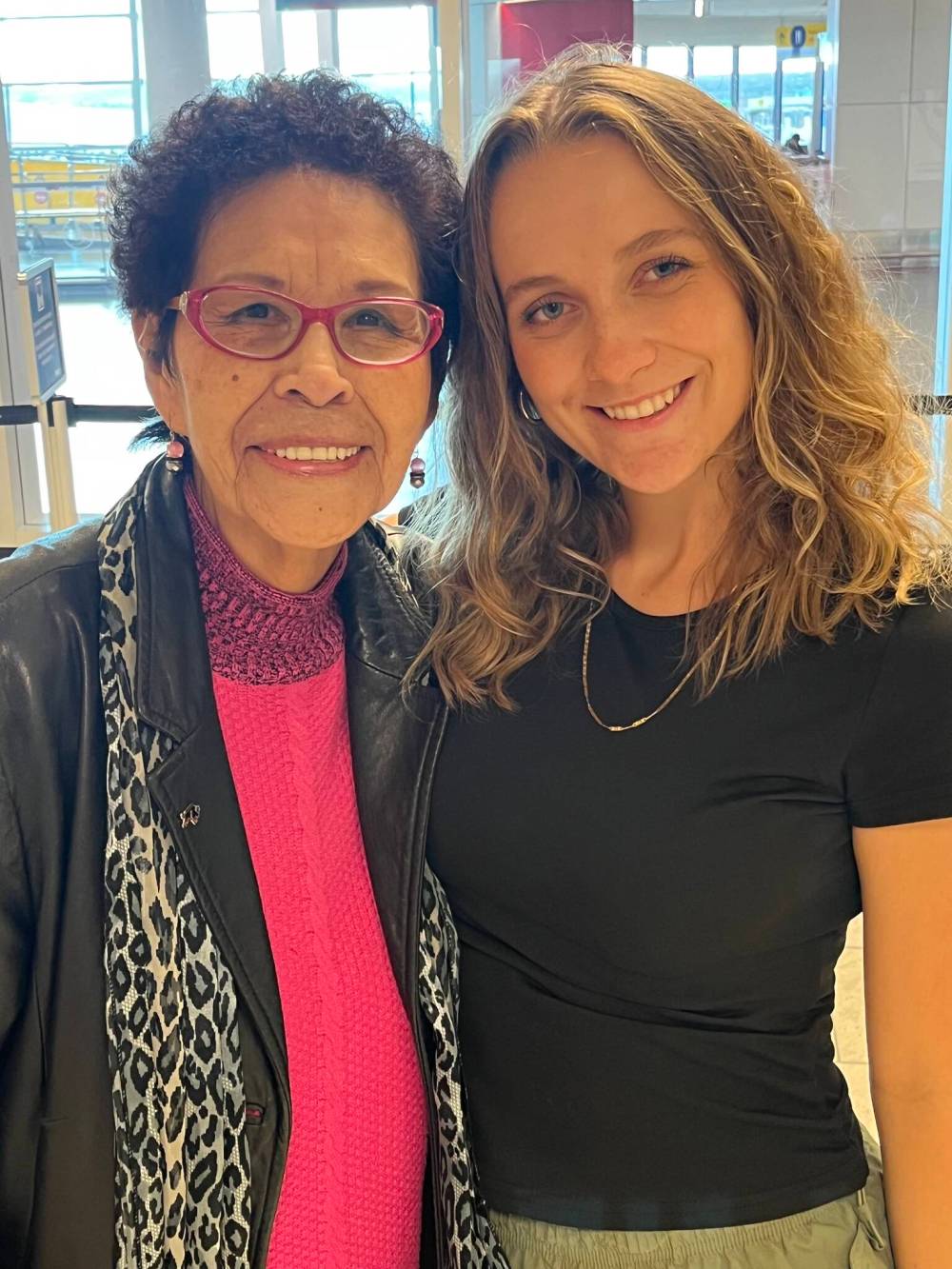
“I kept asking him questions — ‘Do you understand what I am saying, where I am coming from?’ — because I am very protective of my Indigenous heritage because it took me so many years to break down those barriers of colonization and to find my voice.”
It took three years for the movie to come together, Eerkes says.
“We did a year of research with Cross Lake Nation, working with them and with Sandy Robinson, no cameras rolling, and then two years of filming of current events interspersed with reenactions,” Eerkes says.
“I heard of the residential school system, but never learned about it in school or anything. Hearing the words directly from elder Betty of her own journey as a little girl made me think of my own children, not imagining them ever having to go through something so devastating. But also the sacred teachings that she now carries because of her father. They stand as a light for all of us who suffered past injustices,”
It’s those teachings that have helped her forgive those who committed atrocities against her, Ross says, though it has taken many years.
“I was so angry. They literally tried to crucify me for who I was. I had to look deep into the recesses of my being to find the strength, to be able to look at the forgiveness,” she says.
“I looked at those systems and they were very very heavy and I said ‘I forgive you’ because my father said, ‘You have to do this; if you don’t do it you will never move forward, you will never remember who you are.’”
Ross returns to Sugar Falls for the first time in 70 years.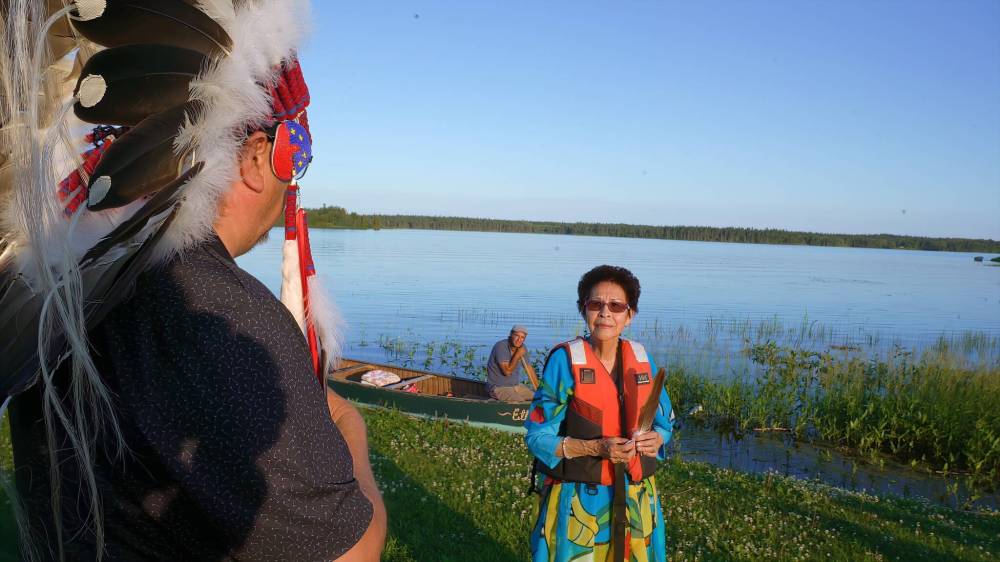
Ross now works with schools and community organizations across the country, sharing the true history of the residential school experience.
“It is a long road towards reconciliation. It is a very, very long journey. It starts with the truth and I have worked hard for that truth, here in Treaty 1 and in my nation, Treaty 5,” she says.
av.kitching@freepress.mb.ca

AV Kitching is an arts and life writer at the Free Press. She has been a journalist for more than two decades and has worked across three continents writing about people, travel, food, and fashion. Read more about AV.
Every piece of reporting AV produces is reviewed by an editing team before it is posted online or published in print — part of the Free Press‘s tradition, since 1872, of producing reliable independent journalism. Read more about Free Press’s history and mandate, and learn how our newsroom operates.
Our newsroom depends on a growing audience of readers to power our journalism. If you are not a paid reader, please consider becoming a subscriber.
Our newsroom depends on its audience of readers to power our journalism. Thank you for your support.