Rising tension
Elevator a smart setting for funny, pointed commentary on reconciliation

Advertisement
Read this article for free:
or
Already have an account? Log in here »
To continue reading, please subscribe:

Digital Subscription
One year of digital access for only $205*
- Enjoy unlimited reading on winnipegfreepress.com
- Read the E-Edition, our digital replica newspaper
- Access News Break, our award-winning app
- Play interactive puzzles
*First annual payment billed as $205.00 + GST for one year. This annual subscription will automatically renew at $233.00 + GST every 52 weeks (10% off the regular annual price of $259.35). Offer available to new and qualified returning subscribers only. Cancel any time.
To continue reading, please subscribe:
Add Free Press access to your Brandon Sun subscription for only an additional
$1 for the first 4 weeks*
- Enjoy unlimited reading on winnipegfreepress.com
- Read the E-Edition, our digital replica newspaper
- Access News Break, our award-winning app
- Play interactive puzzles
*Your next Brandon Sun subscription payment will increase by $1.00 and you will be charged $17.95 plus GST for four weeks. After four weeks, your payment will increase to $24.95 plus GST every four weeks.
Read unlimited articles for free today:
or
Already have an account? Log in here »
Hey there, time traveller!
This article was published 25/04/2025 (526 days ago), so information in it may no longer be current.
The title of playwright David McLeod’s self-secure and roof-raisingly funny new work, Elevate: Manaaji’idiwin, prepares the audience for a comedy defined by an inherited colonial divide.
From an anglocentric perspective, the punctuation implies an interconnectivity between independent clauses. As a symbol of ratio, the colon expresses comparison and can also act as a stand-in for equal measure and reciprocity. It’s assumed one side means the same as the other. But what’s that thing they taught us about assumptions?
Missed understanding and ceiling-shifting command is at the heart of Elevate: Manaaji’idiwin, which had its première Thursday on Royal Manitoba Theatre Centre’s mainstage after five years of development beginning in the company’s Pimootayowin Creators Circle, an incubator for new plays by Manitoba-based Indigenous artists.
DYLAN HEWLETT PHOTO
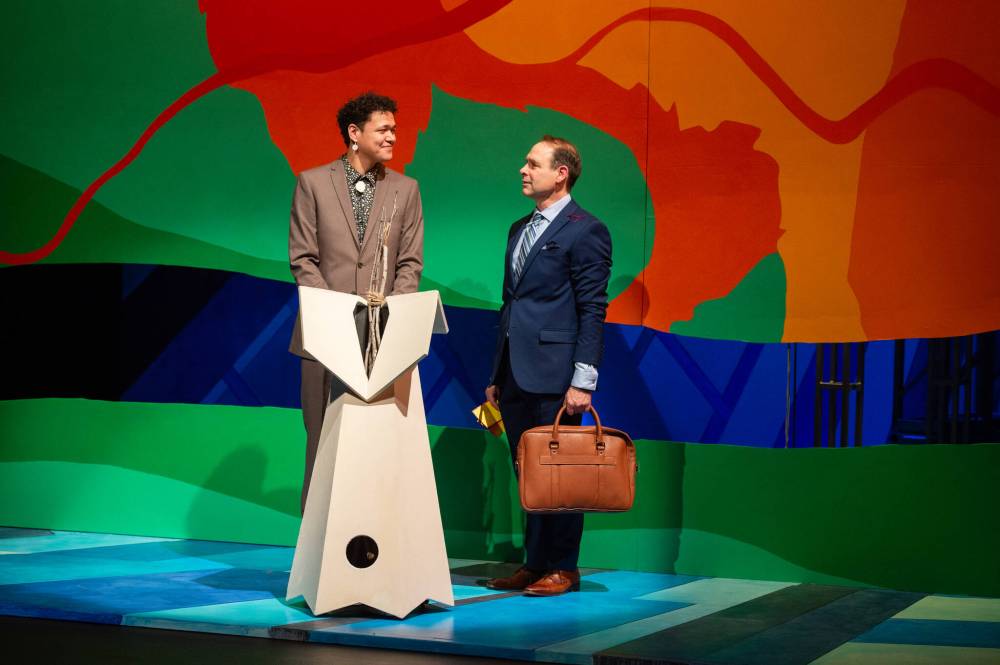
Nolan Moberly and Kevin Klassen get to know eachother in the confined space of ELEVATE: Manaaji’idiwin.
(Manaaji’idiwin doesn’t translate directly to “elevate,” but means “to go easy on one another and all of Creation” and is commonly a reference to respect.)
As far as theatrical framing goes, McLeod did himself a favour by constraining this land’s most pressing conversation into a tinder box for two.
Before the living, breathing characters enter, designer William Layton’s fractal, fractured vision of downtown Winnipeg blues, the centrepiece of the production — a Mondrian-esque cage promoting dissent and descent — immediately flashes its potential as a metaphor for rising and falling action.
The elevator is posed as a disruptive vehicle of industrialism, an invention defined by access. In downtown Winnipeg of the past, attendants in department stores, such as Eaton’s or Hudson’s Bay, decided who went where, and when.
In an era resembling our own, a computerized interface called Sharon (Melissa Langdon) is the gatekeeper for this tower’s 33 floors.
Even as he jokes about his tendency to arrive fashionably late in accordance with “Indian time,” Tallahassee (Nolan Moberly) is the first man on the scene; it’s an indisputable fact.
But from the moment he enters, Sharon’s “real-time optimization” is at odds with Tallahassee’s presence. Trained by flawed humans, the artificial intelligence is predisposed to sound the intruder alarm.
Moments after assuring Tallahassee that “Indigenous rights are human rights,” the interface threatens his removal and calls into question his stability, despite having no reason other than learned bias to do so. Who taught the machine to hate like that?
Built on an experience the local playwright had in his early 20s, when he was clocked as a threat based solely on appearance and identity, this opening scene greases the cogs for a subtle yet scathing critique of militaristic, racist and technocratic securitization, which tends to serve as a means of protection for those who believe they have more to lose than those who have already faced the loss of everything they’d ever cherished.
DYLAN HEWLETT PHOTO
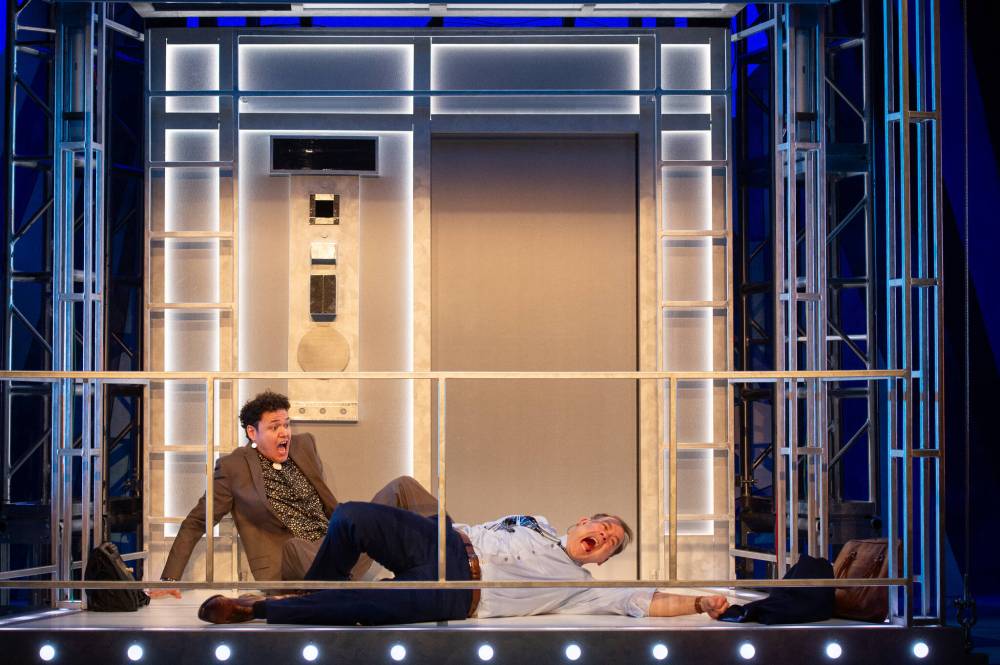
Nolan Moberly (left) and Kevin Klassen’s actions evolve to play with tropes from science fiction and racist 1970s westerns.
Enter Harrison T. Jones (Kevin Klassen), a lawyer who is late for a very important date in the profit-driven wonderland of the 33rd floor.
“Excuse me,” he tells Tallahassee as he crosses the threshold into the ensuing ethical cage match. “You’re kind of in my way.”
More concerned with the implications of the next contract than the ramifications of first contact, Jones is a strawman convinced he’s a brick house.
“I’m gonna end this little exchange before it turns into a conversation,” says the custom-suited solicitor, a woefully lonely man who’s never been suitable for equal partnership.
This dismissal is nothing new for Tallahassee, who walks with the clarity of a man who’s counted every courthouse step and knows not to be fooled by a Faustian handshake. (Both characters, costumed by Amy McPherson, use clothing as security blanket.)
“I’m visiting a white guy,” Tallahassee tells a friend before losing cell reception, revelling in making Jonesie squirm. “He’s got a very small place. No kitchen, no windows, no toilet and no running water. Still nicer than yours.”
With expert direction from Herbie Barnes, Elevate: Manaaji’idiwin is sly and knowing, a city play that should reach the highest offices of any corporation espousing reconciliation in its words, but denying lived truth in its actions. Sharply rendered, McLeod’s script, though long, never wastes time, gleefully dancing through dreamscape, family history and folkloric, magical realism.
As lines are drawn on the suddenly shared territory, the characters’ actions evolve to play with tropes from science fiction (a flux capacitor is referenced) and 1970s western “redsploitation.”
“Your attitude is burning both sides of my bannock,” Tallahassee scowls, transforming into his alter-ego, Billy Jack, whose jean jacket is his bulletproof vest. (Sharon provides an IMDb logline for the 1971 film about a part-Navajo antihero, played by white actor Tom Laughlin, to assist the uninitiated.) Soon, the characters are engaged in a rap battle, having a ball while brawling their way to the top.
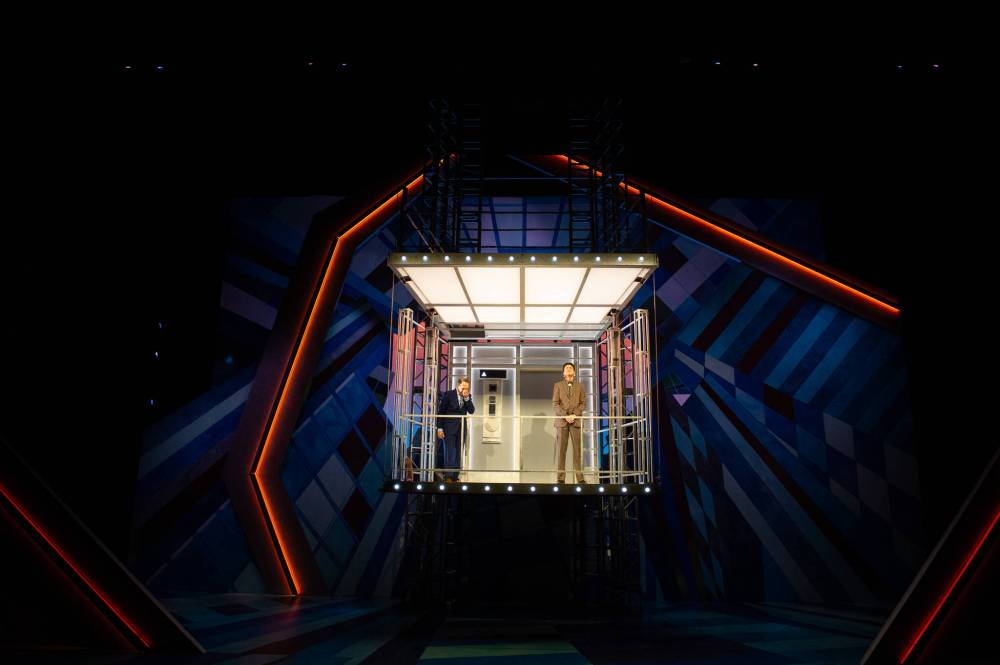
DYLAN HEWLETT PHOTO
The play’s centrepiece is a Mondrian-esque cage promoting dissent and descent.

“Are we fighting on the three or the four?” Jonesie asks, establishing ground rules while simultaneously alluding to the fact that he doesn’t know which treaty land he stands on.
If there’s any critique to be made about this production, it might be that Tallahassee’s grace and capacity to work within and around Jonesie’s racist anachronisms is otherworldly, and therefore, unrealistic. Indeed, when the characters eventually meet at eye level against visual artist Peatr Thomas’s monumental, gorgeous backdrop, a few groans were stifled in the theatre’s lower bowl.
“Personally, I can believe a fairy tale if it connects,” Jonesie says, after finally giving Tallahassee the last word.
“A red thread,” Tallahassee says. “This is a good sign, Jonesie.”
ben.waldman@winnipegfreepress.com
Ben Waldman is a National Newspaper Award-nominated reporter on the Arts & Life desk at the Free Press. Born and raised in Winnipeg, Ben completed three internships with the Free Press while earning his degree at Ryerson University’s (now Toronto Metropolitan University’s) School of Journalism before joining the newsroom full-time in 2019. Read more about Ben.
Every piece of reporting Ben produces is reviewed by an editing team before it is posted online or published in print — part of the Free Press‘s tradition, since 1872, of producing reliable independent journalism. Read more about Free Press’s history and mandate, and learn how our newsroom operates.
Our newsroom depends on a growing audience of readers to power our journalism. If you are not a paid reader, please consider becoming a subscriber.
Our newsroom depends on its audience of readers to power our journalism. Thank you for your support.
Theatre Review
Elevate: Manaaji’idiwn
● Royal Manitoba Theatre Centre John Hirsch Mainstage
● To May 17
● Tickets at royalmtc.ca
★★★★ out of five
Ben Waldman is a National Newspaper Award-nominated reporter on the Arts & Life desk at the Free Press. Born and raised in Winnipeg, Ben completed three internships with the Free Press while earning his degree at Ryerson University’s (now Toronto Metropolitan University’s) School of Journalism before joining the newsroom full-time in 2019. Read more about Ben.
Every piece of reporting Ben produces is reviewed by an editing team before it is posted online or published in print — part of the Free Press‘s tradition, since 1872, of producing reliable independent journalism. Read more about Free Press’s history and mandate, and learn how our newsroom operates.
Our newsroom depends on a growing audience of readers to power our journalism. If you are not a paid reader, please consider becoming a subscriber.
Our newsroom depends on its audience of readers to power our journalism. Thank you for your support.
Related Articles
Face to face in our often contentious historical space
Advertisement Advertise With Us
Advertisement Advertise With Us