Lost worlds, rediscovered Fascinating new fossil provides insight into evolution of arthropods
Read this article for free:
or
Already have an account? Log in here »
To continue reading, please subscribe:
Digital Subscription
One year of digital access for only $1.44 a week*
- Enjoy unlimited reading on winnipegfreepress.com
- Read the E-Edition, our digital replica newspaper
- Access News Break, our award-winning app
- Play interactive puzzles
*Billed as $5.77 plus GST every four weeks. After 52 weeks, price increases to the regular rate of $19.95 plus GST every four weeks. Offer available to new and qualified returning subscribers only. Cancel any time.
To continue reading, please subscribe:
Add Free Press access to your Brandon Sun subscription for only an additional
$1 for the first 4 weeks*
- Enjoy unlimited reading on winnipegfreepress.com
- Read the E-Edition, our digital replica newspaper
- Access News Break, our award-winning app
- Play interactive puzzles
*Your next Brandon Sun subscription payment will increase by $1.00 and you will be charged $17.95 plus GST for four weeks. After four weeks, your payment will increase to $24.95 plus GST every four weeks.
Read unlimited articles for free today:
or
Already have an account? Log in here »
Hey there, time traveller!
This article was published 21/05/2025 (520 days ago), so information in it may no longer be current.
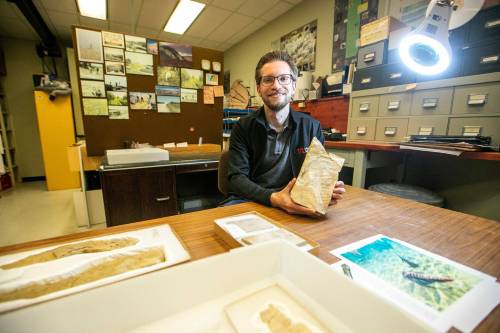
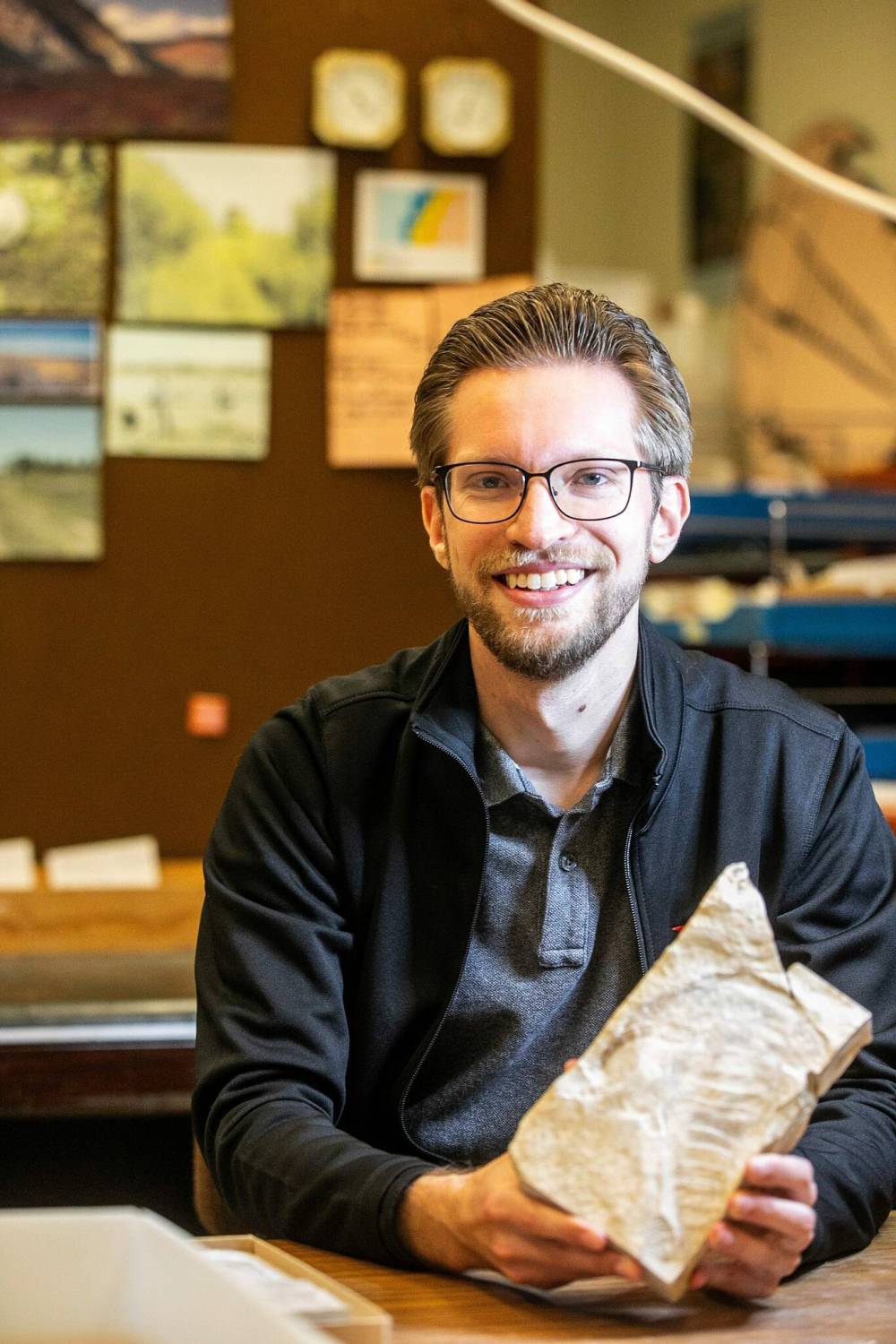
In his office piled high with papers, behind a desk strewn with specimens, Joe Moysiuk, curator of paleontology and geology at the Manitoba Museum, turns a fossil over in his hands.
“You never really know what you’ll uncover when you head into the field,” he says, grinning.
“That’s what keeps it exciting — the chance to piece together something that reshapes how we understand life’s earliest history.”
MIKAELA MACKENZIE / FREE PRESS
Joe Moysiuk, curator of paleontology and geology at the Manitoba Museum, said the discovery of the new fossil shows that arthropods evolved in more varied ways than we previously thought.
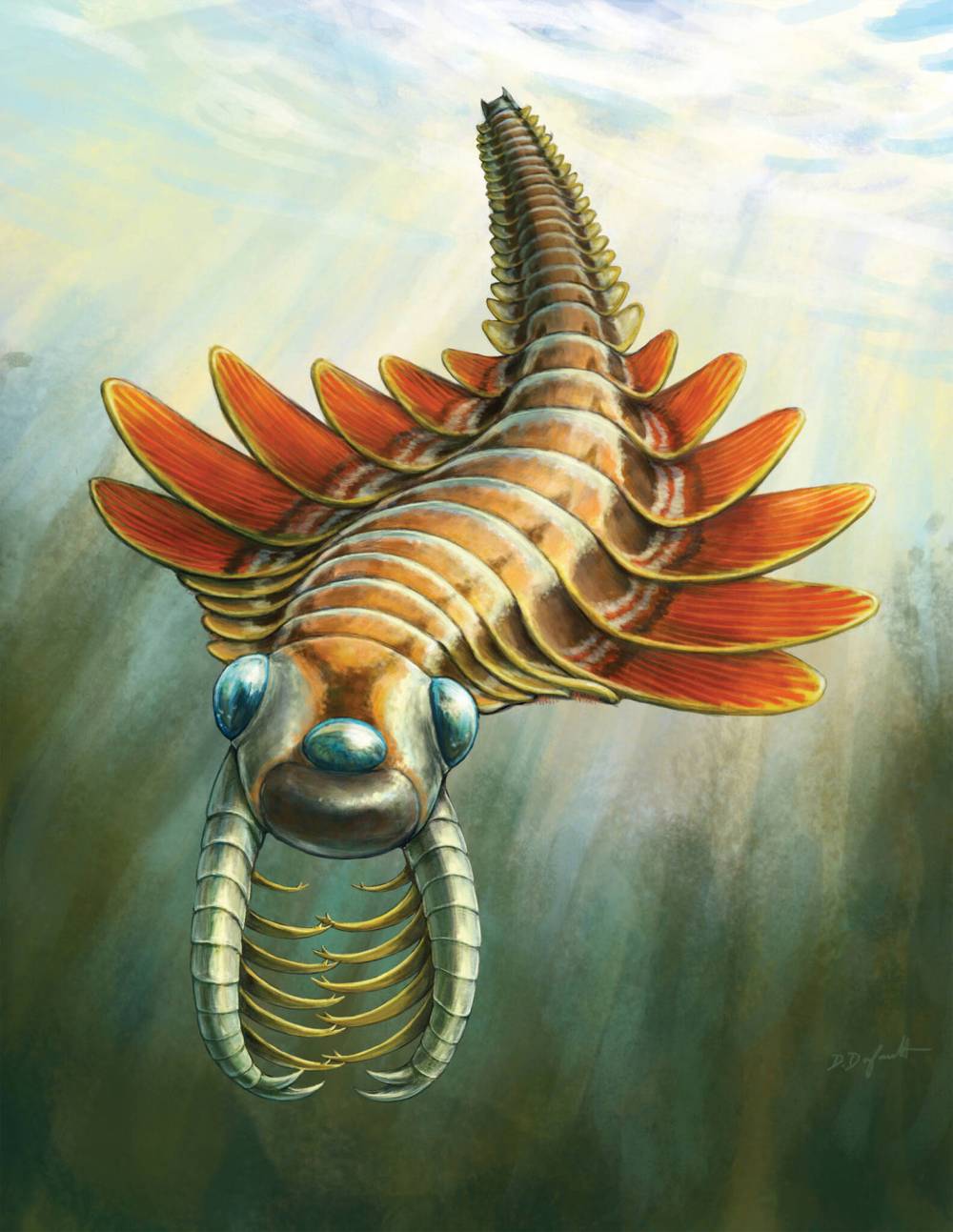
He gestures toward an illustration of his latest discovery, Mosura fentoni.
“This little creature might seem insignificant at just five or six centimetres long, but its features tell an incredible story. Three eyes, a unique segmented body and flap-like structures — nothing like it exists today,” he says.
“The more we study it, the clearer it becomes that arthropods evolved in more varied ways than we previously thought.”
Mosura fentoni is a new genus from the Burgess Shale in British Columbia, detailed in his upcoming paper, Early evolvability in arthropod tagmosis exemplified by a new radiodont from the Burgess Shale (co-authored with Jean-Bernard Caron, University of Toronto), in Royal Society Open Science.
“This animal is incredible. It has compound eyes, a third eye positioned at the front and flap-like structures that resemble moth wings, but were used for swimming instead. The back of its body looks like an insect’s abdomen, specialized in a way we hadn’t seen in radiodonts (an extinct form of invertebrate predator) before,” Moysiuk says.
Mosura has 16 segments lined with gills at the rear end of its body, a feature that converges with modern creatures such as horseshoe crabs, woodlice and insects, which have respiratory organs at the rear of the body.
The reason for this adaptation is unknown, but researchers theorize it may be related to particular habitat preference or behaviour of Mosura that called for more efficient respiration.
“This little creature might seem insignificant… but its features tell an incredible story… nothing like it exists today.”–Joe Moysiuk
The animal’s vague similarity to a moth inspired its discoverers to “have a bit of a fun” when naming it, Moysiuk says.
“‘Mosura’ is a nod to the Japanese movie monster Mothra, and ‘fentoni’ honours one of our longtime ROM (Royal Ontario Museum) colleagues,” he says.
Moysiuk flips through a series of photos taken under different lighting conditions, revealing intricate features of the fossil, which has a circular, tooth-filled mouth and spiny claws.
“One image shows the external features — the dark outline of the body. Another captures reflective patches extending into the swimming flaps. These remnants of circulatory structures help us understand how early arthropods transported oxygen,” he explains.
Instead of arteries and veins, Mosura had an open circulatory system; its heart pumped blood into large internal body cavities. The preservation of these structures confirms the ancient origin of this type of system, Moysiuk says.
The fossils in the Burgess Shale — dating from the Cambrian Period, approximately 508 million years ago — are famous for their well-preserved soft parts, showing details such as eyeballs and brains.
“The Burgess Shale has been known since 1909, when Charles Walcott discovered it,” Moysiuk says of the site located in Yoho National Park and Kootenay National Park in British Columbia.
Danielle Dufault / Royal Ontario Museum Life
An artistic rendering of what Mosura fentoni would have looked like.
“The preservation here is phenomenal — eyes, guts, even an animal’s last meal trapped inside its stomach.”
His own connection to the site runs deep, dating to his first expedition in 2014 when Moysiuk was still an undergraduate.
“We had just discovered a new Burgess Shale site in Marble Canyon, in Kootenay National Park, south of the original one Yoho National Park site. Twenty per cent of the species we found at Marble Canyon were previously unknown,” he says.
He pauses, tapping a cabinet in his office.
“Some of the specimens we studied for this paper were collected back in 2014; others date even earlier. It’s a long process. Years of collecting, followed by years of research and writing.”
Down the hall, in the Collection Room, Moysiuk slides open another towering cabinet, revealing mammoth tusks, ancient bison skulls and rare fossils that yield fragments of prehistoric life.
MIKAELA MACKENZIE / FREE PRESS
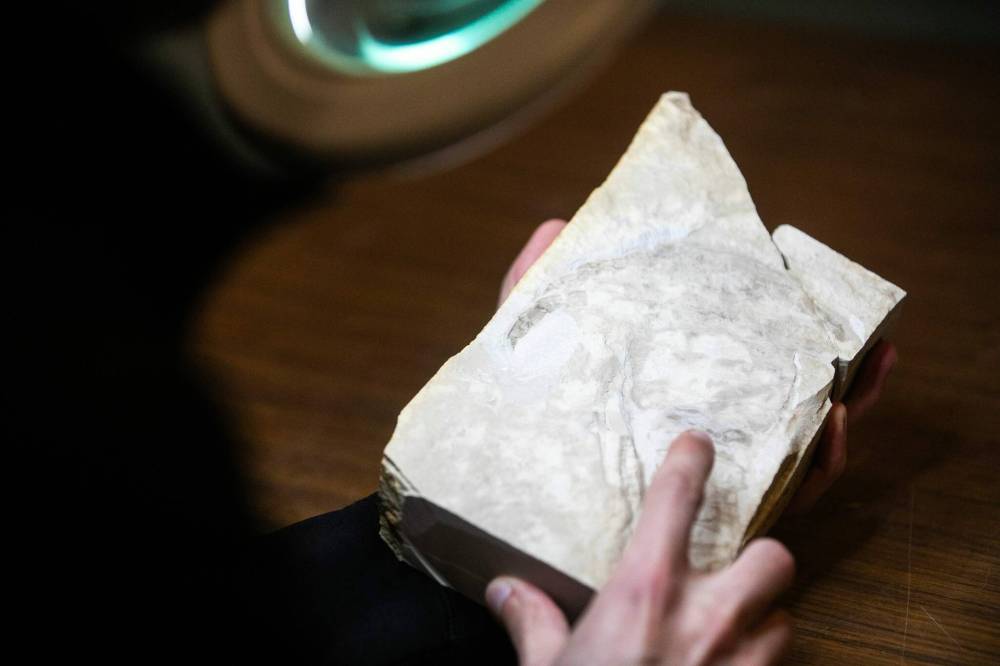
A eurypterid ‘scorpion’ found in Grand Rapids, Man., represents a new species that has yet to be named.
“Every specimen has a story, from how they were found to what they reveal about natural history ” Moysiuk says, following the outline of a tusk with one finger.
He steps back, scanning the room.
“So many of us live in cities now, disconnected from the natural world. Museums help bridge that gap. They let people experience things they might never see otherwise,” he says.
Back in his office, surrounded by maps from past expeditions, he smiles.
“Evolution is full of surprises. These fossils challenge us to rethink long-held assumptions, and when you get the chance to be part of that process, to rewrite even a small piece of Earth’s history, it’s pretty special,” Moysiuk says.

He gestures to his desk, buried beneath research materials.
“It’s a puzzle, piecing together the story of these ancient creatures,” he says.
MIKAELA MACKENZIE / FREE PRESS
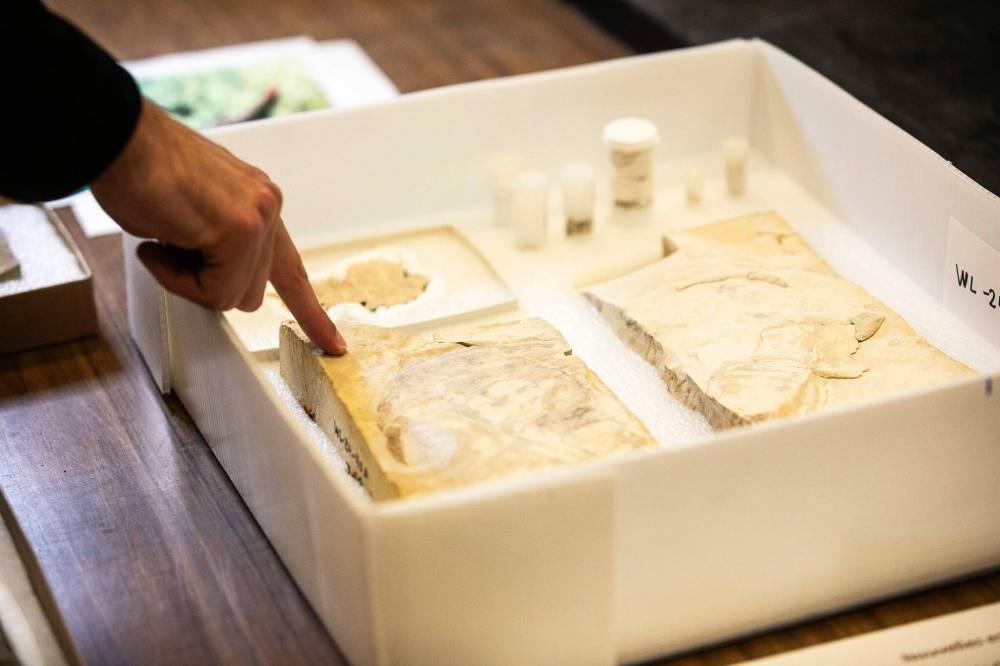
Moysiuk shows off some of the Manitoba Museum’s collection of fossils.
“It’s sharing these stories with colleagues and the public that’s always the greatest reward.”
A specimen of Mosura will go on display at the Manitoba Museum this fall.
arts@freepress.mb.ca
A lifelong passion for ancient creatures
Joe Moysiuk, curator of paleontology and geology at the Manitoba Museum, notes that he’s also an evolutionary biologist with research interests in macroevolution, evolutionary developmental biology and the origin of animal body plans.
“I am passionate about natural history and collections-based research,” says the curator, who is also an adjunct professor at the University of Saskatchewan and a research associate at the Royal Ontario Museum in Toronto (his hometown).
“My work frequently combines systematics with the assessment of various broader evolutionary questions related to animal origins,” says the scientist, who has published papers in influential journals such as Nature and Current Biology.
Moysiuk has travelled to important Paleozoic fossil sites in Manitoba, Ontario, British Columbia and the eastern United States.
“I am especially interested in sites exhibiting exceptional preservation, and have led the description of new occurrences of rare soft-tissue preservation,” Moysiuk says.
His most recent work, Early evolvability in arthropod tagmosis exemplified by a new radiodont from the Burgess Shale, co-authored with Jean-Bernard Caron, was published in the Royal Society Open Science on May 14.