

Bibi, the ‘anti-Bibi’ and the ‘wanna-Bibis’
Advertisement
Read this article for free:
or
Already have an account? Log in here »
To continue reading, please subscribe:
Digital Subscription
One year of digital access for only $1.44 a week*
- Enjoy unlimited reading on winnipegfreepress.com
- Read the E-Edition, our digital replica newspaper
- Access News Break, our award-winning app
- Play interactive puzzles
*Billed as $5.77 plus GST every four weeks. After 52 weeks, price increases to the regular rate of $19.95 plus GST every four weeks. Offer available to new and qualified returning subscribers only. Cancel any time.
To continue reading, please subscribe:
Add Free Press access to your Brandon Sun subscription for only an additional
$1 for the first 4 weeks*
- Enjoy unlimited reading on winnipegfreepress.com
- Read the E-Edition, our digital replica newspaper
- Access News Break, our award-winning app
- Play interactive puzzles
*Your next Brandon Sun subscription payment will increase by $1.00 and you will be charged $17.95 plus GST for four weeks. After four weeks, your payment will increase to $24.95 plus GST every four weeks.
Read unlimited articles for free today:
or
Already have an account? Log in here »
According to the 1970s anarchist slogan, “No matter who you vote for, the government always gets in.”
That’s certainly true for the election in Israel on Tuesday, even if the winner is not Prime Minister Benjamin (Bibi) Netanyahu himself. All the other party leaders, says Israeli journalist Anshel Pfeffer, are just “wanna-Bibis.”
Or rather, all the rest except one. Former general Gadi Eisenkot, the main opposition candidate, is the “anti-Bibi,” Pfeffer says. He’s a working-class hero who joined the army as a private and worked his way up to chief of staff of the Israel Defence Forces (IDF). He retired and went into politics only four years ago, he’s modest and honest, what’s not to love?
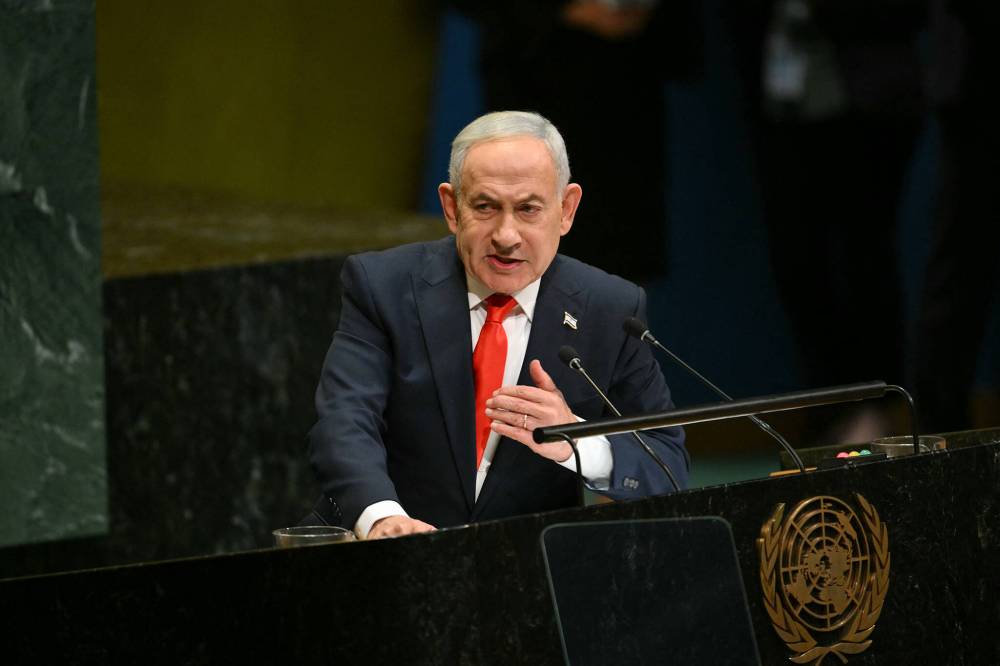
Tribune News Service
Israeli Prime Minister Benjamin Netanyahu addresses the 81st United Nations General Assembly in New York last month. Israel’s national election will be held Tuesday.
Eisenkot certainly stands out among the party leaders in terms of style, but not so much in terms of actual policies. He was realistic enough to know that “total victory’ over Hamas was not likely, but his “Dahiya” strategy of causing “immense damage and destruction” (in Lebanon in the 2006 war) foreshadowed the cataclysm that the IDF has inflicted on Gaza since 2023.
Eisenkot supports Jewish settlement in the occupied Palestinian territories and he opposes the two-state solution to the Israeli-Palestinian conflict (as do all the wanna-Bibis). He wants a full investigation of the intelligence failures that enabled Hamas to commit the massacres of Jewish civilians on Oct. 7, 2023, like every other party leader (except Netanyahu himself).
Moreover, even if Eisenkot won the largest number of seats in the Knesset (parliament) and was asked to form a government, he would have to form a coalition with other parties that are farther to the right than his own Yashar Party. The next Israeli government will probably be just as expansionist, and just as willing to go to war again, as the current one is.
How did it come to this? How did “gallant little Israel” turn into the militaristic dwarf superpower that torments the Middle East today? I don’t usually have recourse to “great man” theories of history, and I don’t think that Benjamin Netanyahu is a great or even a good man, but he has had a huge influence on Israel and the entire Middle East.
You could make the shallowest dive possible into the past and explain Israel’s brutal current behaviour (see, for example, recent revelations about killing Palestinian civilians in Gaza, as revealed in NAZA) as vengefulness for the massacres of Israelis by Hamas three years ago.
You could dig a little deeper and blame the deepening ethno-nationalism of the younger generation of Israelis, driven by their experience of many long, small, indecisive wars rather than the brief, infrequent and triumphant wars of their parents’ generation. (Their extremism often shocks their parents.)
Or you could go all the way back to the turning point of 1995, when unspoken collaboration between Israeli and Palestinian hard-liners, both opposed to the two-state solution, managed to kill the peace deal at a time when it really was within reach.
And every time, Netanyahu is there, making sure the fear never fades (he has been warning that Iran is on the brink of getting a nuclear weapon for 34 years now) and the threat of war always seems close. That’s his ticket to power, and it has made him prime minister of Israel for more than half of the past 25 years.
Incredibly, he is still in the running for prime minister in the current election campaign despite the fact that all the ugly details about his failure to foresee Hamas’s 2023 attack have been spilling out in the media.

He was given warnings about it well beforehand, with specific details, by Egypt’s intelligence chief Abbas Kamel and by Mohamed bin Zayed Al Nahyan, the president of the United Arab Emirates. Kamel even flew to Israel to emphasize the urgency of the matter. Netanyhu did nothing about it, nor did he pass any of the warnings on to the IDF or Israeli intelligence.
Did he want the attack to happen (presumably underestimating its scale) in order to exploit it for some domestic political purpose? Did he just forget to mention it? There are many possible explanations, but none of them show him in a good light.
Yet Netanyahu is still there, trailing Eisenkot’s Yashar Party by a bit in the polls but definitely still in the race. The Israeli public knows about his little lapse of memory, but a great many of them don’t care. Some 46 per cent of Israeli voters think Netanyahu is best suited to be prime minister, compared to 29 per cent for Eisenkot.
And 80 per cent would like to restart the war in Lebanon.
Gwynne Dyer’s new book is Intervention Earth: Life-Saving Ideas from the World’s Climate Engineers.