Cutting edge tips Learn kitchen knife skills in our new monthly cooking feature
Read this article for free:
or
Already have an account? Log in here »
To continue reading, please subscribe:

Digital Subscription
One year of digital access for only $205*
- Enjoy unlimited reading on winnipegfreepress.com
- Read the E-Edition, our digital replica newspaper
- Access News Break, our award-winning app
- Play interactive puzzles
*First annual payment billed as $205.00 + GST for one year. This annual subscription will automatically renew at $233.00 + GST every 52 weeks (10% off the regular annual price of $259.35). Offer available to new and qualified returning subscribers only. Cancel any time.
To continue reading, please subscribe:
Add Free Press access to your Brandon Sun subscription for only an additional
$1 for the first 4 weeks*
- Enjoy unlimited reading on winnipegfreepress.com
- Read the E-Edition, our digital replica newspaper
- Access News Break, our award-winning app
- Play interactive puzzles
*Your next Brandon Sun subscription payment will increase by $1.00 and you will be charged $17.95 plus GST for four weeks. After four weeks, your payment will increase to $24.95 plus GST every four weeks.
Read unlimited articles for free today:
or
Already have an account? Log in here »
Hey there, time traveller!
This article was published 10/06/2025 (473 days ago), so information in it may no longer be current.
Welcome to the first class of Homemade: Cooking School, a new Free Press series featuring in-depth cooking tutorials from professional local chefs.
These monthly guides were created with instructors from Red River College Polytechnic’s culinary arts program and will provide useful tips for newbies and confident cooks alike.
We’re kicking things off with a lesson on knife skills led by chef Terry Gereta.
Gereta and his wife owned the former Mise Bistro & Lounge on Corydon Avenue for more than a decade until he made the move to teaching full time in 2015.
At Red River, he teaches students how to work in a full-service, public-facing kitchen at Jane’s, a fine-dining restaurant on the main floor of the Paterson Global Foods Institute.
A culinary career wasn’t what he had in mind when he landed his first kitchen job in 1984.
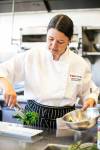
MIKAELA MACKENZIE / FREE PRESS Terry Gereta demonstrates knife skills at RRC Polytech on Monday. He says a sharp knife is a safe knife, as a dull knife may move while cutting.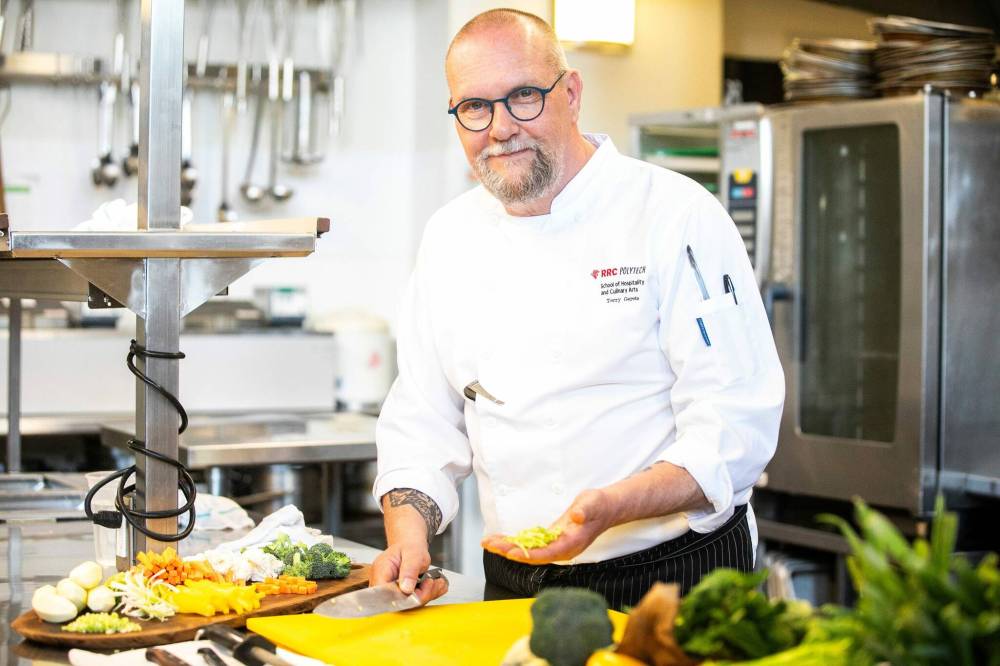
“I fell into it and was really good at it,” Gereta says, adding his favourite thing about cooking is “the speed of it, the variety of the job, the multiple chances to get it right. You’re always going for the same thing and trying to perfect it every time.”
That’s a perfect segue into knife skills.
Choose the right knife
There are knives for cutting tomatoes, knives for deboning meat and knives for slicing sashimi. While it’s nice to have the right tool for the job, you’ll find more value in multipurpose utensils.
MIKAELA MACKENZIE / FREE PRESS From top: A honing steel is used to maintain the edge of a knife between sharpenings. A paring knife is used for trimming and precision tasks. A petty or utility knife is used for in-between jobs. And a chef’s knife is used for all manner of chopping.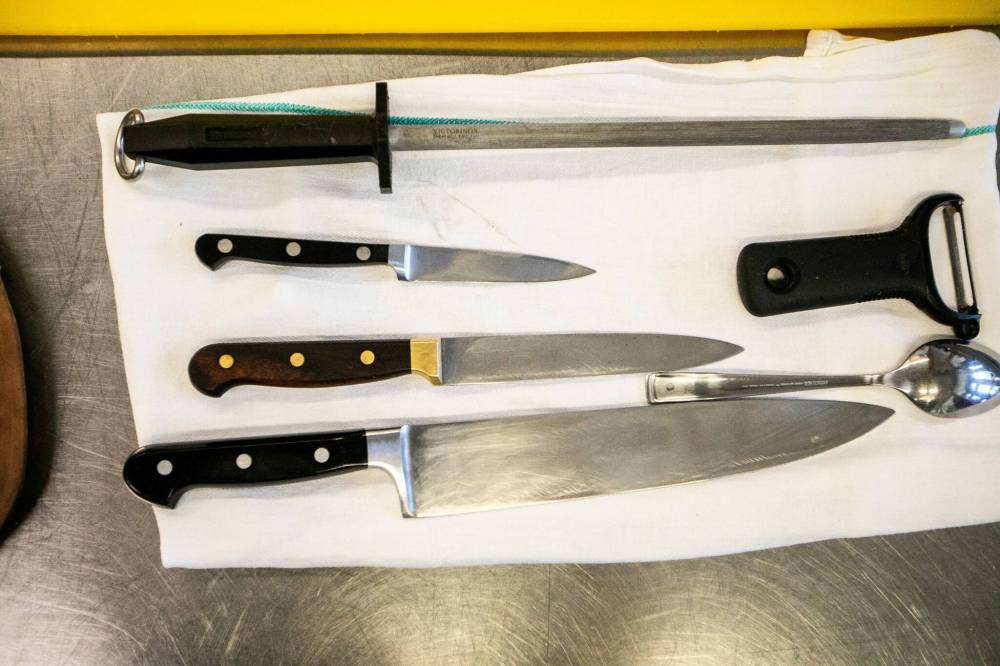
Gereta recommends owning three basic knives:
● Paring knife: A small knife with a 3- to 4-inch blade used for peeling, trimming and precision cuts.
● Petty or utility knife: A versatile knife with a 4- to 6-inch blade used for medium-sized ingredients and in-between tasks.
● Chef’s knife: A long 6- to 12-inch knife used for virtually any kitchen job, from cutting meat to dicing vegetables to slicing herbs.
Knives can be an expensive investment. Keep an eye out for good-quality second-hand knives that can be sharpened back into commission.
Maintenance, care and storage
A sharp knife is a safe knife, says Gereta.
“If you have a dull knife and you try and cut something, it will probably move and, more often than not, you’ll cut yourself.”
A dull knife will also tear food instead of slicing it cleanly.
He recommends getting knives professionally sharpened once per year and using a honing or sharpening steel — a handled metal rod with an abrasive surface — regularly to keep the cutting edge straight and sharp.
Hold the steel in your non-dominant hand and keep it steady while running the edge of the knife along the rod from the heel (the area closest to the handle) to the tip at a slight angle. Work slowly and repeat several times on both sides of the cutting edge.
Hand wash your knife with soap and water as soon as you’ve finished using it to avoid the need for scrubbing, which can be dangerous with a sharp tool. Never put knives in the dishwasher.
Keep your tools in tip-top shape by storing them properly.
“The bad way is in a drawer, the good way is somewhere they won’t bump into other things,” he says.
Knife blocks and wall-mounted magnetic strips both fall into the “good” category.
Practise the mechanics
Learning how to handle your knives correctly will make kitchen prep safer and more efficient.
Hold your knife as if going in for a handshake. Wrap your fingers around the handle firmly but comfortably and choke up on the blade slightly with your thumb and a curved index finger. This grip allows for more control while chopping.
Guide the ingredients with your other hand using a claw-like grip to protect your fingers from the sharp cutting edge. Pinch the item with your thumb and pinky and curl your remaining fingers away from the blade. The flat side of the knife should butt up your knuckles, removing the risk of nicking an outstretched fingertip.
Keep the tip of your knife in contact with the cutting board and move the tool in a wave-like motion that begins in the shoulder.
Keep your elbow tucked into your side for stability and control.
Steady your cutting surface by placing a damp towel or a non-slip mat underneath your cutting board.
Repetition and focus are key to improving knife skills.
“Make sure you respect your knife. I’ve chopped a fair amount of carrots in 40 years, but I still have to pay attention,” Gereta says.
Get organized
Watchers of The Bear might be familiar with the concept of mise en place. It sounds fancy, but mise en place simply refers to the process of gathering ingredients and organizing your workstation prior to cooking.
Good mise en place means having all the ingredients in a recipe chopped, prepped and portioned before moving on to the cooking directions. That way you won’t be stuck cutting something while another ingredient is left frying on the stove — a form of multitasking that can lead to burned or overcooked food.
Solid organization can also make cleanup easier.
“For a home cook, having good mise en place is important because the dishes can pile up pretty quick,” says Gereta, who abides by the “if you can lean, you can clean” school of thought and usually tidies up while things are simmering safely.
Learn the common cuts
Recipes often call for ingredients to cut a certain way. This is because food cooks more evenly when everything is the same size and shape.
Flavour distribution, texture and appearance of a final dish can also be improved with cut consistency.
Students at Red River learn the textbook dimensions of different cuts down to the millimetre, but there’s more wiggle room for home cooks.
“It’s all personal preference, as long as everything is the same size,” Gereta says.
The first cuts are the deepest, or rather, the most important. When dicing a carrot, for example, square off the ends and ensure the remaining sections are the same length to create a common baseline before breaking down the vegetable further.
Here are definitions of some common knife cuts:
● Julienne: Long, thin strips
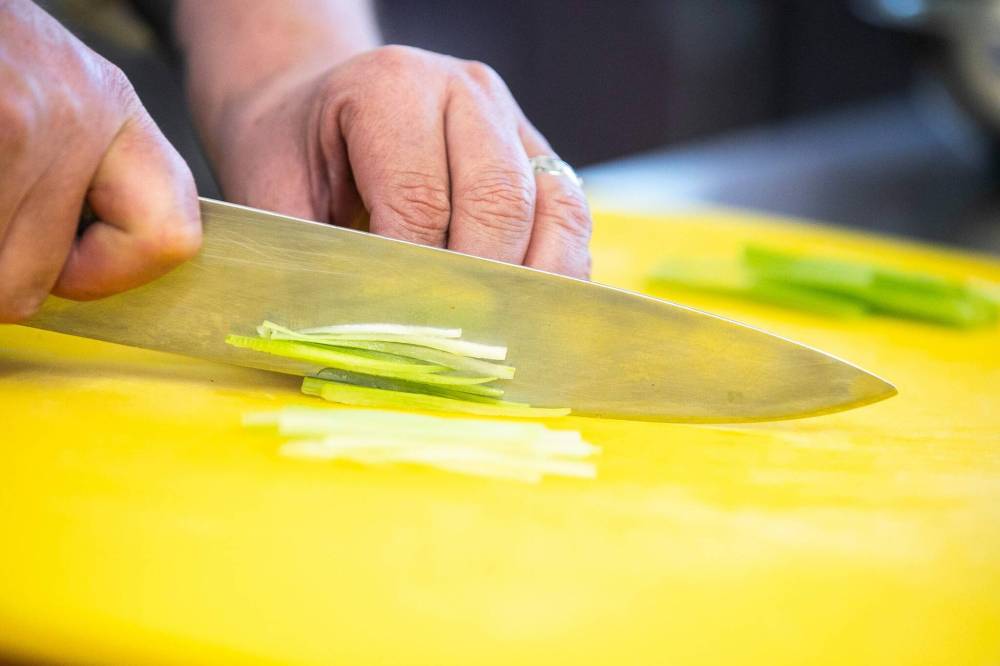
Julienne cuts create long, thin strips.
● Batonnet: Small sticks; think carrot sticks and French fries
MIKAELA MACKENZIE / FREE PRESS Batonnet is a small, square stick. 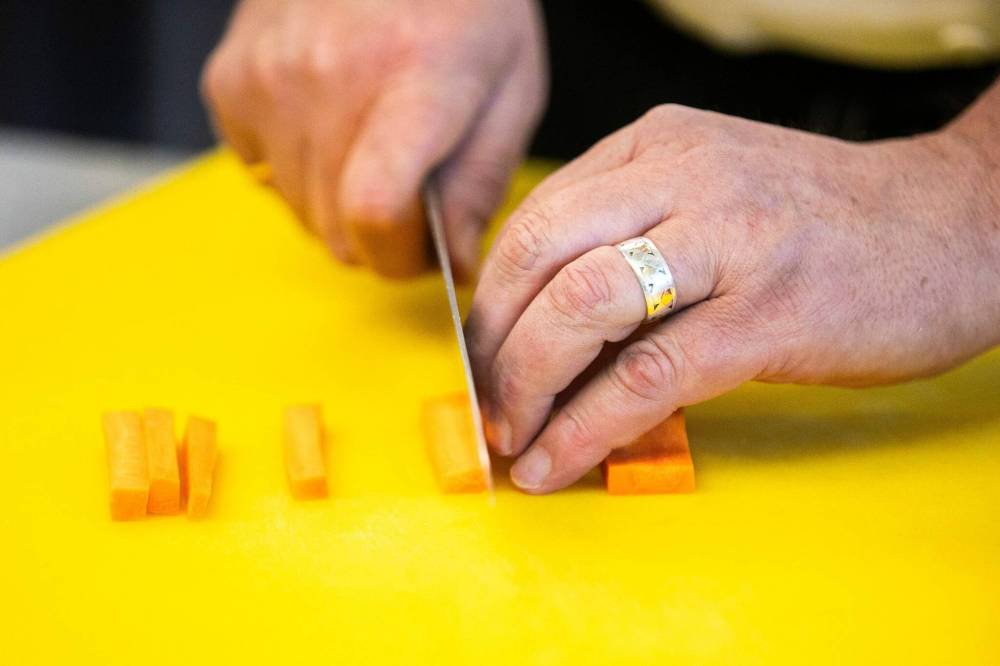
● Dice: Small- or medium-sized uniform cubes
MIKAELA MACKENZIE / FREE PRESS Dice is a uniform cube, made from a batonnet.
● Brunoise: A very small dice or mince
MIKAELA MACKENZIE / FREE PRESS Brunoise is a very small dice, made from a julienne.
● Chiffonade: Leafy greens or herbs rolled into a cigar-like shape and finely sliced
MIKAELA MACKENZIE / FREE PRESS Chiffonade is used to finely slice herbs or leafy greens.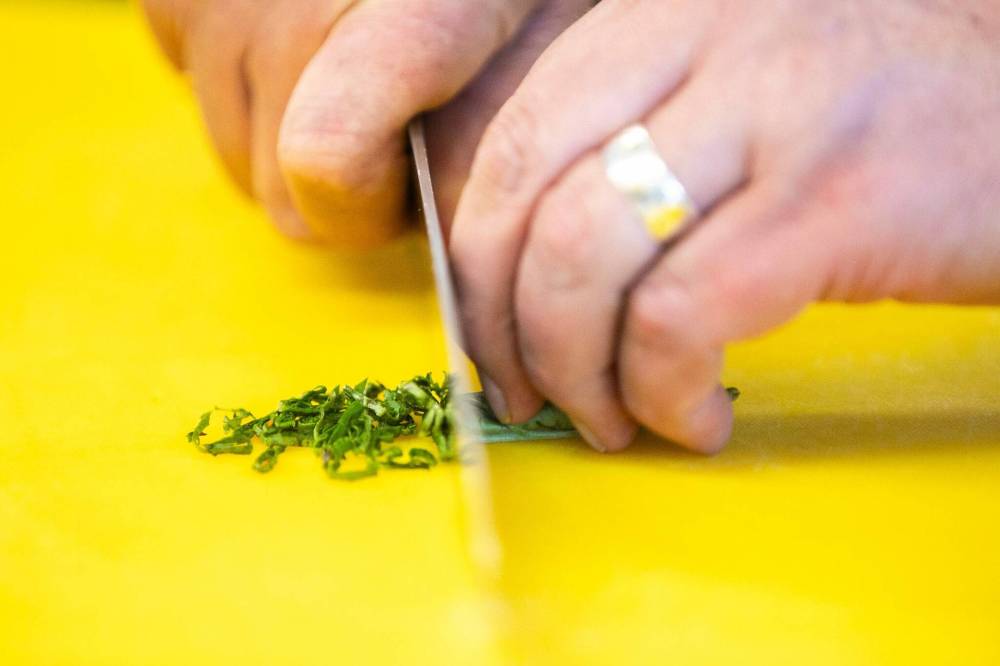
Consider composting or saving your vegetable scraps to use in soup stocks — a topic we’ll discuss further in next month’s Cooking School on stocks and sauces.
eva.wasney@winnipegfreepress.com


Eva Wasney covers environmental issues in Manitoba for The Narwhal in partnership with the Winnipeg Free Press. Read more about Eva.
Every piece of reporting Eva produces is reviewed by an editing team before it is posted online or published in print — part of the Free Press‘s tradition, since 1872, of producing reliable independent journalism. Read more about Free Press’s history and mandate, and learn how our newsroom operates.
Our newsroom depends on a growing audience of readers to power our journalism. If you are not a paid reader, please consider becoming a subscriber.
Our newsroom depends on its audience of readers to power our journalism. Thank you for your support.
Related Articles
Preserve your backyard bounty with family-tested canning recipes


History
Updated on Wednesday, June 11, 2025 2:00 PM CDT: Fixes typo