Sharing a gaze across centuries of time

Advertisement
Read this article for free:
or
Already have an account? Log in here »
To continue reading, please subscribe:

Digital Subscription
One year of digital access for only $205*
- Enjoy unlimited reading on winnipegfreepress.com
- Read the E-Edition, our digital replica newspaper
- Access News Break, our award-winning app
- Play interactive puzzles
*First annual payment billed as $205.00 + GST for one year. This annual subscription will automatically renew at $233.00 + GST every 52 weeks (10% off the regular annual price of $259.35). Offer available to new and qualified returning subscribers only. Cancel any time.
To continue reading, please subscribe:
Add Free Press access to your Brandon Sun subscription for only an additional
$1 for the first 4 weeks*
- Enjoy unlimited reading on winnipegfreepress.com
- Read the E-Edition, our digital replica newspaper
- Access News Break, our award-winning app
- Play interactive puzzles
*Your next Brandon Sun subscription payment will increase by $1.00 and you will be charged $17.95 plus GST for four weeks. After four weeks, your payment will increase to $24.95 plus GST every four weeks.
Read unlimited articles for free today:
or
Already have an account? Log in here »
Hey there, time traveller!
This article was published 02/08/2025 (418 days ago), so information in it may no longer be current.
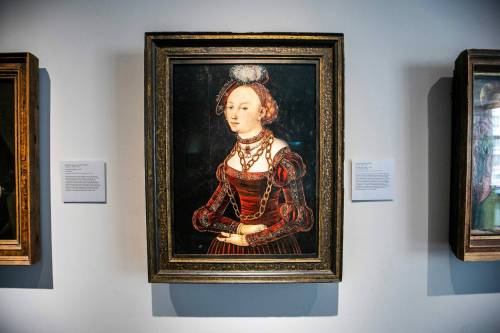
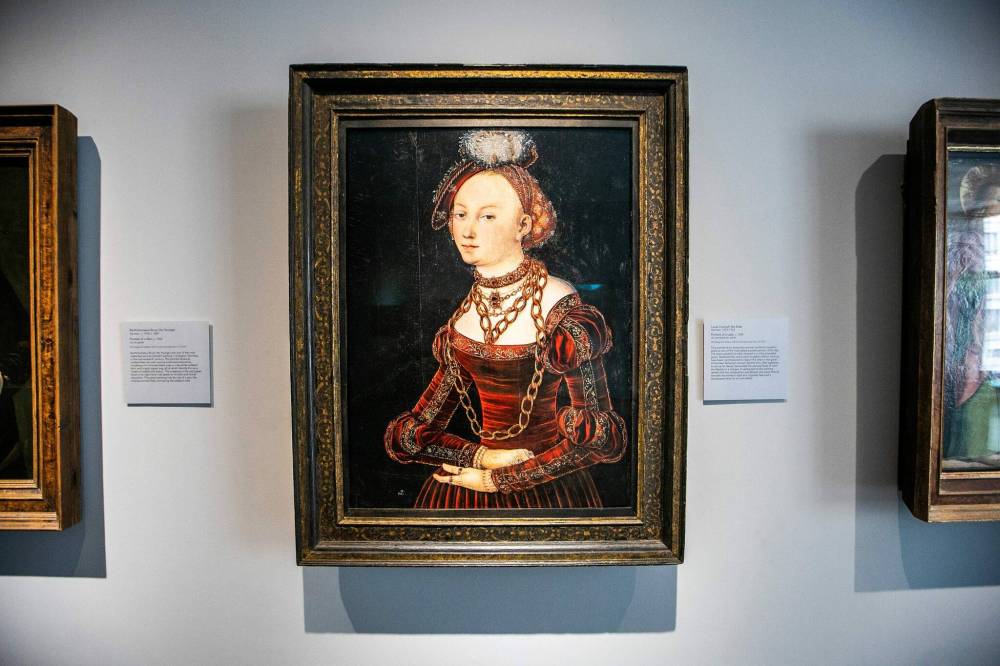
WHAT IT IS: A painting of oil and tempera on wood, Portrait of a Lady (dated about 1540) by German artist Lucas Cranach the Elder, is from the WAG-Qaumajuq’s permanent collection. It is currently on view as part of the historical collection of paintings, sculpture, furniture and decorative art in the long, narrow Gallery 1.
Shows of new works and big-name travelling exhibitions tend to grab all the art-world attention. But the permanent collections of large art institutions are important resources for scholarship and research. They’re crucial in the preservation of cultural heritage.
Beyond that, there’s just something satisfying for regular gallery visitors in being able to return to favourite pieces over the years, visiting them like old friends.
MIKAELA MACKENZIE / FREE PRESS
Portrait of a Lady (dated about 1540) by German artist Lucas Cranach the Elder.
WHAT IT’S ABOUT: Cranach was a painter to the Saxony court in Wittenberg, and his portraits of women generally express Northern Renaissance ideals of beauty and fashion.
Here, the subject has a high, unmarked forehead, which was considered a sign of beauty and serenity. (Elegant women of the day often painstakingly plucked their hair to achieve this look.) She also has the physical slightness, the narrow sloping shoulders, the extreme paleness that Cranach favoured in the female form, holdovers of the Gothic style.
The sitter’s outfit shows off not just her wealth and status but also the artist’s ability to capture texture and detail. We see the sumptuous, velvety material of the dress, the hard metallic gleam of the chains, the delicate puff of feathers atop her intricate headgear.
But underneath all this finery, who is this unnamed woman? In historical portraiture in the European tradition, men are generally defined by their achievements, while women are defined by their physical appearance.
Cranach has painted her as she is expected to be — beautiful and stylish. The one place where her individuality might break through is in her facial expression, and that remains enigmatic, hard to read.
This mysterious quality was only underlined when a radiographic examination revealed that at one point the good lady had a platter with a severed human head under her arms, in the lower left of the panel.
This suggests the sitter was initially portrayed in the guise of Salome, who danced before Herod and then demanded the head of John the Baptist as a reward. Cranach had kind of a thing for lovely women and decapitations, and he often painted women of the court as Salome or as Judith with the head of Holofernes. There are weird juxtapositions in these works, between the smooth, pale, composed faces of the women and the gawping mouths and raggedly bloody necks of their victims.
WHY IT MATTERS: Galleries and museums often reframe and recontextualize works in their permanent collection through themed exhibitions. There are two such shows on right now at WAG-Qaumajuq, Crying Over Spilt Tea and a matter of time, and these are important projects, demonstrating how the meanings and effects of art can shift over time, as culture, society and audiences change.
But there’s also something valuable in the serendipitous experiences that can be found when wandering through the historical galleries, where groupings are loosely chronological or regional. Without a lot of connecting information, a viewer often ends up in an odd, unexpected, one-on-one connection with a work that just draws them in, sometimes for reasons that aren’t initially clear.

Cranach’s work might just be an arrangement of paint on wood, but because it’s a portrait, it can feel like a personal encounter — we look at her, and she looks at us, across centuries of time.
In the daily art posts he wrote during the COVID-19 lockdown, Stephen Borys, WAG-Qaumajuq’s then director and CEO, said he finds her gaze “both intense and gentle,” and I can see that, too.
At other times, I think I see a hint of haughty, dangerous eroticism, perhaps a holdover from her incarnation as Salome. Is there even something a little challenging in the direct way she looks at us?
I honestly don’t know, which is frustrating but also fascinating — and why I keep going back.
alison.gillmor@freepress.mb.ca
Studying at the University of Winnipeg and later Toronto’s York University, Alison Gillmor planned to become an art historian. She ended up catching the journalism bug when she started as visual arts reviewer at the Winnipeg Free Press in 1992.
Our newsroom depends on a growing audience of readers to power our journalism. If you are not a paid reader, please consider becoming a subscriber.
Our newsroom depends on its audience of readers to power our journalism. Thank you for your support.
Studying at the University of Winnipeg and later Toronto’s York University, Alison Gillmor planned to become an art historian. She ended up catching the journalism bug when she started as visual arts reviewer at the Winnipeg Free Press in 1992.
Our newsroom depends on a growing audience of readers to power our journalism. If you are not a paid reader, please consider becoming a subscriber.
Our newsroom depends on its audience of readers to power our journalism. Thank you for your support.
Advertisement Advertise With Us
Advertisement Advertise With Us