From stump to sculpture
Abstract wood artist Victor Klassen listens to what his medium has to say

Advertisement
Read this article for free:
or
Already have an account? Log in here »
To continue reading, please subscribe:

Digital Subscription
One year of digital access for only $205*
- Enjoy unlimited reading on winnipegfreepress.com
- Read the E-Edition, our digital replica newspaper
- Access News Break, our award-winning app
- Play interactive puzzles
*First annual payment billed as $205.00 + GST for one year. This annual subscription will automatically renew at $233.00 + GST every 52 weeks (10% off the regular annual price of $259.35). Offer available to new and qualified returning subscribers only. Cancel any time.
To continue reading, please subscribe:
Add Free Press access to your Brandon Sun subscription for only an additional
$1 for the first 4 weeks*
- Enjoy unlimited reading on winnipegfreepress.com
- Read the E-Edition, our digital replica newspaper
- Access News Break, our award-winning app
- Play interactive puzzles
*Your next Brandon Sun subscription payment will increase by $1.00 and you will be charged $17.95 plus GST for four weeks. After four weeks, your payment will increase to $24.95 plus GST every four weeks.
Read unlimited articles for free today:
or
Already have an account? Log in here »
Hey there, time traveller!
This article was published 10/10/2025 (321 days ago), so information in it may no longer be current.
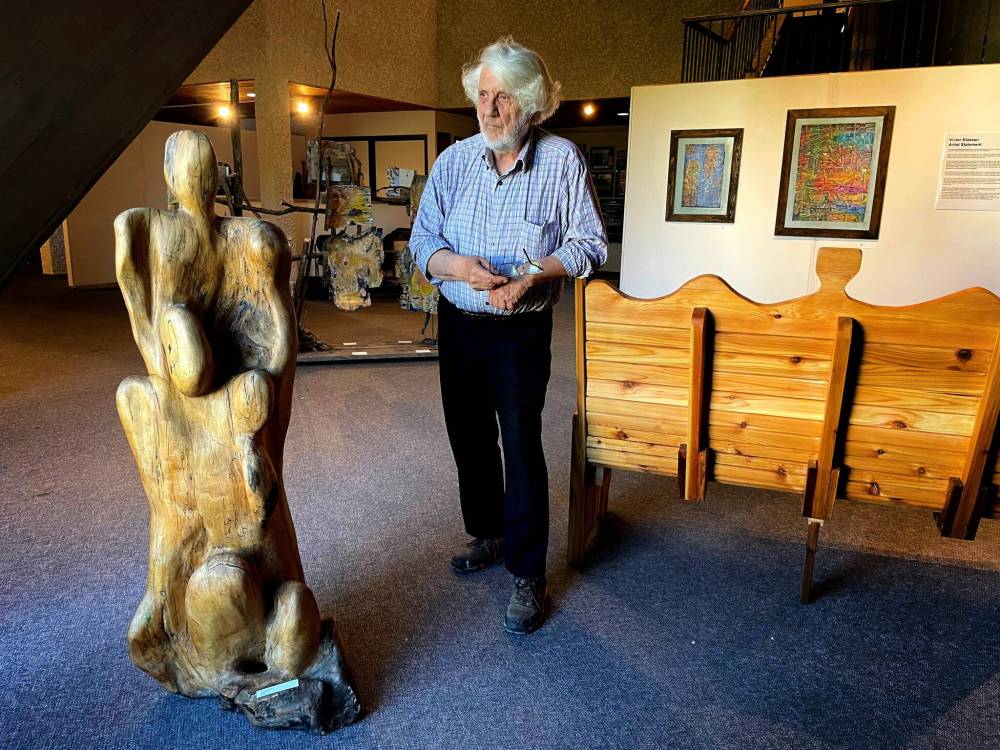
Where one person might see a tree stump, Victor Klassen sees a sculpture.
“The wood and I got to talking, and I mostly just took the rot out,” the artist says of Family, an abstract wood sculpture made out of Manitoba maple.
And indeed, there it is — a six-person family, or perhaps six generations of a family.
Ruth Bonneville / Free Press
Arist Victor Klassen grew up in rural Manitoba but calls Mexico home now.
Klassen, 80, is mostly based in Mexico these days, but he was raised in a Mennonite community in rural Manitoba. His current exhibition, Seeing, on view until Oct. 25 at MHC Gallery at the Canadian Mennonite University, marks the first time his work has ever been shown in his home province.
“I only have 44 nieces and nephews, and most of them live in Manitoba, so that’s been very supportive. They have to put up with me,” he says.
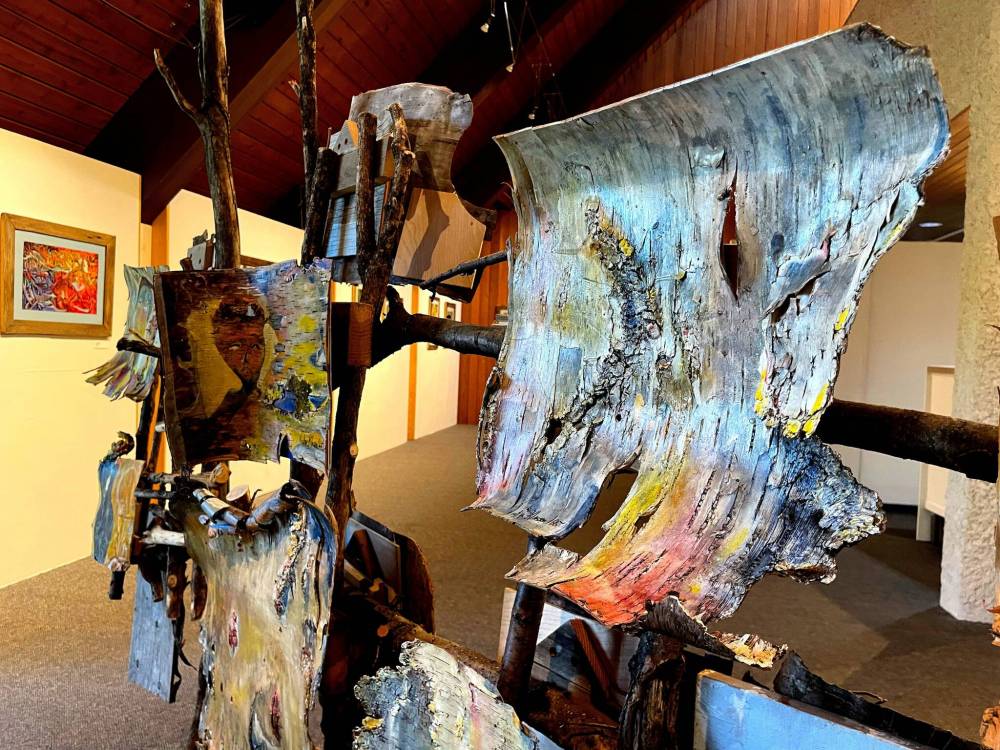
Seeing is a survey of his 40-year artistic practice, composed of furniture, paintings and sculpture. The throughline is Klassen’s work with wood in all its iterations, including a recent collection of colourful paintings on birchbark he created for this exhibition.
“Originally, the deal was to do some AI stuff, and then I got word from the forest that they’ve been doing intelligent design for millions of years,” he deadpans.
Klassen says he tries to see himself as a servant of the wood. It shows him what to do. So much of it is art already. (He does have a favourite wood: tropical red cedar. “It has a chemical structure that does not allow parasites to enter. It’s very resistant to moisture. It’s very stable, and it’s very beautiful.”)
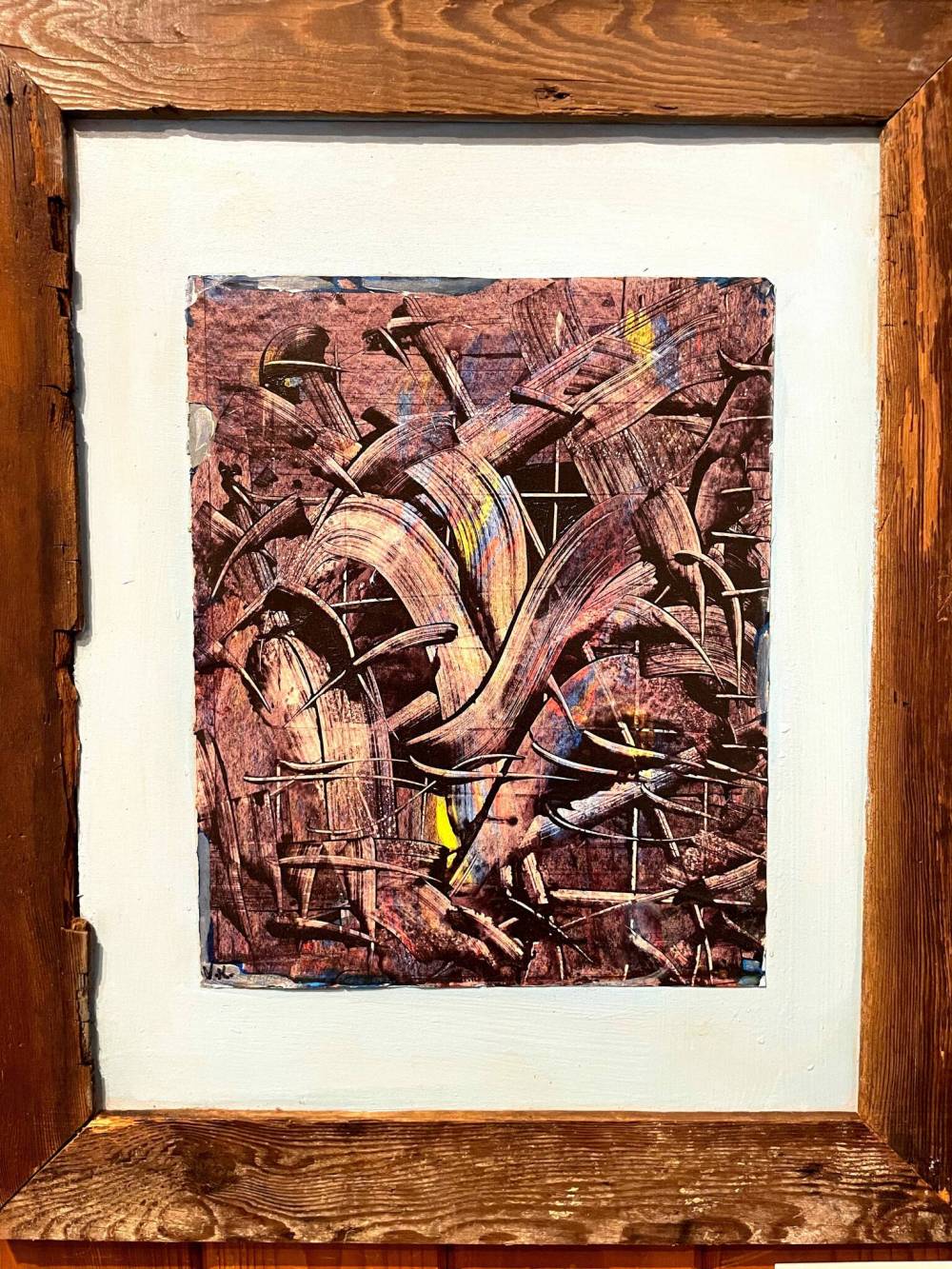
Even the paintings in the exhibition are framed with reclaimed wood from the house he grew up in near Homewood, close to Carman, which was built in 1945, the year he was born.
“My father would say it was built by the second-best carpenter from Steinbach, his cousin.”
That’s not how his interest in making art from wood began, however. Art wasn’t a priority in the culture he grew up in, he says, nor was it viewed as a viable way to make a living.
But Klassen recalls a family gathering near Moose Lake, Ont., when he was a teenager, and he and three of his sisters went out gathering driftwood. He tucked the pieces away in a bag.
“The next year, I was in Toronto and a bit depressed. I took out the bag and started playing with (the wood), and a beautiful, abstract face appeared. And that was that,” he says.
Klassen started going to Mexico in 1973 and moved there in the mid-’80s, inspired by the culture and the emphasis on artistic expression. His own home is an incredible work of art; there’s a video of it as part of the exhibition.
Ruth Bonneville / Free Press
The ’80s was also when he discovered meditation, which was transformative for him. He would do intensive, 15-day retreat courses and later became a meditation teacher himself.
Meditation — and specifically the Zen Buddhist practice of “no mind” meditation — has deeply informed his art practice
“The whole technique, the no-mind technique, is based on dredging up the subconscious and expressing it, but getting past the mind. I was just reading today that apparently we make between 60,000 and 70,000 thoughts every day. In meditation we learn to quieten the mind a bit,” he says.
Meditation also quiets the internal critic. When Klassen can get into that state, the work flows; he once made a painting in 29 seconds.
“Now, I’m not bragging. There was somebody with me when I did it, but there was no mind, just action,” he says.
For decades, Klassen ran a successful atelier in Mexico with a group of artisans, making sculptural statement pieces of high-quality wood furniture that, much like his home, are themselves works of art.
A bench is included in the exhibition with an invitation to “please sit!”
“An artist friend of mine always said, ‘Do furniture to survive, and then you can do whatever you want,’” he says.
Klassen has stepped back from day-to-day production, though he will occasionally come back to work on a particularly interesting project. His approach to furniture making isn’t all that different from his other art making.
“Sometimes clients, they’d be spending $50,000 and they’d ask for drawings. And I’d say, ‘I don’t give drawings because I don’t know what I’m going to be making.’ But I always said, ‘I’ll give you your money back if you don’t like it.’
Ruth Bonneville / Free Press
One of Klassen’s large, abstract pieces; left, his paintings are framed with reclaimed wood.
“I never had to give anybody their money back.”
Whether it’s his furniture, paintings or sculpture, details in Klassen’s works reveal themselves the more one looks at them. That’s why he called his exhibition Seeing.

“And the idea isn’t that they see it the way I do because I really try to have no intention in my drawing and painting, and so people can look at them in their own way,” he says.
Klassen’s works are also a reminder that you can see art everywhere and in everything, far beyond a gallery’s walls. Nature, he says, is what taught him beauty.
So you can imagine what he thinks of so-called AI “art.”
“AI can organize parking lots and things like that. But art? Leave it alone.”
jen.zoratti@freepress.mb.ca
Jen Zoratti is a columnist and feature writer working in the Arts & Life department, as well as the author of the weekly newsletter NEXT. A National Newspaper Award finalist for arts and entertainment writing, Jen is a graduate of the Creative Communications program at RRC Polytech and was a music writer before joining the Free Press in 2013. Read more about Jen.
Every piece of reporting Jen produces is reviewed by an editing team before it is posted online or published in print – part of the Free Press‘s tradition, since 1872, of producing reliable independent journalism. Read more about Free Press’s history and mandate, and learn how our newsroom operates.
Our newsroom depends on a growing audience of readers to power our journalism. If you are not a paid reader, please consider becoming a subscriber.
Our newsroom depends on its audience of readers to power our journalism. Thank you for your support.
Exhibition preview
Victor Klassen: Seeing
● MHC Gallery, 610 Shaftesbury Blvd.
● To Oct 25
Jen Zoratti is a columnist and feature writer working in the Arts & Life department, as well as the author of the weekly newsletter NEXT. A National Newspaper Award finalist for arts and entertainment writing, Jen is a graduate of the Creative Communications program at RRC Polytech and was a music writer before joining the Free Press in 2013. Read more about Jen.
Every piece of reporting Jen produces is reviewed by an editing team before it is posted online or published in print – part of the Free Press‘s tradition, since 1872, of producing reliable independent journalism. Read more about Free Press’s history and mandate, and learn how our newsroom operates.
Our newsroom depends on a growing audience of readers to power our journalism. If you are not a paid reader, please consider becoming a subscriber.
Our newsroom depends on its audience of readers to power our journalism. Thank you for your support.
Advertisement Advertise With Us
Advertisement Advertise With Us