Earning its stripes Stunning Life of Pi stage show brings award-winning novel to vibrant life
Read this article for free:
or
Already have an account? Log in here »
To continue reading, please subscribe:
Digital Subscription
One year of digital access for only $1.44 a week*
- Enjoy unlimited reading on winnipegfreepress.com
- Read the E-Edition, our digital replica newspaper
- Access News Break, our award-winning app
- Play interactive puzzles
*Billed as $5.77 plus GST every four weeks. After 52 weeks, price increases to the regular rate of $19.95 plus GST every four weeks. Offer available to new and qualified returning subscribers only. Cancel any time.
To continue reading, please subscribe:
Add Free Press access to your Brandon Sun subscription for only an additional
$1 for the first 4 weeks*
- Enjoy unlimited reading on winnipegfreepress.com
- Read the E-Edition, our digital replica newspaper
- Access News Break, our award-winning app
- Play interactive puzzles
*Your next Brandon Sun subscription payment will increase by $1.00 and you will be charged $17.95 plus GST for four weeks. After four weeks, your payment will increase to $24.95 plus GST every four weeks.
Read unlimited articles for free today:
or
Already have an account? Log in here »
Hey there, time traveller!
This article was published 17/10/2025 (371 days ago), so information in it may no longer be current.
Royal Manitoba Theatre Centre’s season opener is one of its most fantastical productions, in which all lines between fact and fiction blur and wash away.
Life of Pi — an all-Canadian show directed by Haysam Kadri and co-produced with Edmonton’s Citadel Theatre — is based on Saskatoon-based writer Yann Martel’s 2001 Booker Prize-winning novel, adapted by English actor/playwright Lolita Chakrabarti.
Chakrabarti has taken poetic licence with many of the novel’s original details, with the story told through a series of flashbacks, beginning in a Mexican hospital room in 1978.
In the two-hour (including intermission) production, the 17-year-old Piscine (Pi) Molitor Patel recounts his harrowing tale of surviving a shipwreck for 227 days aboard a lifeboat with only a Royal Bengal tiger as his companion.
NANC PRICE PHOTO The set and costuming in Life of Pi make for a visually breathtaking production.
He is being interrogated by Mrs. Okamoto (Andrea Cheung, also portraying the ship’s captain), a representative of the Japanese company that owned the doomed cargo ship, and Lulu Chen (Bailey Chin, who also plays Jai), a dutiful staff member from the Canadian Embassy, as they attempt to determine what happened.
Through his vivid narration, Pi reveals he had been voyaging to Canada with his zookeeper father (Ali Kazmi, also cast as ghost father), mother Amma (Deena Aziz, also nurse), sister Rani (Anaka Maharaj-Sandhu; ghost Rani) and a menagerie of zoo animals. They were trying to escape civil unrest in their homeland of India, but a thunderous storm capsized the ship and sent his family members to their watery graves.
Life of Pi might be one of the most visually breathtaking productions on this stage in recent memory, with set designer Beyata Hackborn’s compact, modular pieces seamlessly moved into position for each scene, becoming a living kaleidoscope.
Theatre review
Life of Pi
● Royal Manitoba Theatre Centre
● John Hirsch Mainstage
● To Nov. 8
★★★★½ out of five
A glowing celestial orb, looming over the stage and flanked by a starry proscenium arch, becomes both moon and sun, and serves as a screen for video/projection designer Corwin Ferguson’s images of crashing waves, scene titles and archival photos that anchor the brisk narrative.
Lighting designer April Viczko also serves yeowoman’s duty, creating eye-popping hues that infuse the production with atmospheric mystery — particularly during Act I’s violent storm scene, which includes terrifying flashes of lightning, further heightened by composer/sound designer Joelysa Pankanea’s sensitively crafted score.
The eye-popping production rounds out with Joseph Abetria’s effective costumes, ranging from colourful Indian sarees to more neutral tunics and trousers.
And then there are the astounding life-size anthropomorphic puppets created by Calgary-based Puppet Stuff Canada (led by designers Brendon James Boys and Reese Scott), in the spirit of theatrical productions such as War Horse and The Lion King. Puppeteers harness their entire bodies in bringing to magical life a zebra, an orangutan named Orange Juice, a laughing hyena, schools of iridescent flying fish and an ill-fated sea turtle, as well as the show’s shaggy star, a Bengal tiger named Richard Parker.
Kudos especially to tiger-mates Troy Feldman and Braydon Dowler-Coltman, astutely coached by puppet director Dayna Tietzen, for ensuring every one of the big cat’s carefully articulated, rocketing leaps, coiled pacing and paw licks, as well as bestial, hunger-filled grunts, resonate with believability.
NANC PRICE PHOTO Pi Patel (right), played by Davinder Malhi, fends off the tiger Richard Parker, puppetted by Braydon Dowler-Coltman and Troy Feldman.
It’s difficult to imagine this production without Davinder Malhi, marking his RMTC debut as the title character, who fearlessly challenges his father’s alpha-male treatment of his zoo animals, and takes a deep dive into the nature of faith as he ecumenically adopts three religions — Hinduism, Christianity and Islam — later declaring to his hospital interrogators that his tale will “make you believe in God.”
Malhi successfully navigates his emotional trajectory from boyish enthusiasm to shell-shocked shipwreck survivor. Several of his later hallucinatory scenes are particularly chilling, as he conjures ghostly visions of his deceased family members, as well as a strapping Admiral Jackson (Garett Ross, also Russian Sailor), who comically shares seafaring tips. The actor’s convincing portrayal walks a thin plank between gut-level survival and utter madness.
Kadri’s razor-sharp direction ensures that the 14-member ensemble is as tightly knitted as a sailor’s knot. All save Malhi portray multiple characters, including Winnipeg’s Kevin Klassen, whose chameleonic artistry flip-flops between Act I’s benevolent Father Martin and the ship’s heavily tatted cook, who cruelly mocks the Patels’ vegetarianism.
NANC PRICE PHOTO Davinder Malhi makes his Royal Manitoba Theatre Centre debut as Pi Patel.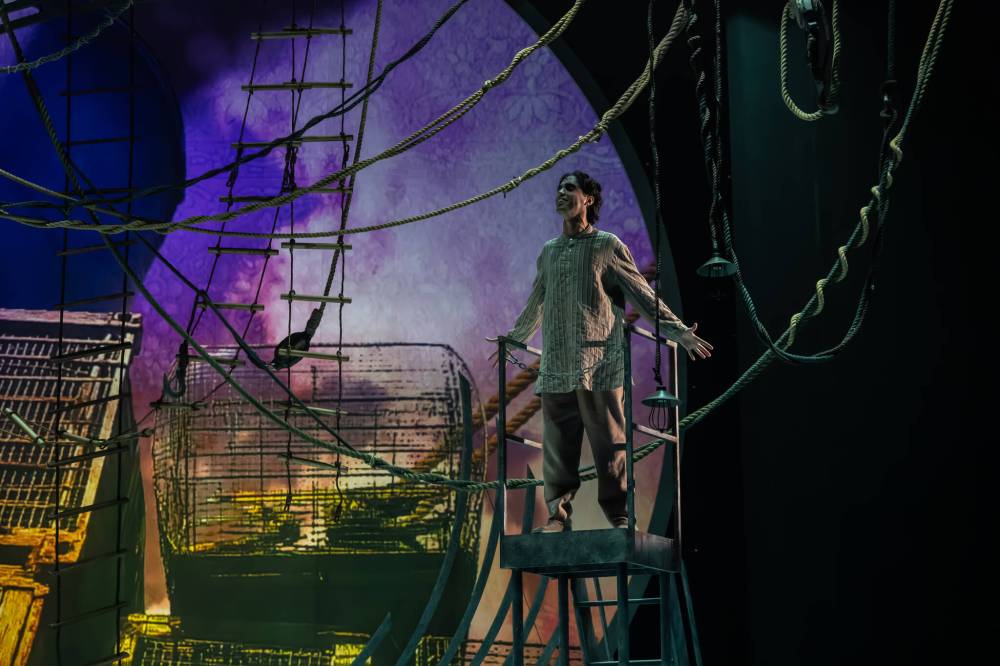
Chin, last seen in RMTC’s Little Women, embarks on her own narrative arc as Lulu Chen, at first clipped and efficient before more sympathetic shards of doubt appear.
At times, the show’s breathless pace does not allow individual actors’ lines to be heard clearly, as during the escalating chaos in Pi’s hometown of Pondicherry and the highly visceral storm scene.
It also too quickly glosses over Martel’s thoughtfully posed larger existential questions of faith and the power of imagination in understanding life’s myriad complexities. Plumbing those darker depths is what theatre does best; doing so would deliver an even greater emotional wallop, as when Pi openly questions the existence of God.
However, the production wisely leaves that porthole open for further reflection, with Pi’s triumphant final declaration — “I survived” — a mantra for today’s imperfect, hopelessly complicated world.
holly.harris@shaw.ca
Holly Harris writes about music for the Free Press Arts & Life department.
Our newsroom depends on a growing audience of readers to power our journalism. If you are not a paid reader, please consider becoming a subscriber.
Our newsroom depends on its audience of readers to power our journalism. Thank you for your support.