

Outbreak should never have happened
Advertisement
Read this article for free:
or
Already have an account? Log in here »
To continue reading, please subscribe:
Digital Subscription
One year of digital access for only $1.44 a week*
- Enjoy unlimited reading on winnipegfreepress.com
- Read the E-Edition, our digital replica newspaper
- Access News Break, our award-winning app
- Play interactive puzzles
*Billed as $5.77 plus GST every four weeks. After 52 weeks, price increases to the regular rate of $19.95 plus GST every four weeks. Offer available to new and qualified returning subscribers only. Cancel any time.
To continue reading, please subscribe:
Add Free Press access to your Brandon Sun subscription for only an additional
$1 for the first 4 weeks*
- Enjoy unlimited reading on winnipegfreepress.com
- Read the E-Edition, our digital replica newspaper
- Access News Break, our award-winning app
- Play interactive puzzles
*Your next Brandon Sun subscription payment will increase by $1.00 and you will be charged $17.95 plus GST for four weeks. After four weeks, your payment will increase to $24.95 plus GST every four weeks.
Read unlimited articles for free today:
or
Already have an account? Log in here »
The headline offered a vague sense that something had been accomplished, but it most certainly did not describe anything worth celebrating:
“Manitoba declares measles outbreak over.”
The news item in the Oct. 17 Free Press noted provincial public health officials had confirmed Manitoba’s last laboratory-confirmed case of measles was identified in August, and that the absence of any new cases since had allowed for the aforementioned declaration.
The Associated Press files
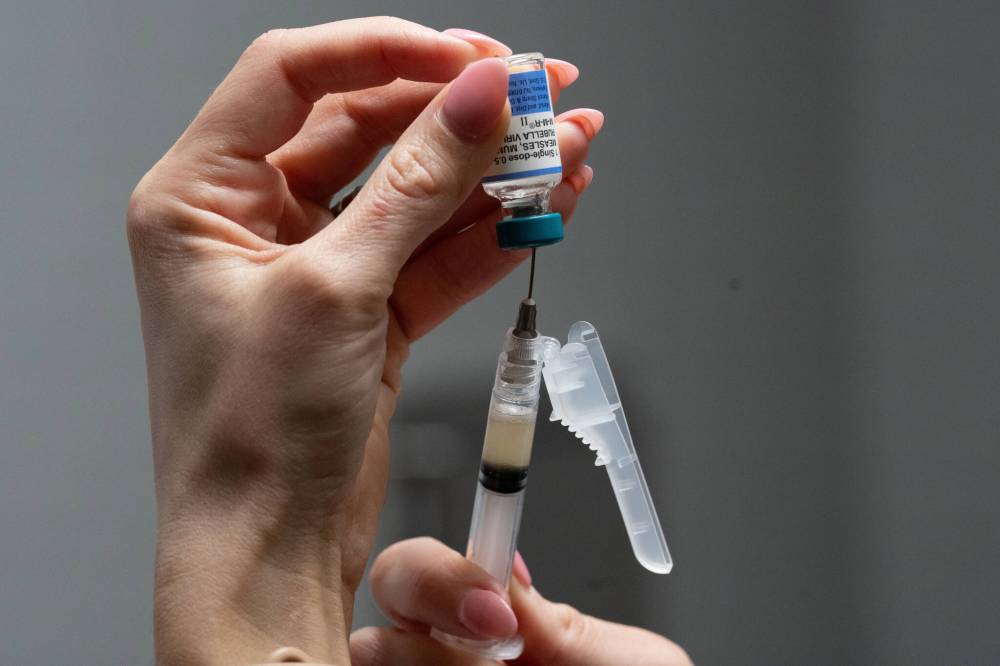
Vaccine skepticism is mostly to blame for the recent resurgence of measles in Manitoba. The highly communicable disease had been eradicated.
The end of the outbreak — which began in February 2025 and included a significant stretch this year during which Manitoba experienced more measles cases than any other province — is certainly worth noting. But it bears reminding that the real story here is that this province, and others across Canada, experienced a resurgence of this highly communicable but successfully eradicated disease in the first place.
It was so, so completely unnecessary.
Canada’s outbreak of measles — widely considered to be among the most virulent and potentially dangerous of communicable diseases — first took hold in New Brunswick in October 2024 and began spreading into other jurisdictions. By the following February it had arrived in Manitoba, and for the next 11 months this province’s totals of confirmed and probable cases hovered in the multiple dozens before surging to well in excess of 100 per month during late winter/early spring of this year.
Not surprisingly, the outbreak was concentrated in areas of the province considered to be “under-vaccinated” against the disease. In total, Manitoba had 1,038 cases (931 confirmed, 107 probable) during the months in question. Prior to February 2025, the province had experienced one case of measles since 2019 — and it was related to out-of-province travel.
The reasons for the re-emergence of measles are not difficult to decipher, though they are intensely frustrating to ponder and, unfortunately, seemingly impossible to combat.
Skepticism about the widely used and extremely effective measles, mumps and rubella (MMR) vaccine began to spread just before the turn of the 21st century, after The Lancet published the results, in 1998, of a poorly conducted study that erroneously suggested a link between the vaccine and autism in children who received it.

Despite being quickly debunked (its sample size was only 12, making its conclusions at best wildly speculative), the study was circulated widely on the then-nascent World Wide Web. An online community of skeptics formed, fueled by misinformation that was endorsed by a few high-profile users whose celebrity gave their uninformed views unwarranted weight.
Social media became unduly influential as trust in science and medical expertise diminished and the inclination of individuals and communities to “do their own research” ushered in what has widely become known — particularly since Donald Trump’s ascension in U.S. politics — as the “post-truth” era.
The COVID-19 pandemic brought lockdowns, during which online misinformation exploded, and necessary vaccine mandates were met with not just skepticism but outright refusal and rebellion. MMR vaccination rates, already on the wane before the pandemic, slumped even more profoundly, eliminating any chance of maintaining the “herd immunity” that made possible the eradication of measles in Canada.
Vaccination uptake of 95 per cent across a population is required to maintain herd immunity; Manitoba’s overall MMR vaccination currently sits at just over 65.4 per cent (for seven-year-olds having received the prescribed two doses). In the Southern Health region, where the majority of measles cases were confirmed, the rate is 53.3 per cent.
So here we are. The recent outbreak may have been declared over, but given the numbers, measles is not going away anytime soon. There are many reasons for the return of measles in 21st-century society, but not a single one of them could be described as good.
Related Articles
Manitoba declares 20-month measles outbreak over
Advertisement Advertise With Us
Advertisement Advertise With Us