Survival instincts
‘Embodied storytelling’ conveys life of residential school residents in young-adult play

Advertisement
Read this article for free:
or
Already have an account? Log in here »
To continue reading, please subscribe:

Digital Subscription
One year of digital access for only $205*
- Enjoy unlimited reading on winnipegfreepress.com
- Read the E-Edition, our digital replica newspaper
- Access News Break, our award-winning app
- Play interactive puzzles
*First annual payment billed as $205.00 + GST for one year. This annual subscription will automatically renew at $233.00 + GST every 52 weeks (10% off the regular annual price of $259.35). Offer available to new and qualified returning subscribers only. Cancel any time.
To continue reading, please subscribe:
Add Free Press access to your Brandon Sun subscription for only an additional
$1 for the first 4 weeks*
- Enjoy unlimited reading on winnipegfreepress.com
- Read the E-Edition, our digital replica newspaper
- Access News Break, our award-winning app
- Play interactive puzzles
*Your next Brandon Sun subscription payment will increase by $1.00 and you will be charged $17.95 plus GST for four weeks. After four weeks, your payment will increase to $24.95 plus GST every four weeks.
Read unlimited articles for free today:
or
Already have an account? Log in here »
Hey there, time traveller!
This article was published 01/11/2025 (345 days ago), so information in it may no longer be current.
Before it was shut down in June 1970, more than 15,000 Indigenous children were forced to attend the Mohawk Institute Indian Residential School in Brantford, Ont.
Santee Smith’s great-grandmother was one of them.
“We didn’t know anything about it. We knew that the Mohawk Institute was there, but nobody really knew anything about it except the survivors, and they were silent,” says Smith, who was born and raised in Six Nations of the Grand River after the genocidal institute — nicknamed the Mush Hole for its legacy of malnourishment — was shuttered.
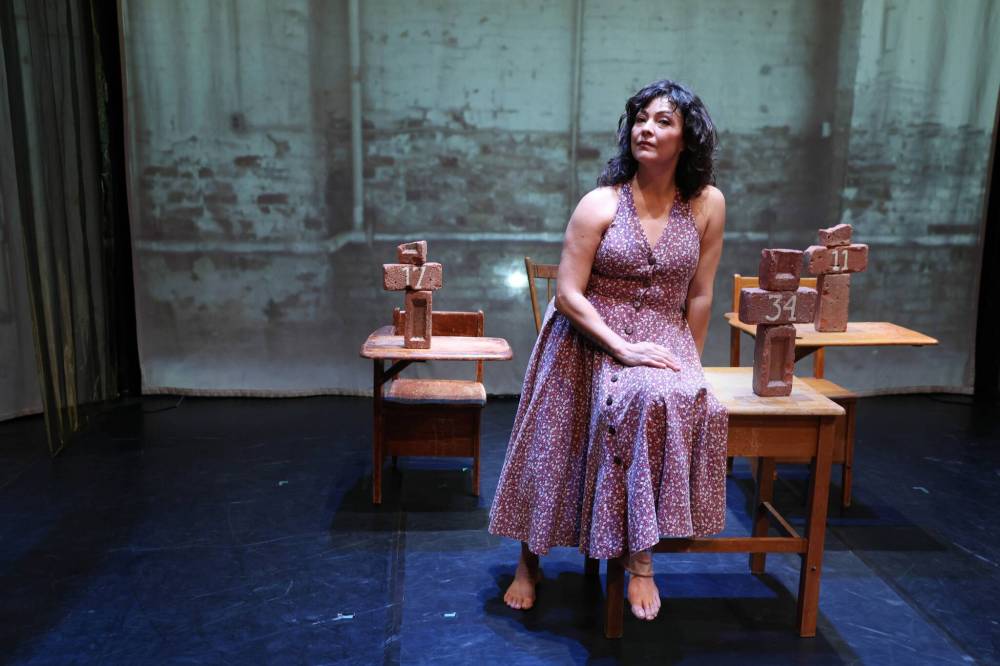
Ruth Bonneville / Free Press
Santee Smith is the creator of The Mush Hole, a story about the Mohawk Institute told with movement.
Wordlessness — as punishment, as expectation, as rule and as response to indescribable pain — becomes a powerful mechanism of what Smith calls “embodied storytelling” in The Mush Hole, a movement-rich production that returns to the Manitoba Theatre for Young People’s stage after its local première there in February 2020.
“It’s very much in the body, very theatrical, very character based, with a lot of gestural movement,” says Smith, an award-winning dance artist, a Member of the Order of Canada and the current chancellor of McMaster University in Hamilton, Ont.
In this environment, raising a hand, scrubbing a floor, standing in line or running away — what might independently be viewed as “pedestrian” actions — become gateways to visceral experiences for both performer and audience member alike: they consider the weight of every word spoken by those survivors who have taken it upon themselves to speak their experience in their own words.
“You can’t unsee or unfeel it. Once you’re allowed to — or allow yourself to — witness it, you get the emotional depth of truth of these experiences,” says Smith, who leads a dance theatre called Kaha:wi, which means “to carry” in Kanien’kéha, the Mohawk language.
“We’re carrying forward stories from the past to the present. We’re carrying truth, beauty, strength. We’re carrying forward culture and understanding. We have a basket of expressions we’re carrying in the work that we do.”
To understand the depth and variety of those experiences, Smith went straight to the source of the show’s spiritual and historical heart.
In 2016, Smith headed to the former Mohawk Institute, whose grounds were returned to the Six Nations in 1971.
Since the 1990s, Smith had frequently worked with the Woodland Cultural Centre, a hub located on those grounds, but had never so directly attempted to respond artistically to the institute’s national, intergenerational legacy of displacement, separation and attempted cultural erasure.
Smith and her creative collaborators worked closely with survivors of the institute to ground the piece in testimony and lived experience, developing a movement vocabulary that accurately reflected the strictures of both the physical environment and the system that enabled its nefarious function.
When discussing the boys’ playroom, where the creative team spent considerable time developing The Mush Hole, Smith fights through tears.
“The playroom is in the basement, but it has windows, and a survivor, Geronimo Henry, who’s still with us, told us about looking out those windows and waiting for his family to come that never came to pick him up. That’s the second image we see in the show, and every time I’m standing there with my hands as if I’m looking out that window, I’m in that room. I don’t even have to imagine I’m there. I’m mentally in there, looking out that window, and all these stories of being trapped inside return.
“When we were working on site, many times, all of a sudden a car would pull up, and you can just tell they were survivor families.”
Earlier this year, on the National Day for Truth and Reconciliation, the former Mohawk Institute — where an estimated 105 children died throughout its 142-year history according to the Survivors’ Secretariat, a not-for-profit, survivor-led organization established in 2021 — opened to the public as a museum following six years of renovation.
MTYP artistic director Pablo Felices-Luna said that the word he most closely associates with The Mush Hole is “urgent.”
Smith agrees, saying this production run feels particularly potent, as it coincides with the 10-year anniversary of the Truth and Reconciliation Commission’s final report and 94 recommendations, a moment in time that led to more open discussion and testimony of the traumas of residential school.
“The show has become more potent, even in our performance, because the content remains relevant,” says Smith, who directs and performs the piece alongside Katie Couchie, Montana Summers, Kali Kennedy Bomberry and Faciony Patiño.

While much of the production from 2020 is retained as was, Smith says a few updates have been made, including motions that stand in for the ground-penetrating radar technology being used to search residential school sites across the country for human remains and unmarked graves.
John Elliot, a Survivors’ Secretariat board member who died earlier this year, was sent to the Mohawk Institute from 1947 to 1951. Smith says the survivor, whose feedback guided the first production, suggested to incorporate a small suitcase, which they’ve now done.
As a symbol, Smith says the prop — like every motion in the show — is potent, loaded with potential for both connection and interpretation.
“Every time we come back, we deepen the story. There are always more layers.”
ben.waldman@freepress.mb.ca
Ben Waldman is a National Newspaper Award-nominated reporter on the Arts & Life desk at the Free Press. Born and raised in Winnipeg, Ben completed three internships with the Free Press while earning his degree at Ryerson University’s (now Toronto Metropolitan University’s) School of Journalism before joining the newsroom full-time in 2019. Read more about Ben.
Every piece of reporting Ben produces is reviewed by an editing team before it is posted online or published in print — part of the Free Press‘s tradition, since 1872, of producing reliable independent journalism. Read more about Free Press’s history and mandate, and learn how our newsroom operates.
Our newsroom depends on a growing audience of readers to power our journalism. If you are not a paid reader, please consider becoming a subscriber.
Our newsroom depends on its audience of readers to power our journalism. Thank you for your support.
Theatre preview
The Mush Hole
● Manitoba Theatre for Young People
● To Nov. 9
● Recommended for audiences 13 and up
● Tickets $28 at mtyp.ca
Ben Waldman is a National Newspaper Award-nominated reporter on the Arts & Life desk at the Free Press. Born and raised in Winnipeg, Ben completed three internships with the Free Press while earning his degree at Ryerson University’s (now Toronto Metropolitan University’s) School of Journalism before joining the newsroom full-time in 2019. Read more about Ben.
Every piece of reporting Ben produces is reviewed by an editing team before it is posted online or published in print — part of the Free Press‘s tradition, since 1872, of producing reliable independent journalism. Read more about Free Press’s history and mandate, and learn how our newsroom operates.
Our newsroom depends on a growing audience of readers to power our journalism. If you are not a paid reader, please consider becoming a subscriber.
Our newsroom depends on its audience of readers to power our journalism. Thank you for your support.
Advertisement Advertise With Us
Advertisement Advertise With Us