Bearing the weight of history
With few words, play captures isolation, ethnic cleansing behind residential schools

Advertisement
Read this article for free:
or
Already have an account? Log in here »
To continue reading, please subscribe:

Digital Subscription
One year of digital access for only $205*
- Enjoy unlimited reading on winnipegfreepress.com
- Read the E-Edition, our digital replica newspaper
- Access News Break, our award-winning app
- Play interactive puzzles
*First annual payment billed as $205.00 + GST for one year. This annual subscription will automatically renew at $233.00 + GST every 52 weeks (10% off the regular annual price of $259.35). Offer available to new and qualified returning subscribers only. Cancel any time.
To continue reading, please subscribe:
Add Free Press access to your Brandon Sun subscription for only an additional
$1 for the first 4 weeks*
- Enjoy unlimited reading on winnipegfreepress.com
- Read the E-Edition, our digital replica newspaper
- Access News Break, our award-winning app
- Play interactive puzzles
*Your next Brandon Sun subscription payment will increase by $1.00 and you will be charged $17.95 plus GST for four weeks. After four weeks, your payment will increase to $24.95 plus GST every four weeks.
Read unlimited articles for free today:
or
Already have an account? Log in here »
Hey there, time traveller!
This article was published 04/11/2025 (332 days ago), so information in it may no longer be current.
Before a single soul appears onstage in The Mush Hole, the atmosphere of this unsettling and deeply affecting journey of resilient storytelling is already set by its sonic atmosphere.
In the not-so-distant past, church bells chime and children stifle their weeping while unseen vehicles rumble further and further away from the front steps as silence floods the theatre.
None of this was by accident: for 142 years, until its closure in 1970, the Mohawk Institute — the template for all residential schools in Canada — was an outpost of a national campaign for cultural erasure, abuse and elimination of Indigenous identity.
thomas boethe photograph
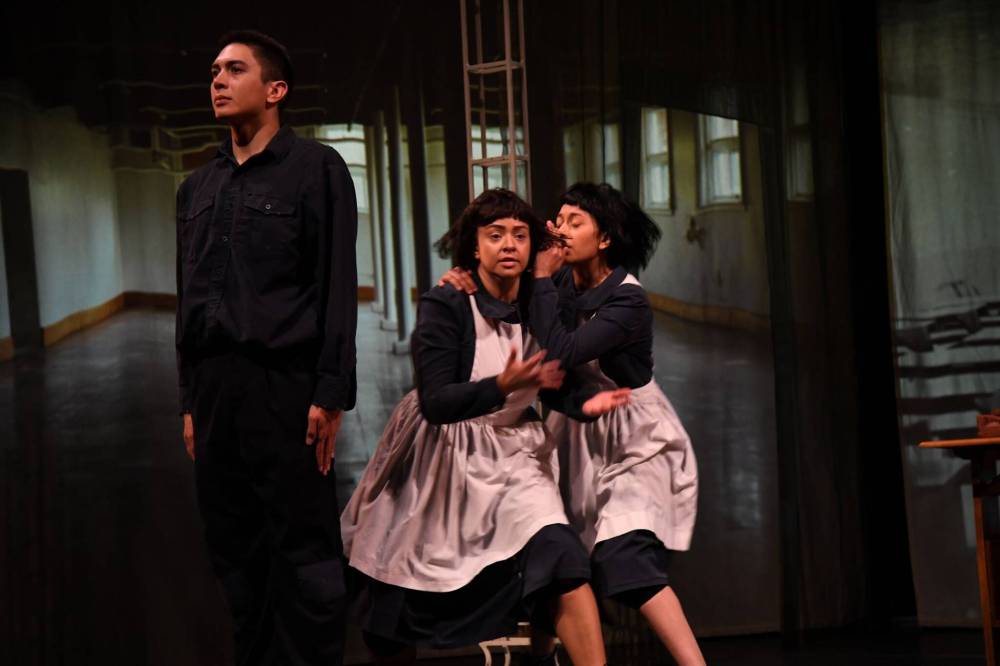
Silence speaks volumes in Kaha:wi Dance Theatre’s The Mush Hole.
Behind the bricks, the truth was concealed.
In this piece from Toronto’s Kaha:wi Dance Theatre, composed of 17 motion-driven tableaus, the architectural facades are removed to reveal a framework of intergenerational trauma. Drawing from the experiences of several survivors of the institute — nicknamed the Mush Hole for its legacy of malnourishment — the first mainstage production of the Manitoba Theatre for Young People season amplifies history beyond doubt and denial. This is what Canada endorsed and what it allowed to happen.
Divided into three wings of parallel storytelling is Andy Moro’s brickless set, erected to resemble the institute’s blueprint, reminding viewers that these buildings were designed by professionals, outfitted by trained tradespeople, constructed to suit a genocidal end.
In the central section, three young people — played by Montana Summers, Kali Kennedy Bomberry and Katie Couchie — march as if at war, their movement manipulated and mechanized, scattered and shaken.
They sit at their desks, each topped by a cross made up by broken bricks and labelled with a number – 11, 34, 17. As composer Jesse Zubot’s tectonic score shifts in unpredictable fashion, these children, whose names have been replaced by digits, disassemble and rebuild their crosses, taking themselves apart in the process.
No Lego or Duplo at this “school”: these are the building blocks for a sanitized identity, in keeping with prime minister John A. MacDonald’s desire to instil “the habits and modes of thought of white men.”
Nearby, two adults (Falciony Patino and Santee Smith) etch their numbers and their names onto brick walls, designed as projections by Moro.
Throughout the rest of this hour-long production, the narratives of struggle emerge from within the architecture, with video footage shot on the institute’s grounds transporting the audience into a realm defined by a gradual descent into spiritual struggle, darkness and isolation.
On their hands and knees, the children scrub the floors. They’re confined to small spaces. The food they eat — shown by projection — is stirred by the undulation of meal worms.
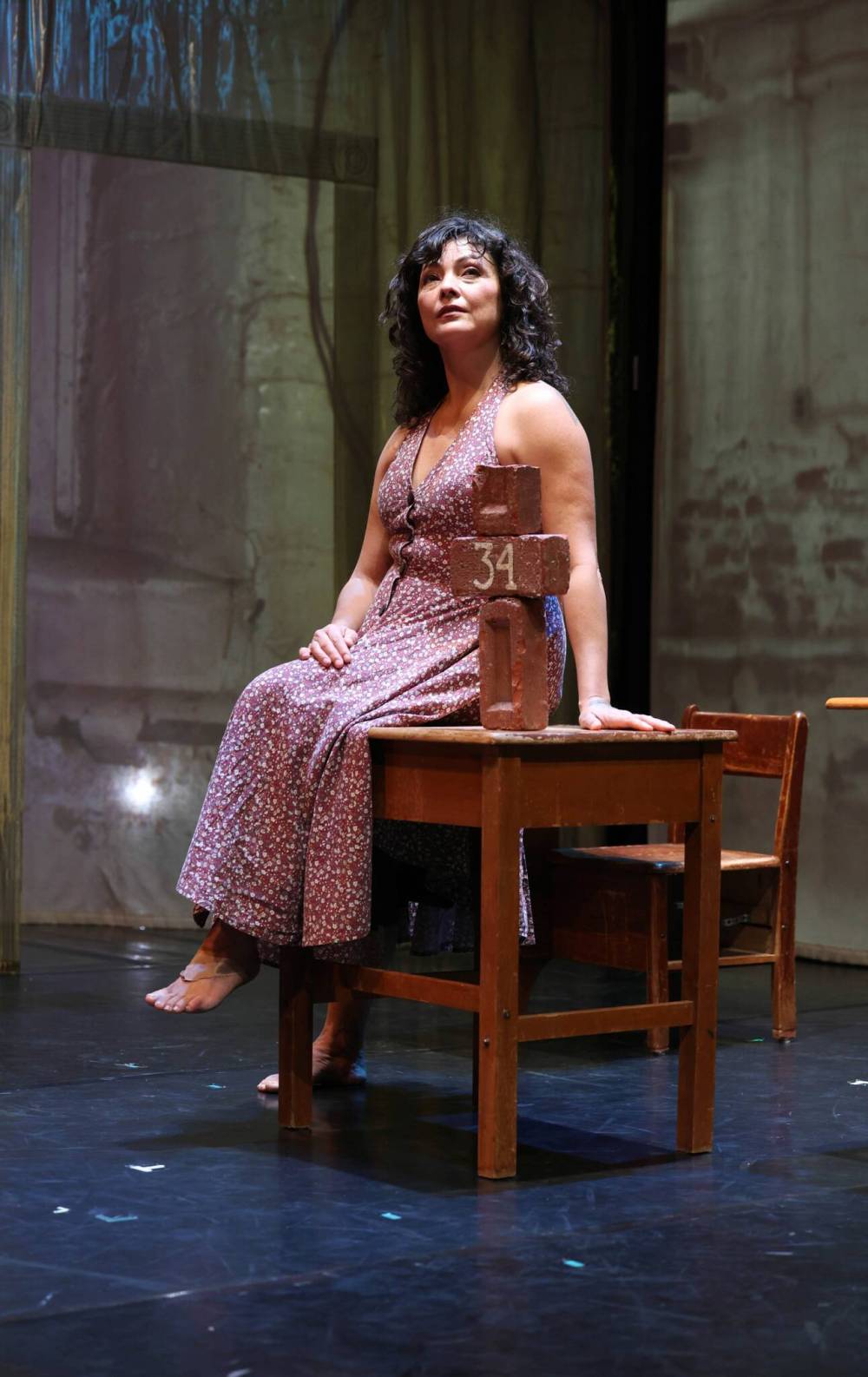
Ruth Bonneville / Free Press
Santee Smith created The Mush Hole to retell the story of the Mohawk Institute, the template for Canada’s residential school network.
Through repetitive motion, the award-winning production, which premièred at MTYP in 2020, induces visceral response, even when the tableaus occur beyond the institute’s walls.

A kitchen-table duet between Patino and Smith, who are presented as parental figures as well as survivors, set to Nick Sherman’s rendition of I’m So Lonesome I Could Cry, is particularly illustrative of the far-reaching impacts of the removal of children from their home environment, including PTSD and substance abuse.
As Patino’s Ernest sips from a beer bottle, Smith’s Mabel repeatedly hugs the air where children once sat. Ernest removes the unused chairs, gently urging Mabel to accept reality, but the woman keeps setting the extra places, unwilling to relinquish her hope for familial unity.
Aside from several musical interludes and a few lines of dialogue, there are hardly any words spoken in The Mush Hole. It’s a creative choice that encourages quiet reflection and consideration of the weight of speaking out that the survivors of these institutions must have felt and resisted in order to stay alive.
That reality gives every movement in The Mush Hole the feeling of living history — one we cannot afford to see erased. It’s a living history that needs to be underlined.
ben.waldman@freepress.mb.ca
Ben Waldman is a National Newspaper Award-nominated reporter on the Arts & Life desk at the Free Press. Born and raised in Winnipeg, Ben completed three internships with the Free Press while earning his degree at Ryerson University’s (now Toronto Metropolitan University’s) School of Journalism before joining the newsroom full-time in 2019. Read more about Ben.
Every piece of reporting Ben produces is reviewed by an editing team before it is posted online or published in print — part of the Free Press‘s tradition, since 1872, of producing reliable independent journalism. Read more about Free Press’s history and mandate, and learn how our newsroom operates.
Our newsroom depends on a growing audience of readers to power our journalism. If you are not a paid reader, please consider becoming a subscriber.
Our newsroom depends on its audience of readers to power our journalism. Thank you for your support.
Theatre review
The Mush Hole
● Manitoba Theatre for Young People
● Next shows Saturday and Sunday, 1 p.m.
★★★★ out of five
Ben Waldman is a National Newspaper Award-nominated reporter on the Arts & Life desk at the Free Press. Born and raised in Winnipeg, Ben completed three internships with the Free Press while earning his degree at Ryerson University’s (now Toronto Metropolitan University’s) School of Journalism before joining the newsroom full-time in 2019. Read more about Ben.
Every piece of reporting Ben produces is reviewed by an editing team before it is posted online or published in print — part of the Free Press‘s tradition, since 1872, of producing reliable independent journalism. Read more about Free Press’s history and mandate, and learn how our newsroom operates.
Our newsroom depends on a growing audience of readers to power our journalism. If you are not a paid reader, please consider becoming a subscriber.
Our newsroom depends on its audience of readers to power our journalism. Thank you for your support.
Advertisement Advertise With Us
Advertisement Advertise With Us