Singular footsteps on a shared path
Ekene Emeka Maduka carves a personal signature out of broad social themes

Advertisement
Read this article for free:
or
Already have an account? Log in here »
To continue reading, please subscribe:

Digital Subscription
One year of digital access for only $205*
- Enjoy unlimited reading on winnipegfreepress.com
- Read the E-Edition, our digital replica newspaper
- Access News Break, our award-winning app
- Play interactive puzzles
*First annual payment billed as $205.00 + GST for one year. This annual subscription will automatically renew at $233.00 + GST every 52 weeks (10% off the regular annual price of $259.35). Offer available to new and qualified returning subscribers only. Cancel any time.
To continue reading, please subscribe:
Add Free Press access to your Brandon Sun subscription for only an additional
$1 for the first 4 weeks*
- Enjoy unlimited reading on winnipegfreepress.com
- Read the E-Edition, our digital replica newspaper
- Access News Break, our award-winning app
- Play interactive puzzles
*Your next Brandon Sun subscription payment will increase by $1.00 and you will be charged $17.95 plus GST for four weeks. After four weeks, your payment will increase to $24.95 plus GST every four weeks.
Read unlimited articles for free today:
or
Already have an account? Log in here »
Hey there, time traveller!
This article was published 06/11/2025 (337 days ago), so information in it may no longer be current.
Young Winnipeg painters are having an exciting moment.
For the past six weeks or so, Dee Barsy’s signature aqua blues have washed over the 300,000 people who daily visit Toronto’s Union Station, which is decorated with a dozen of her bird-themed murals, buoying Toronto Blue Jays fans during the World Series.
Last month, artist, curator and writer Chukwudubem Ukaigwe was shortlisted to represent the Prairies region for the Sobey Art Award 2025 — Canada’s largest prize for visual artists, which will be handed out on Saturday.
Supplied
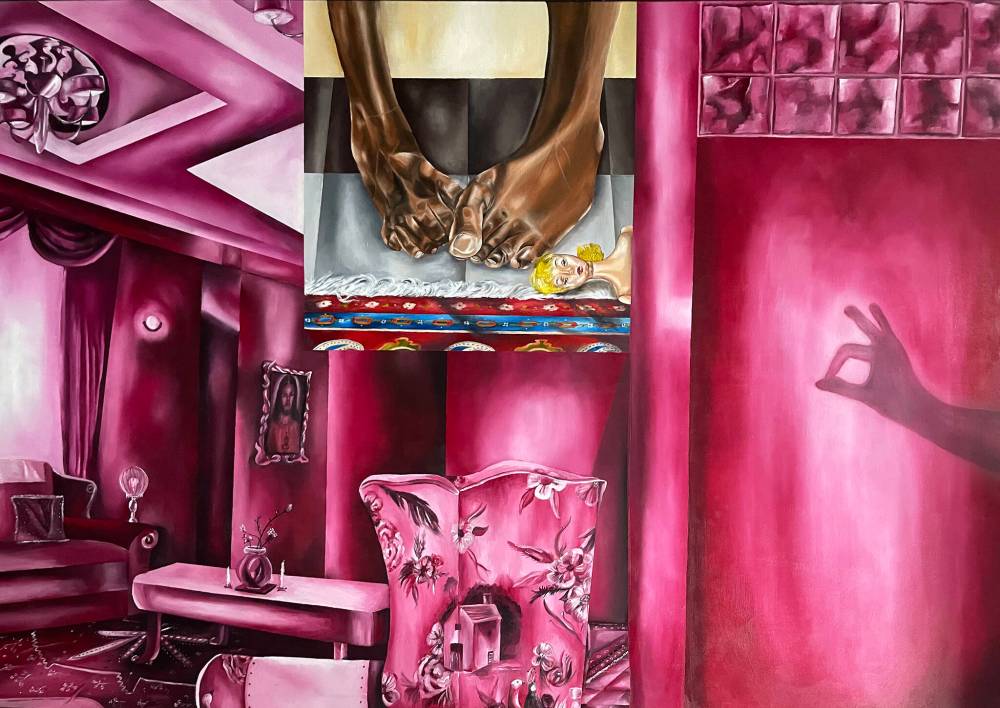
Ekene Emeka Maduka’s Hide and Seek, 2022, oil on canvas
Ukaigwe is perhaps best recognized for his paintings, often colourful to the point of psychedelic while refined in their details and lifelikeness, blending elements of realism, pop art and surrealism.
The artist is among a small group of artists around 30 or under, many of whom went to art school together at the University of Manitoba, and who may appear — at least at first glance — to be working in similar directions.
Two others are painters Bria Fernandes and Ekene Emeka Maduka, who sat down to discuss their work in a public conversation at the University of Winnipeg in mid-October.
Fernandes opened by discussing a piece on which she had collaborated with Maduka in art school in an obvious Renaissance style, before moving on to more recent works.
One of these appeared at the Winnipeg Art Gallery’s Threads of Kin and Belonging: A Trinnipeg Live Mixtape Project show last year, while others were the basis for Gallery 1C03’s Things Left Unsaid exhibit, which ran in September and October.
The Baroque and Renaissance influences clearly inflect these later paintings, too, reflected in her gift for stark contrasts and tight representational technique.
When it came time for the Nigerian-born Maduka to speak, her artistic references leaned more on pop culture.
“When I had moved here, people would say things like, ‘Oh, wow, your accent is so good.’ But then I grew up watching Hannah Montana, so I already practised how to speak this way. Then when I go home, I can take it off,” the 29-year-old said at the talk.
“A lot of my work really kind of interrogates these splintered identities — almost like playing a chameleon — and blending into spaces.”
Supplied
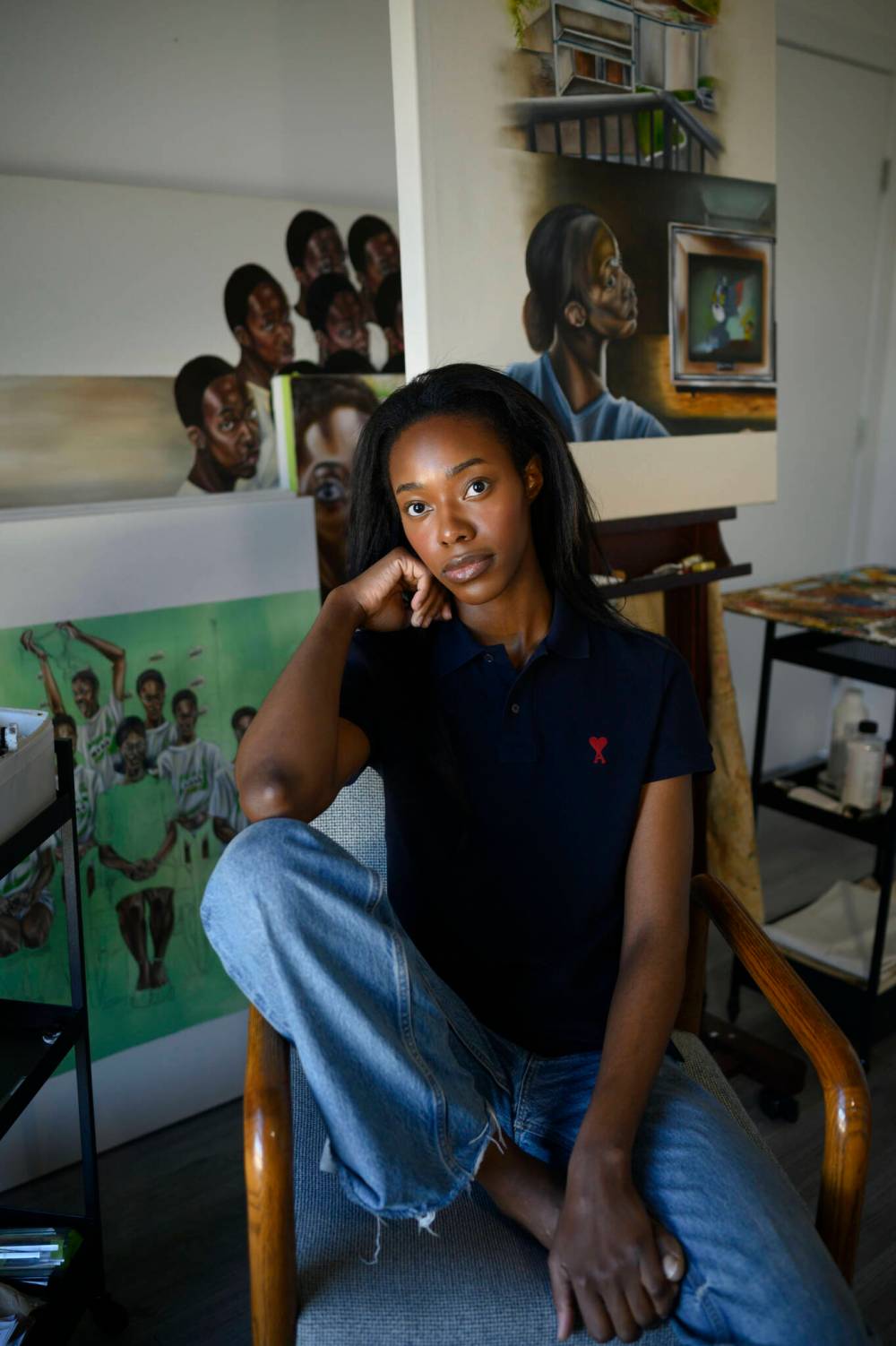
U of M-trained artist Ekene Emeka Maduka, 29, often deals with the theme of memory in her paintings.
Given that Maduka and Fernandes, like Ukaigwe, are all Black artists whose work sometimes reflects on diasporic cultures, it might be tempting to group them neatly into a common current.
And while a figurative dialogue appears to be happening among these virtuosic young figurative painters, their themes are personal.
A central theme in Maduka’s work, as she identifies it, is memory — a source of meaning and continuity through experiences across continents as a Canadian newcomer, but something that also warps the past in idiosyncratic, humorous ways.
“What happens after the fact, after you’ve had this experience? Now, what does that morph into? And I talk about it from a point of immigration because that’s my story,” she says.
As someone whose first visual grammar wasn’t informed by the highfalutin worlds of either European masters or art theory so much as Tumblr, Tom and Jerry cartoons, Nollywood films and fashion magazines, she says she’s inspired by media that recall early childhood experiences.
She’s attracted to photography for the way it resembles memory — a snapshot both from and of a vantage point, fading over time — and incorporates it in different ways into her practice.
One of her earliest works is a family portrait with a mischievous twist. Every face is, in fact, Maduka’s — based on photographs of her best attempt to imitate her parents and siblings.
“I was like, ‘Who the f— is my dad?’ I came into this world just knowing him in this position of a father, but I was like, ‘This guy… had a whole thing going on before me,’” she says.
Rather than pretend to penetrate to the essence of her subjects, she decided to lean, with a winking narcissism, into her own subjectivity. But, in this way, she says she hoped to expose that even within the family unit, the experience of Nigerians is so eclectic to resist simple generalizations.
Supplied
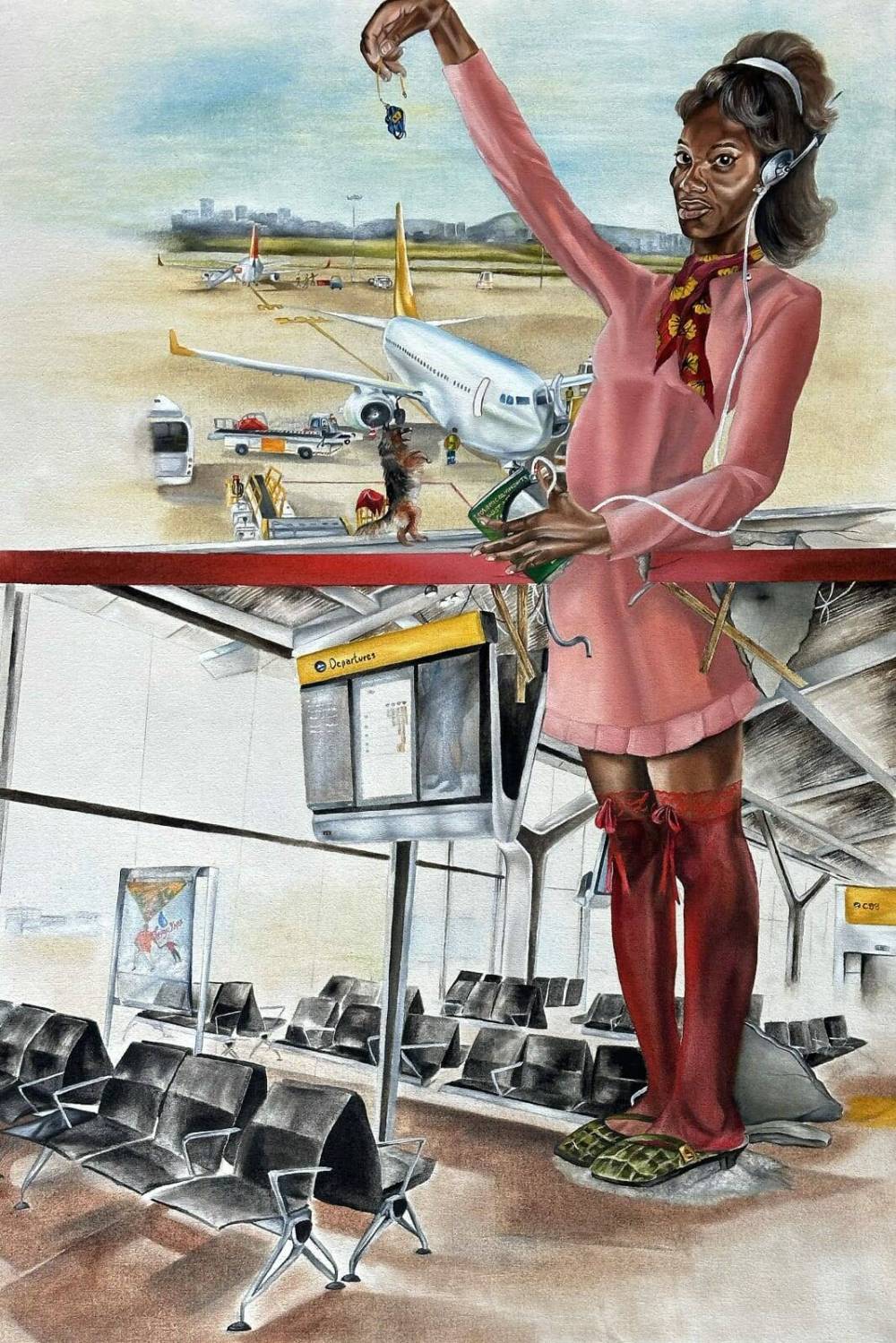
Na who big pass? by Ekene Emeka Maduka, 2024, oil on canvas
Ironically, this early motif has blossomed into an extraordinary act of homogenizing, where every character in her dramatic paintings is, in fact, unmistakeably her.
Scroll through ekeneemekamaduka.com, and even the cursor is a mini self-portrait — a floating face in her likeness.
“It was a way to remove race as an inherent conversation in my work. They can’t talk about, ‘All the Black bodies,’ because no, it’s just me! It’s literally just one person,” she says.
Maduka talks about the pressures sometimes put on Black artists by gatekeepers in the arts world to conform to a politically useful image of Blackness.
While she’s glad for the conversations about inclusivity in the arts that have been opened up in recent years, she suggests that some approaches to “diversity, equity, inclusion” are less sophisticated than others, and risk undermining artistic freedom and flattening Black experiences into stereotypes.
“I think sometimes that Black experience is borrowed from the States in an interesting way, (but) I cannot steal someone’s experience I do not know anything about. I know more about British colonial rule and British school system,” she says.
Beauty, irony, a bold subjectivity — these are the ways Maduka says she’s worked to reconcile authenticity with broader social themes. But she doesn’t see her work as apolitical or so laden with in-jokes and private meanings to be sealed from the ordinary viewer.
The artist, who has already exhibited in the United States, Switzerland, Morrocco, France and the United Kingdom, recalls an art fair in New York when a woman, who had worked as a cleaner until finding a job as a security guard in arts institutions, stopped to compliment her boots.
“But then she said, ‘I never really understood (art); I always thought these artist people were crazy … super useless,’” Maduka says.
Supplied
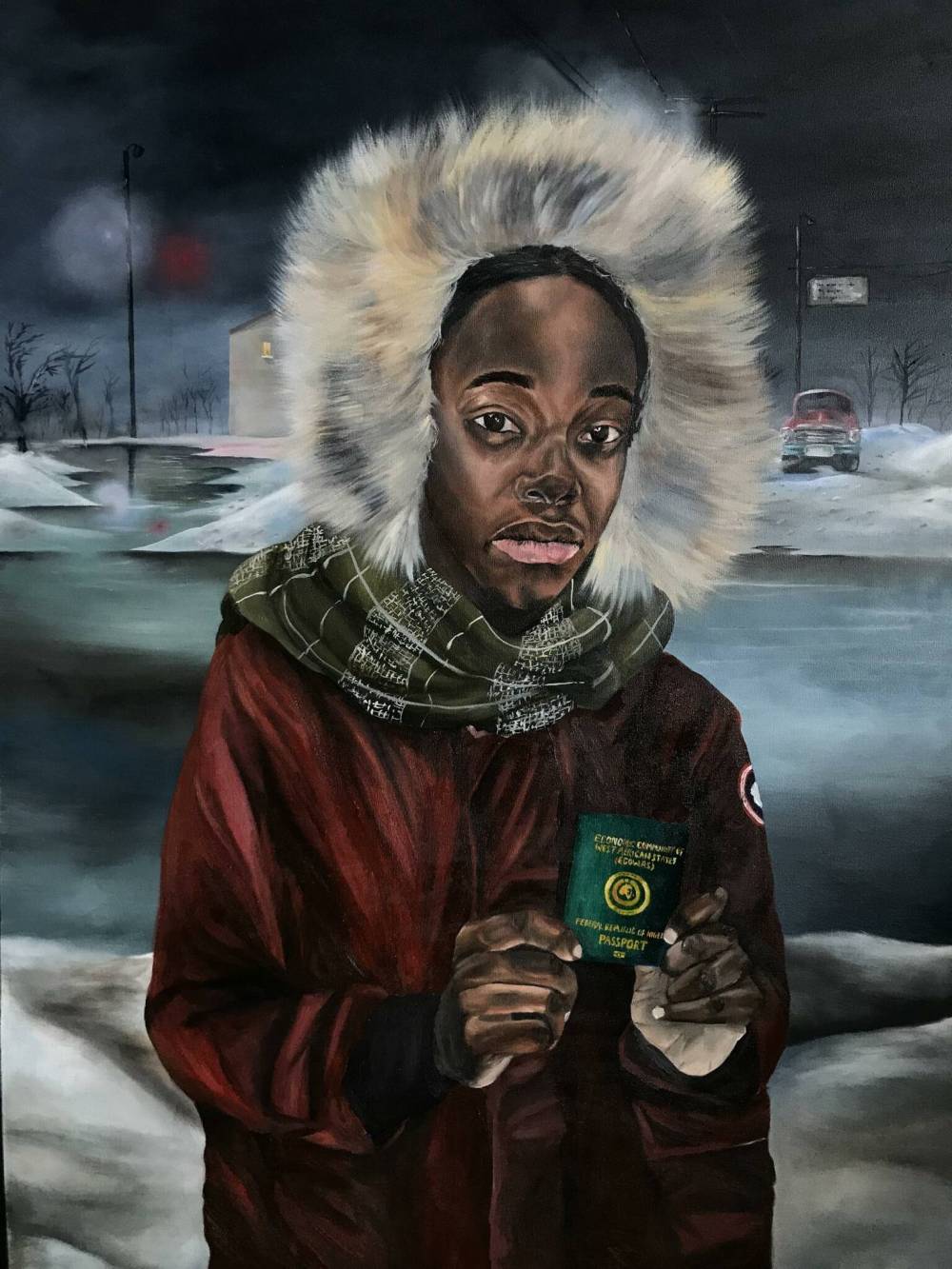
Longings for Ulo (Deer in Headlights) by Ekene Emeka Maduka, 2019, oil on canvas

At the time Maduka was exhibiting work from her airport-themed series, Lessons on Flying, about a woman who steals a hostess uniform in an attempt to stow away. A connection was made.
“But then she said, ‘The more I’ve spent time in these places, I’ve come to appreciate (certain things) and it’s stuff like what you’re doing that I like.’”
In the midst of the highly competitive art fair, the brief encounter left Maduka buoyed about her future as an artist beyond art world games of commerce and performative politics.
“Like, even if we sold absolutely nothing, I was walking out of that place goddamned happy because of her,” she says.
conrad.sweatman@freepress.mb.ca
Conrad Sweatman is an arts reporter and feature writer. Before joining the Free Press full-time in 2024, he worked in the U.K. and Canadian cultural sectors and freelanced for outlets including The Walrus, VICE and Prairie Fire. Read more about Conrad.
Our newsroom depends on a growing audience of readers to power our journalism. If you are not a paid reader, please consider becoming a subscriber.
Our newsroom depends on its audience of readers to power our journalism. Thank you for your support.
Conrad Sweatman is an arts reporter and feature writer. Before joining the Free Press full-time in 2024, he worked in the U.K. and Canadian cultural sectors and freelanced for outlets including The Walrus, VICE and Prairie Fire. Read more about Conrad.
Our newsroom depends on a growing audience of readers to power our journalism. If you are not a paid reader, please consider becoming a subscriber.
Our newsroom depends on its audience of readers to power our journalism. Thank you for your support.
Advertisement Advertise With Us
Advertisement Advertise With Us
History
Updated on Thursday, November 6, 2025 8:09 AM CST: Changes tile photo
Updated on Thursday, November 6, 2025 8:13 AM CST: Adds web headline, corrects typo