Down to Earth Pop culture helps astrophysicist make complicated topics, ideas understandable
Read this article for free:
or
Already have an account? Log in here »
To continue reading, please subscribe:

Digital Subscription
One year of digital access for only $205*
- Enjoy unlimited reading on winnipegfreepress.com
- Read the E-Edition, our digital replica newspaper
- Access News Break, our award-winning app
- Play interactive puzzles
*First annual payment billed as $205.00 + GST for one year. This annual subscription will automatically renew at $233.00 + GST every 52 weeks (10% off the regular annual price of $259.35). Offer available to new and qualified returning subscribers only. Cancel any time.
To continue reading, please subscribe:
Add Free Press access to your Brandon Sun subscription for only an additional
$1 for the first 4 weeks*
- Enjoy unlimited reading on winnipegfreepress.com
- Read the E-Edition, our digital replica newspaper
- Access News Break, our award-winning app
- Play interactive puzzles
*Your next Brandon Sun subscription payment will increase by $1.00 and you will be charged $17.95 plus GST for four weeks. After four weeks, your payment will increase to $24.95 plus GST every four weeks.
Read unlimited articles for free today:
or
Already have an account? Log in here »
Hey there, time traveller!
This article was published 02/12/2025 (246 days ago), so information in it may no longer be current.
Renowned astrophysicist Neil deGrasse Tyson is set to land in Winnipeg Friday equipped with pop-culture references and insights into humanity’s biggest scientific question: are we alone in the universe?
“There’s a lot of effort by NASA to try to find life of any kind in the universe, which if we did, would completely transform biology and would force us to rethink, maybe for the first time, what our place is in the universe,” deGrasse Tyson says over a video call from his home in New York City.
His hands are stained with ink after a morning spent responding to fan mail. There’s a collection of fountain pens on his desk, including a novel one made from an ostrich feather. A painting of van Gogh’s Starry Night hangs in the background.
The scientist, author, television host and podcaster has achieved global stardom for his ability to bring complex ideas down to Earth — often with the help of mainstream entertainment.
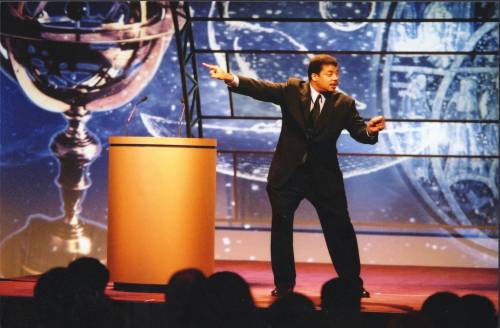
STARTALK / C. PICADAS PHOTO Neil deGrasse Tyson is arguably the most well-kwown astrophysicist in the world. 
It’s something deGrasse Tyson learned early on during conversations with the general public about his work as an astrophysicist.
Unsurprisingly, he applied the scientific method when answering questions about black holes, the Big Bang and Pluto.
“I would monitor their non-verbal communication or their body language as I would give explanations. If they smiled, if they found something humorous, they’d come back for more. If I attached it to something they already know very well, they’re more likely to remember it, and that’s where pop culture comes in,” he says.
Despite having little personal interest in pop music, prime-time television or the Super Bowl, for example, deGrasse Tyson spends a “stupid, crazy fraction,” of his life familiarizing himself with what people are watching, listening to or reading.
“I think of it as entirely for its utility that awareness makes for a more potent educational experience,” says the director of the Hayden Planetarium and former host of NOVA ScienceNow on PBS.
While discussing his talk in Winnipeg, titled The Search for Life in the Universe, deGrasse Tyson points to the original Star Trek series as an example of common misconceptions — which he says he also held at one point — about the fragile atmospheric conditions needed for life to take hold.
In the 1960s show, William Shatner and Leonard Nimoy are seen beaming down to rocky planets sans spacesuit.
“You wouldn’t see vibrant trees or algae or anything else that would be producing oxygen, so I was left thinking, let’s just look at enough planets and one of them is going to be right for us as though it’s just some random combination of gases, but it’s not random,” he says.
Event Preview
Neil deGrasse Tyson
Centennial Concert Hall, 555 Main St.
Friday, 8 p.m.
Tickets $133 to $176.50 at centennialconcerthall.com
The way science is depicted in science fiction is a favourite topic on deGrasse Tyson’s podcast, StarTalk. In it, he and his guests discuss the good and bad science that exists in Hollywood, such as the gravitational improbability of Sandra Bullock’s bangs in Gravity or the “silly” biology on display in Jurassic Park.
A surprisingly accurate movie moment? The opening scene of Frozen, when the ice harvesters are collecting blocks from a frozen lake.
“One thing that is accurately portrayed is how much the ice is sticking out of the water, somebody knew that and put it into the script,” deGrasse Tyson says.
“The fact that misinformation or disinformation or just blunt ignorance is also platformed on social media, makes it hard for a person to know what’s true and what’s not.”
Accuracy also extends to his mission as a science communicator in the age of the internet and AI-generated content. While he enjoys being able to reach a wide audience on social media, he’s keenly aware of the ways bad online information can impact human curiosity and the public’s understanding of reality.

“The fact that misinformation or disinformation or just blunt ignorance is also platformed on social media, makes it hard for a person to know what’s true and what’s not,” says deGrasse Tyson, who has been the subject of AI deepfakes, including a recent video in which his likeness was used to support the conspiracy theory that claims the Earth is flat.
DELVINHAIR PRODUCTIONS Neil deGrasse Tyson’s talk in Winnipeg is titled The Search for Life in the Universe.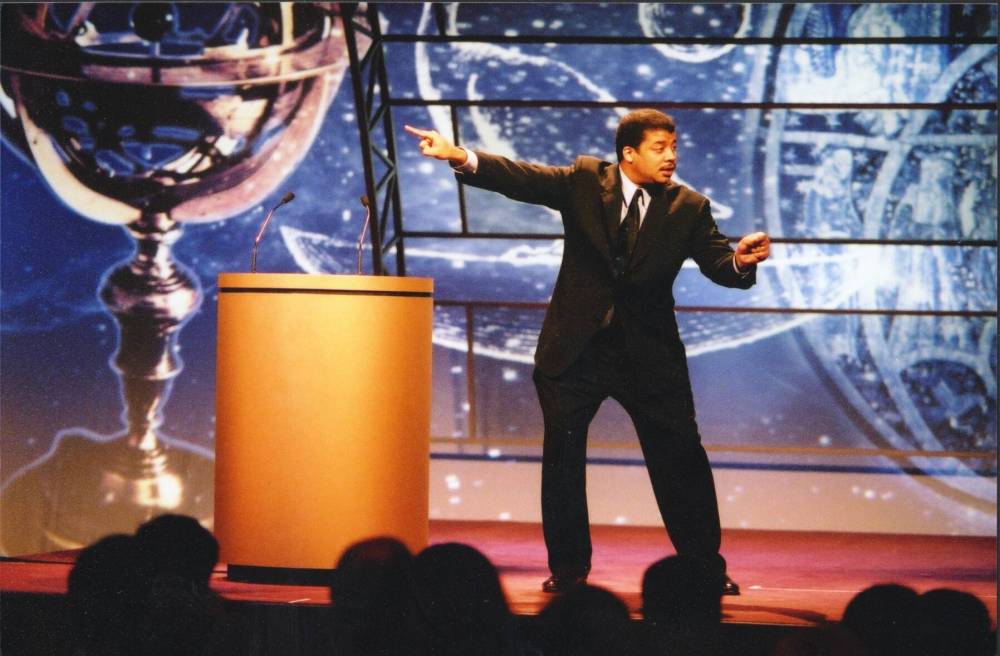
In response, he digs into the pitfalls of deepfakes in a new StarTalk episode, entitled It’s Getting Harder to Know What’s Real.
“Scamming is not new to the internet, ”deGrasse Tyson says in the video podcast. “But with AI participating in this exercise in the hands of the nefarious few, it’s taken to another level.”
winnipegfreepress.com/evawasney
If you value coverage of Manitoba’s arts scene, help us do more.
Your contribution of $10, $25 or more will allow the Free Press to deepen our reporting on theatre, dance, music and galleries while also ensuring the broadest possible audience can access our arts journalism.
BECOME AN ARTS JOURNALISM SUPPORTER
Click here to learn more about the project.

Eva Wasney has been a reporter with the Free Press Arts & Life department since 2019. Read more about Eva.
Every piece of reporting Eva produces is reviewed by an editing team before it is posted online or published in print — part of the Free Press‘s tradition, since 1872, of producing reliable independent journalism. Read more about Free Press’s history and mandate, and learn how our newsroom operates.
Our newsroom depends on a growing audience of readers to power our journalism. If you are not a paid reader, please consider becoming a subscriber.
Our newsroom depends on its audience of readers to power our journalism. Thank you for your support.